
Early ElectroMIX is a series to document the history of experimental Electronic music from the 50s to the 80s, composers making use of electronic instruments, test equipment, generators of synthetic signals and sounds, tape manipulations… to analog synthesizers…
While our sessions document those who make it today my desire is to transmit some pioneering works which paved the way to what we try to create.
Philippe Petit / January 2026.
Recorded for our series available on the platform
https://modular-station.com/modulisme/early-electromix/
Tracklist:
Micheline Coulombe-Saint-Marcoux – Zones (1972) 00:00 > 09:01
Arne Nordheim – Solitaire (1968) 06:36 > 17:44
Liviu Dandara – Affectus Memoria (1982) 15:52 > 25:08
Joel Chadabe – Flowers (1976) 23:44 > 43:04
Emerson Meyers’Provocative electronics – Chez Dentiste (1970) 42:29 > 46:05
Lorq Damon – Through the gates of nightmares (1974) 46:00 > 59:06
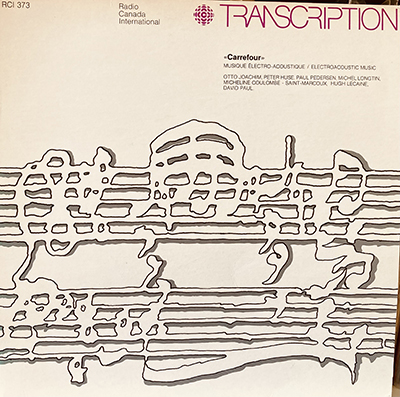
Micheline Coulombe-Saint-Marcoux – Zones (1972 / Radio Canada International)
Coulombe Saint-Marcoux (1938-1985) occupies a pioneering position in Québec’s electroacoustic music scene, blending fixed media with instrumental gestures and exploring spatial and timbral fields in her compositions.
She combined rigorous instrumental training, avant-garde electroacoustic exploration, commitment to education and institutional development, and a strong voice in a male-dominated field. Her work invites listeners into zones of sound, where voice, nature, percussion, electronics and space converge.
Her path acts as both artistic and cultural model, not only for what she composed, but for how she worked: teaching, founding ensembles, building electroacoustic studios, and championing new music in Québec and beyond.
A major milestone came in 1967, when she won the first prize in composition at the Conservatoire for «Modulaire» (for orchestra and Ondes Martenot) and the prestigious Prix d’Europe for composition. That same year, at the suggestion of Iannis Xenakis, she went to Paris (1968–70) to study electroacoustic music. There she worked with the Groupe de recherches musicales (GRM/ORTF), took courses at the Conservatoire de Paris with Pierre Schaeffer (and also studied privately with Gilbert Amy and Jean-Pierre Guézec).
In 1969, she co-founded the Groupe international de musique électroacoustique de Paris (GIMEP), an ensemble that toured Europe, South America, and Canada between 1969 and 1973.
Upon her return to Québec in 1971 she began teaching at the CMQM, where she also contributed to the establishment of an electroacoustic composition studio. She also founded the percussion-and-electronics ensemble Ensemble Polycousmie in 1971, exploring the interplay of percussion, tape, and movement. Her work moved seamlessly between orchestral, chamber, electroacoustic, theatrical and multimedia forms.
Zones is emblematic of Micheline Coulombe Saint-Marcoux’s electroacoustic vision: a refined, exploratory work of sonic space, zone-mapping, and spatialisation. Its legacy lies in how it invites the listener not simply to hear music, but to inhabit zones of sound, to traverse them, reflect within them, and experience sound in three-dimensional space.
She often manipulates sound into evolving textures, sculpting the “body of sound” rather than relying on conventional melody or harmony. The piece may be heard as a path or journey.
Sound unfolds, moves, transforms, rather than simply presenting repeats or traditional structure.
Within the composer’s oeuvre and electroacoustic landscape of the period, Zones stands as a compelling invitation to sonic architecture.

Arne Nordheim – Solitaire (1968 / Philips)
Arne Nordheim was one of Norway’s most innovative composers and a pioneer of electronic and electroacoustic music. Trained as an organist and composer in Oslo, he soon turned toward sound itself as his primary material, exploring its color, texture, and spatial qualities.
From the late 1950s onward, Nordheim explored new musical territories through tape manipulation and electroacoustic experimentation. His encounters with European avant-garde centers – particularly the Polish Radio Experimental Studio in Warsaw – were crucial: there, he created groundbreaking works such as Solitaire (1968) and Lux et Tenebrae (1970), where musique concrète and electronic processing merge into luminous, sculptural soundscapes.
For Nordheim, technology was never an end in itself but a means of revealing the expressive and poetic potential of sound.
Across his electroacoustic and orchestral works alike, he sought to fuse the physical and the spiritual, the material and the immaterial. Throughout his career, Nordheim also composed orchestral, vocal, and stage works, always integrating his sensitivity to electronic sound and sonic space. His influence on later generations of Scandinavian composers is profound, and his vision of music as “organized sound in motion” remains one of the most poetic articulations of electroacoustic art in the 20th century.
The subtlety of this composer particularly moves me and, rather than Colorazione, which fuses traditional orchestral language with tape, or Lux Tenebrae, where sound is no longer merely matter but becomes inner light, I chose Solitaire, which marks a stage of pure electroacoustic research. A work on raw sonic material, created in part during Nordheim’s collaborations with the Polish Radio Experimental Studio, combining techniques of musique concrète and studio electronics.
I am drawn to the symbol of the “solitaire” which refers both to a diamond setting (its brilliance, its facets) and to the idea of isolation or solitude.
Very quickly, one notices the absence of any regular metric pulse: rhythm emerges instead from the momentary appearance of sonic events, isolated pulses, irregular groupings. Relative durations and silences shape our perception of time.
The dominant impression is timbral: micro-sonic events (crackles, clicks, metallic resonances, breaths) are transformed and juxtaposed to produce a crystalline soundscape, flickers, harmonic trails, and sustained layers that appear and fade away.
Nordheim conceives the tape as a kind of space in which sounds circulate, move, create layers and shafts of sonic light.
The piece is non-secular in the tonal sense: its framework is structured by the evolution of timbres and sonic densities rather than by traditional chords or melodies.
It unfolds in sequences of emergence and disappearance: one can identify more “crystalline” zones (small percussive sparks) and more “textural” zones (sustained tones, stretched reverberations). The form feels organic – accumulation followed by decay — rather than a sonata or strophic design.
Spectral control — the emphasis on frequency content, filtering, and resonance — lies at the heart of the piece: Nordheim sculpts the color of sound, blurred pitches, micro-glissandi, overtones, metallic streaks.
This is typical of his electroacoustic writing, where texture itself becomes the main structural element.
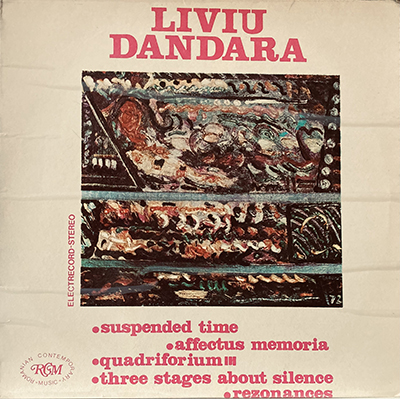
Liviu Dandara – Affectus Memoria (1982 / Electrecord)
Liviu Dandara is a pioneer of Romanian experimental music, significantly contributing to the development of abstract and contemporary aesthetics in national and international music landscapes.
After completing his studies in Bucharest, he participated in international workshops in Darmstadt, which exposed him to European “new” music.
Dandara’s silence speaks louder than words, offering a dialogue between sound and its absence.
Affectus Memoria dates back to 1973, a period during which electroacoustics in Eastern Europe began to develop in specialized studios.
The piece seems to use transformed sound materials (noises, fragments, perhaps human voices or voices that evoke the human voice) that have been electronically modified through filtering, transposition, editing, and reverberation. Unlike a traditional symphonic or “metric” musical form, the piece operates through the emergence, transformation, and disappearance of sound materials.
We are talking about a work in which the “developments” are internal to the sound, its texture, its spatialization, rather than a classical harmonic or melodic progression. In fact, it develops a meditative, introspective atmosphere, which may be mysterious rather than dramatic or gesticulating.
Time seems “stretched,” suspended.
Memory is its central theme — not memory as a simple recollection, but as something transformed, reworked by the machine, by the electronic medium. The recollection itself becomes sound material. Just as memory fades and changes, the sonic matter is subjected to continuous transformation, often losing its identifiable source.
The implicit or explicit presence of the voice — though processed — suggests a bridge between the human and the electronic, between the organic and the mechanical. In Affectus Memoria, the human voice — or at least its inflection, its imprint — plays a fundamental role, even when it is no longer directly recognizable. One can “sense the human voice”, or it “seems to hum softly, like a distant trace of the composition.” This implies that the raw material is most likely the recorded voice, then metamorphosed through studio techniques.
This approach places Dandara in a lineage running from Pierre Schaeffer to Luciano Berio, through Ligeti and Nordheim: the voice is no longer merely a vehicle of language. It becomes a sound substance, revealed and reshaped by technology.
The title Affectus Memoria is crucial: it links affect (emotion, sensitivity) with memory (trace, persistence).
The work stages what the machine inflicts upon sonic memory:
the recorded voice becomes remembrance;
the electronic transformation becomes the process of recollection;
the progressive disappearance of sound evokes forgetting.
Each processing technique acts as a kind of operation on memory:
• filtering = erasing certain frequencies (selectivity of remembrance);
• transposing = altering pitch (distortion of the past);
• reverberating = prolonging the trace (emotional echo).
Thus, the human/machine relationship is not conflictual but mnestic: the machine records, preserves, alters, and revives.
It becomes an organ of memory, an extension of affect.
Symbolically, one might speak of a loss of identity within memory, since the human voice, initially present, dissolves into the electronic fabric. Yet this dissolution is also a rebirth: the sound matter, now abstracted, acquires another kind of expressivity, nonverbal, purely timbral.
Here, Dandara joins the tradition of poetic electroacoustic music — that of Nordheim, Ferrari, and Malec — where meaning shifts from word to sound texture.
In Affectus Memoria, Liviu Dandara anticipates what one could call a post-human poetics of sound: a world in which the human does not vanish beneath technology, but is redeployed through it. The voice, the primary sign of identity, becomes a specter. Circulating through the circuits of the machine, dematerialized, multiplied, filtered, yet still charged with affect.
This displacement transforms the listener’s perception of subjectivity: one no longer hears an embodied voice, but a presence that persists within its absence.
Far from being a neutral tool, the machine here acts as an ontological mediator: it translates human experience into another language, that of frequency, timbre, and texture. The work belongs to a historical moment when sound technology, still analog, remained closely tied to the composer’s manual gesture; the magnetic tape thus becomes the extended body of the composer, a site of inscription where human memory is replayed as waves.
This dialectic between voice and machine, memory and transformation, makes Affectus Memoria a meditation on the sonic condition of modern humanity, a being whose trace survives not in words, but in vibration. Dandara’s spectral voice, oscillating between organic and artificial, materializes the fragility of presence in the technological age.
A music of the in-between, where the machine becomes a sensitive memory, and memory itself becomes an instrument of metamorphosis.
P.S. The Spectral Voice
The notion of the spectral voice designates this paradoxical presence of a disembodied voice, mediated through technology.
Jacques Derrida, in Spectres de Marx (1993), speaks of a “haunted presence” — neither living nor absent — made audible by technological means. In electroacoustic music, this spectrality takes on a concrete form: the recorded and transformed voice becomes a sonic ghost.
Michel Chion describes this as an acousmatic voice, one whose source is heard but unseen (The Voice in Cinema, 1982).
François Bayle, finally, conceives magnetic tape as an arena of metamorphosis, where listening captures “the trace of the body within the sound matter.”
In Affectus Memoria, Liviu Dandara belongs to this lineage: his transformed voice no longer speaks — it reappears, suspended between memory and reinvention — a pure spectral voice, a vibrant memory of an erased body.
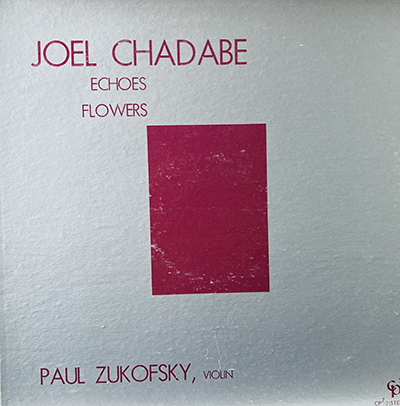
Joel Chadabe – Flowers (1976 / CP² Recordings)
German-American composer and electronic musician, born 9 July 1918 in Berlin, Germany, died 6 November 2000 in Urbana, Illinois, USA. He studied composition with Stefan Wolpe and piano with Frank Pelleg. Brün joined faculty of the University of Illinois in 1962 and taught there until his death. During that period of his life he was very active in using computers for composition.
I. Accumulation Instead of Origin.
“The text—my words and where I want them—has accumulated since 1970.”
This sentence could stand as Chadabe’s autobiography.
He does not claim inspiration, rupture, or revelation. He speaks of accumulation: time layered upon time, decisions sedimented rather than declared.
Chadabe’s beginnings are not heroic. They are methodological. Trained in the discipline of American postwar composition, he arrives at the early 1970s carrying the weight of serial rigor, Cagean indeterminacy, cybernetics, and a growing unease with the idea of the composer as sovereign.
Accumulation implies friction. Each layer responds to the previous one. Meaning does not arrive whole; it thickens.
Music, for Chadabe, is not written once but revised continuously by the systems that host it.II. Discontent as a Compositional Force.
“It responds with discontent to the commonplace of power: ‘Let us do our best for you, or else!’”
This is not a political slogan. It is a diagnosis.
Power, Chadabe suggests, speaks politely but conditionally. Benevolence arrives with an implicit threat.
Whether technological, institutional, or social, such systems demand obedience disguised as care.
Chadabe’s response is not refusal but redesign. He does not oppose power with noise or negation; he undermines it structurally.
His compositions refuse the one-way flow of command.
They respond. They hesitate. They redistribute agency.
Discontent becomes a parameter.III. Toward Flowers: Letting the System Speak.
By the mid-1970s, Chadabe’s work has shifted decisively away from fixed scores.
The question is no longer what notes should happen, but how should decisions happen.
Influenced by systems theory and early artificial intelligence research, he begins to treat music as a dynamic ecology.
Rules interact. Variables negotiate.
Outcomes remain unknown even to their designer.
The composer becomes less an author than a gardener.IV. Flowers (1976): Growth as Form.
Flowers is often cited as a landmark of interactive music, but its true radicalism lies deeper.
The piece consists of a performer interacting with an electronic system – built from generators, oscillators, and filters – that responds in real time. The performer’s gestures influence the system; the system answers according to probabilistic rules.
Neither side dominates. Both adapt.
The metaphor of flowers is not poetic decoration. It is structural truth. Like plants, the sounds grow according to internal constraints while remaining sensitive to their environment. No two realizations are identical. The form emerges rather than being imposed. What we hear is not a composition unfolding, but a situation unfolding itself.V. Tape, Memory, and Refusal of Progress.
“The tape I made, using methods similar to those of 25 years ago”
Here Chadabe folds time back onto itself.
In an era obsessed with technological novelty, he deliberately revisits older methods.
Oscillators and filters are not primitive. They are remembered bodies.
By using techniques from decades earlier, he resists the myth that progress is synonymous with improvement.
Technology does not redeem music. It reveals its ethics.
The tape becomes a memory machine, carrying with it the labor, curiosity, and limits of earlier experimentation.VI. Music as Social Analogy.
“It plays music constructed in analogy to social movements which will, if we fail them, fail us.”
This sentence quietly reframes everything.
Chadabe does not claim that music represents politics. He claims it behaves like it.
Social movements, like interactive systems, depend on responsiveness. They survive only if participants listen, adapt, and care for the structure that holds them. Failure is reciprocal.
To abandon the system is to be abandoned by it.
In Flowers, this reciprocity is audible. The system does not obey; it collaborates.
It can flourish, or collapse, depending on how it is treated.VII. Instruments as Strangers.
“The instruments – strangers between text and tape – wonder how they got here.”
In Chadabe’s universe, instruments are not obedient tools. They are displaced beings, suspended between intention and outcome.
They do not belong entirely to language or to sound. This estrangement is essential. It prevents mastery.
The instrument’s partial autonomy ensures that the system remains alive, slightly unpredictable, resistant to closure.
The machine is not humanized.
The human is decentralized.VIII. Gesture, Memory, Question.
“Calling with remembered with invented gestures for answers to the questions: ‘What was? What is? What next?’”
Gesture becomes inquiry. Memory and invention blur, as they do in any living system.
The performer’s body carries traces of past actions while inventing new ones in response to the present.
The questions are temporal, but also ethical.
What was? — What do we carry forward?
What is? — Where are we now, really?
What next? — What kind of system do we choose to sustain?
These are not answered. They are enacted.IX. Structural Radicalism, Quietly Done.
Chadabe’s revolution is almost invisible. No manifesto. No rupture.
Only carefully designed conditions under which authority dissolves into relationship.
Form is not imposed from above. It arises from interaction.
Meaning is not declared. It accumulates.
Control gives way to trust.
This is the deep coherence between Flowers and Chadabe’s text.
Both operate as systems that doubt themselves.
Both require participation.
Both fail if treated as commodities rather than living processes.Coda: The Composer as Gardener of Uncertainty
Joel Chadabe does not tell sound what to do.
He creates spaces where sound can decide.
His music listens. His systems respond. His structures remain open long after the composer has stepped back.
In Flowers, in his words, in his accumulated thinking since 1970, Chadabe offers not a future of domination by intelligent machines, but a fragile present of shared agency.
A music that grows.
A system that questions.
A listening that listens back.
And in that feedback loop – unstable, poetic, quietly political – we hear not the triumph of technology, but the possibility of care.

Emerson Meyers’Provocative electronics – Chez Dentiste (1970 / Westminster Gold)
Emerson Meyers does not seek harmony. He seeks friction.
Not the theatrical friction of rebellion, but a deeper, infrastructural tension: electricity pressed against intention, provocation embedded not in volume or shock, but in the way sound insists on existing against the listener’s habits.
Emerson Meyers appears around 1970 not as a figure of rupture, but of insistence. While electronic music at the end of the 1960s oscillates between utopian futurism and academic enclosure, Meyers chooses neither. He does not celebrate technology, nor does he retreat into formalism. Instead, he treats electronics as a social fact, already there, already humming, already shaping behavior.
His question is not what can electronics do?
It is: what are they already doing to us?
The phrase Provocative Electronics is not branding. It is a warning.
Provocation, for Meyers, is not scandal. It is disturbance at the level of expectation.
These works do not explode : they irritate, persist, hover.
They place the listener in a situation where sound behaves improperly, too static, too abrupt, too indifferent to musical politeness. Electronics here are not smooth extensions of instrumental logic. They are foreign bodies.
Their presence is felt as pressure, as insistence, as a refusal to disappear into aesthetic pleasure.
Meyers’ early work already suggests a compositional ethic that distrusts expressive immediacy. Sound is not an utterance, it is a condition one must endure. In Provocative Electronics, generators, oscillators, and signal paths are not hidden behind metaphor.
They are exposed. The listener senses the circuitry, the thresholds, the limits of control.
The music does not invite immersion : it enforces awareness.
You do not enter these works. They surround you.
Provocation here is ethical.
It asks: what does it mean to listen when listening is no longer rewarded?
Though less explicitly articulated than in Chadabe’s writing, Meyers’ work resonates with a similar intuition that electronic systems mirror social systems. Signals override gestures. Processes persist beyond intention. Feedback loops do not care about meaning. In Provocative Electronics, one hears a world where agency is partial, delayed, distributed. The human does not vanish, but neither does it dominate. The machine does not rebel, it continues. This continuity is the provocation.
Emerson Meyers does not ask electronics to sing. He asks them to persist. His music does not resolve, persuade, or console.
It provokes by remaining, by holding its ground, by exposing the listener to sound as a structural fact rather than an expressive gift. In Provocative Electronics, we do not hear the future.
We hear the system humming underneath the present.Unromantic.
Unapologetic.
Still vibrating.And perhaps that is the deepest provocation of all.

Lorq Damon – Through the gates of nightmares (1974 / Tala Inc.)
Lorq Damon does not appear in established electronic music histories, encyclopedias, or mainstream databases.
There is no confirmed biography in public discographies or music encyclopedias.
The name may be a pseudonym or project identity rather than a widely recognized individual artist.
The almost-total absence of verifiable biographical detail is part of the work’s historical identity which situates Through the Gates of Nightmares within a class of 1970s experimental/ outsider electronic recordings. LPs made outside institutional infrastructures like academic studios or commercial record labels. Many such works were distributed privately or in tiny pressings, with little documentation and minimal circulation.
The emphasis on altered states, passed thresholds, and subconscious exploration ties the musical project to countercultural fringe practices of the era, including interest in occultism, psychedelia, and experiential ritual. But unlike better-known figures in those movements, Damon did not enter public discourse in ways that left traceable records. Thus, rather than placing Damon into a conventional biography, we treat his absence of biography as part of his artistic aura:
a creator whose public trace is the record itself, and who resurfaced years later in collector fandom precisely because of that trace’s mystery.
Lorq Damon is associated with this obscure, rarely documented LP. The album has intrigued collectors of rare electronic and experimental records precisely because so little biographical information survives about its creator.
The LP’s insert and liner notes present a conceptual framing rooted in dream worlds, astral projection, and altered states of consciousness, rather than conventional musical practice, a reason it has historically circulated more as a curiosity in underground synth circles than as part of the mainstream history of electronic music.
The record is described by listeners and reissue sites as long-form drone work with atmospheric, minimalist analog sounds, sometimes compared to early synth explorations, but also distinguished by its apparent intent of facilitating psychic or trance-like experience.
From the first instruction, this record does not ask to be heard. It asks to be entered.
Through the Gates of Nightmares is not positioned as music, not even as composition, but as apparatus, a controlled breach in consciousness, calibrated somewhere between curiosity and risk. Lorq Damon does not present himself as a composer; he presents himself as a facilitator of passage.« Dedicated to everyone who believes in the beyond »
Belief is the entry requirement.
Not taste.
Not education.
Not training.
Belief, here, is not religious, it is procedural. You must accept the possibility that consciousness can shift, that sound can act not as representation but as key. Without that belief, the record does nothing. With it, the record becomes dangerous.
This is not music addressed to an audience. It is a device addressed to a subject.« The entire collection is about the dream world and astral projection.»
This sentence explicitly rejects metaphor. Dreams are not inspiration; astral projection is not imagery.
These are locations on “a different level of consciousness.” The record positions itself as a cartography.
What is striking is the absence of irony. No distancing language. No hedging. The claim is absolute and calmly stated.
This is not psychedelic suggestion. It is instruction.« You should notice a change of awareness as the concentration is placed on the sounds of this record. »
The listener is asked to concentrate, not to enjoy. Awareness is not expanded by volume or excess, but by focus.
Sound becomes a point of fixation, a stabilizer for internal drift. Here, electronics do not overwhelm the senses. They narrow them. The record works not by stimulation, but by reduction, a clearing away of everyday cognitive noise.« This, then, is meant to be a controlled means of mind expansion. »
Control is the key word.
Unlike the rhetoric of psychedelic liberation, Damon insists on boundaries. Expansion without containment becomes terror.
The record offers structure: track order, sonic pacing, repeated textures. The listener is not abandoned in the void; they are guided through it.
The sequence of titles forms a closed loop:
• Journey To The Land Of Forgotten Dreams
• Entry To The Land Of Dreams
• Falling Up
• Illusions Of Reality
• Running Still In Circles (Running Silent)
• Through The Gates Of Nightmares
• Journey Backwards
This is not narrative. It is topology.
No climax.
No victory.
No enlightenment.
Only passage, disorientation, confrontation, return.
Not transformed—reoriented.« Many listeners have expressed the feeling of floating in a void which can be relaxing of frightening on what you are prepared to experience…
The sounds act as a key to open doors to the sub-conscious. Just remember that ‘’journey’’ is a psychic experience and not a musical composition.»