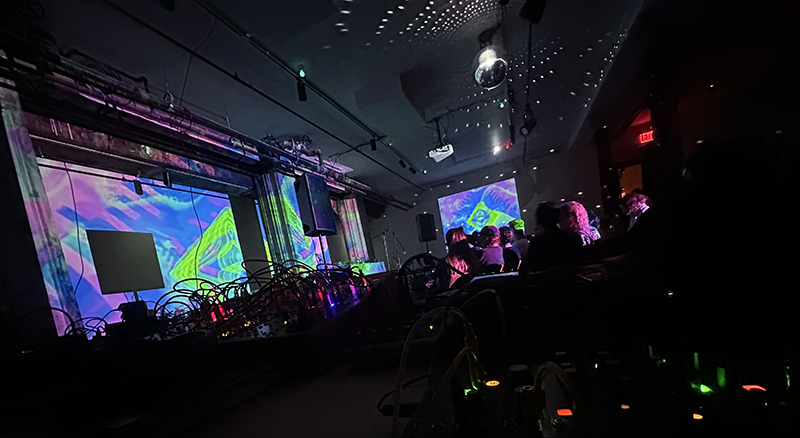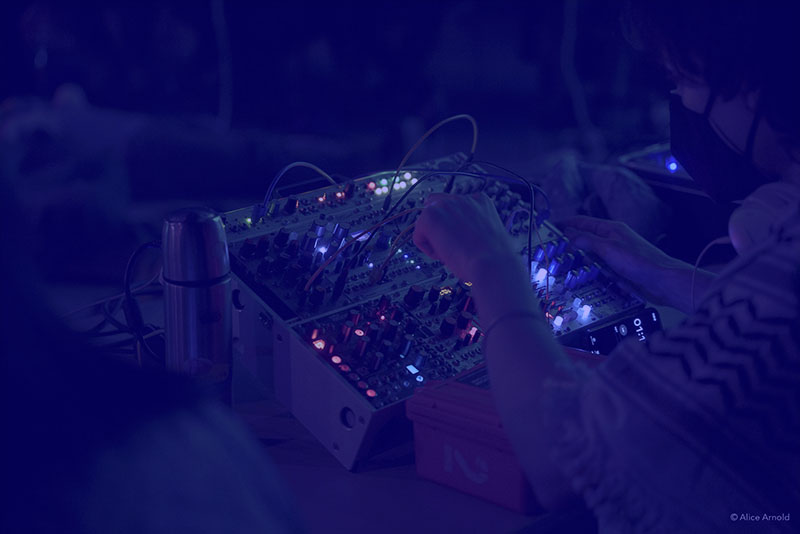
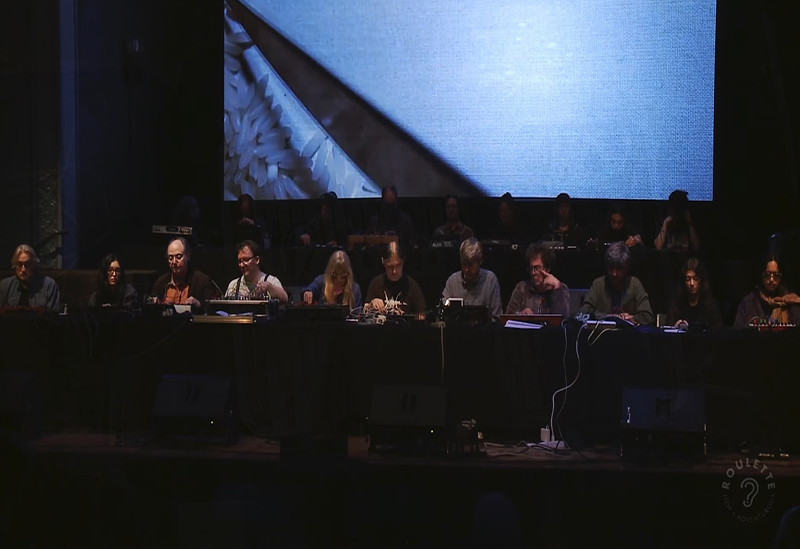
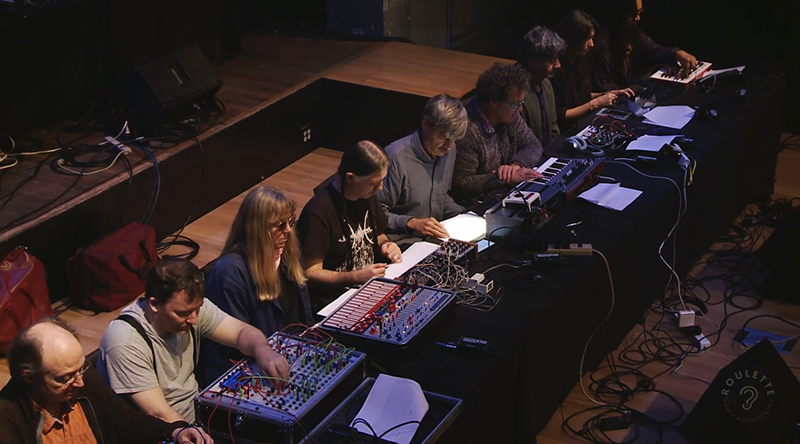
Hans Tammen’s Dark Circuits Orchestra
plays two of Phill Niblock’s orchestra pieces :
Baobab (2011) and 2LIPS (2008)
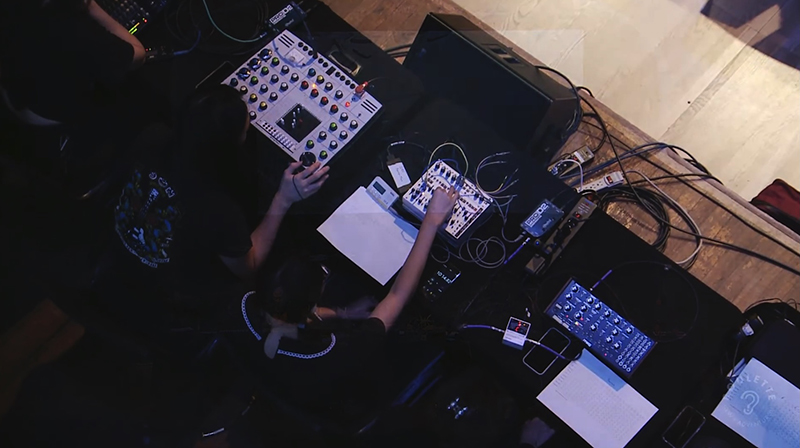
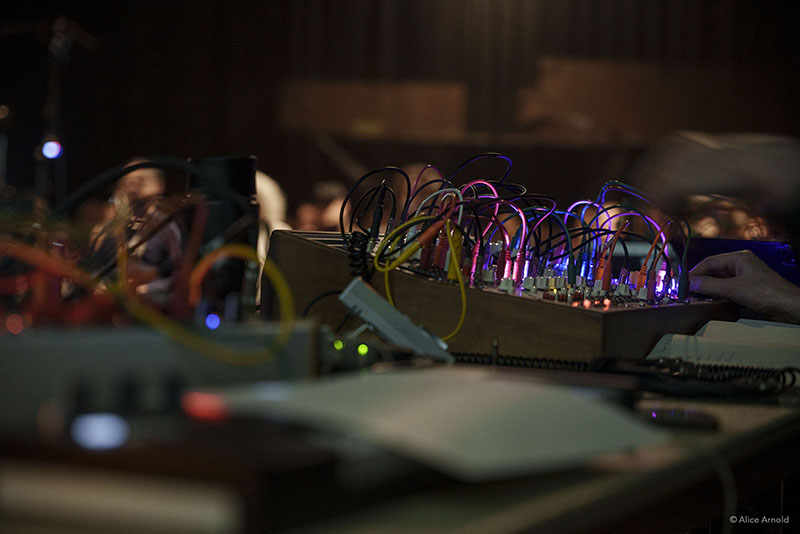
on 20 analog synthesizers and oscillators.
Players : Luc Vitk, Marcia Bassett, Teerapat Parnmongkol, Alex Zhu, Luke Dubois, Noor Sabreen, Monica Rocha, Crystal Penalosa, Chuck Bettis, Kamran Sadeghi, Michael Schumacher, David Galbraith, Larry 7, Abby Davis, David Rothenberg, Daniel Neumann, Ben Manley, Miguel Frasconi, Laura Feathers & Hans Tammen.
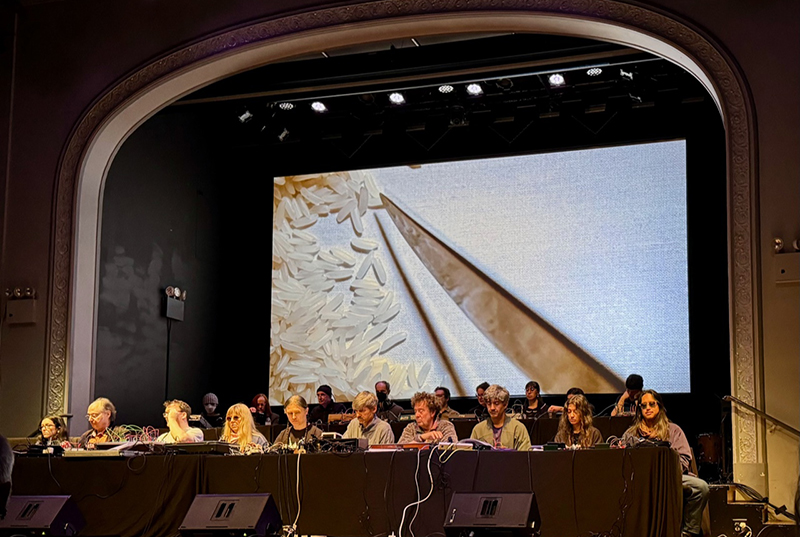
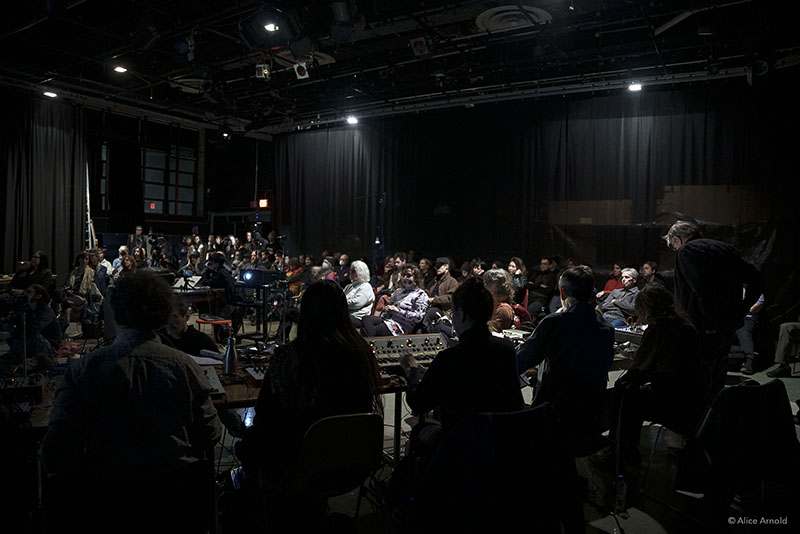
Late in 2023 Phill Niblock & Hans Tammen discussed an all-analog synthesizer version of some of his orchestra pieces. Sadly, Phill passed away just a few weeks before the premiere, which took place at Hunter College’s Black Theater in February 2024. The Dark Circuits Orchestra performed these pieces again at the Phill Niblock Tribute on Oct 5, 2024, at Roulette Intermedium in Brooklyn.
This recording is from the Roulette concert.
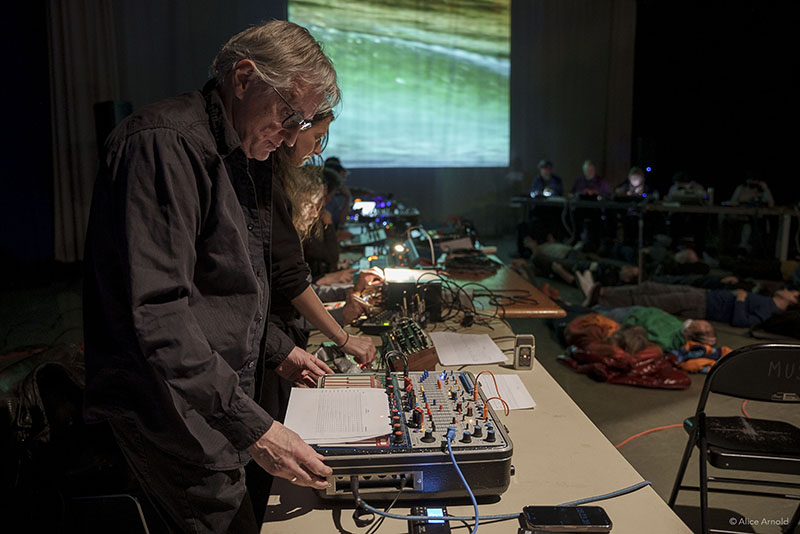
Would you please develop, explain how Phil and you met?
I met Phill originally in 1996, when he had an audio-visual installation going on in a gallery in Kassel, Germany, a city I was living in at the time. His installation was from a series of projects that he apparently later lost interest in, projects in which sound influenced visuals, and visuals influenced sound.
He had a couple of synthesizer modules producing drones, but the sound was sent into speakers filled with water, creating ripples on the water surface. A camera above the speakers pointing at the water surface used Tom Demeyer’s software BigEye to turn those movements into MIDI date, which in turn adjusted the tuning of those synthesizers.That was the first audio-visual project that completely blew me away, one that made sense to me. We talked about the project for quite some while (remember he always talked to everybody, and at length).
I didn’t see him again until I moved to NYC in 2000, and met him at his loft parties and concerts.
What was your relation?
The relationship was more professional in the beginning, but it changed as we talked about 1940’s jazz, something that he was a big fan of. I remember discussing Count Basie’s guitarist Freddie Green endlessly, and he even owned more recordings of Freddie Green than I did! I also helped him later on some of his video projects.
How did you decide to work on those pieces, why these ones?
At some point he gave me a harddrive with his work and scores, and I found scores of his “orchestra” pieces.
Pieces that asked for either 20 or 40 musicians. Now he preferred acoustic instruments because of the rich overtones affecting each other. However, I wondered if the pieces would sound more powerful if they’re all done using sine waves, i.e. synthesizers or test oscillators. He was into it, but sadly wasn’t able to hear the results as he passed away a few weeks before the “sinewave” premiere.
I think he would have loved it, because there was just the unrivaled raw power of a 20-synth ensemble.
Well, there are also scores with 40 musicians, and 40 synthesizers should be better than 20 synthesizers!
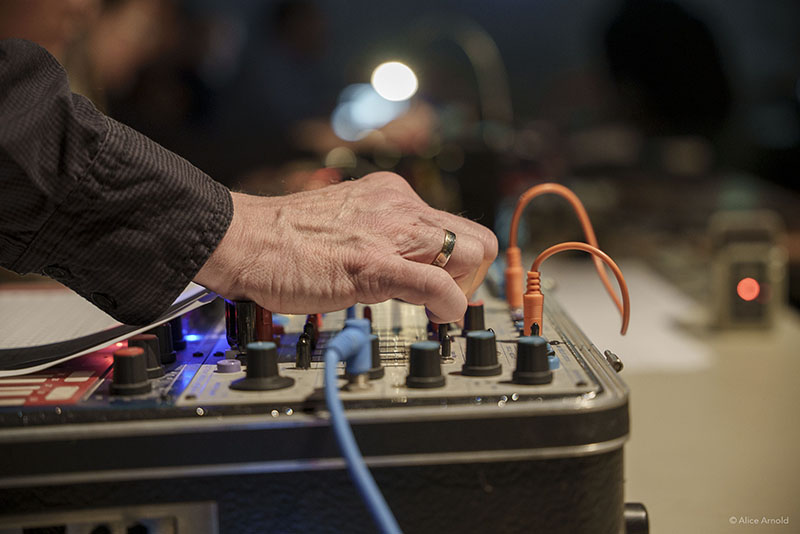
As for the two pieces (Baobab and 2Lips), I chose them because of the different note choices.
Baobab consists of notes spread out at the beginning between C plus approx. 50 cents and B minus approx. 50 cents. Over the course of the piece the notes spread out from the top down to a Bb minus approx. 50 cents, so we’re adding a semitone to the whole thing.
Some voices go up during the piece, others go down, so you get a continuously moving block of sounds.2LIPS, though, is a bit different. We start out with a 150 cent spread between G and G# (+50c), but half of the orchestra plays G, so this pitch is heard prominently at the beginning. The G players spread out between F# (-50c) and F# (+50c), while the people who were doing the microtonal spread around G# are now all playing A at the end.
So while the beginning is kinda dense, we end up with a wider spread between A and F#.
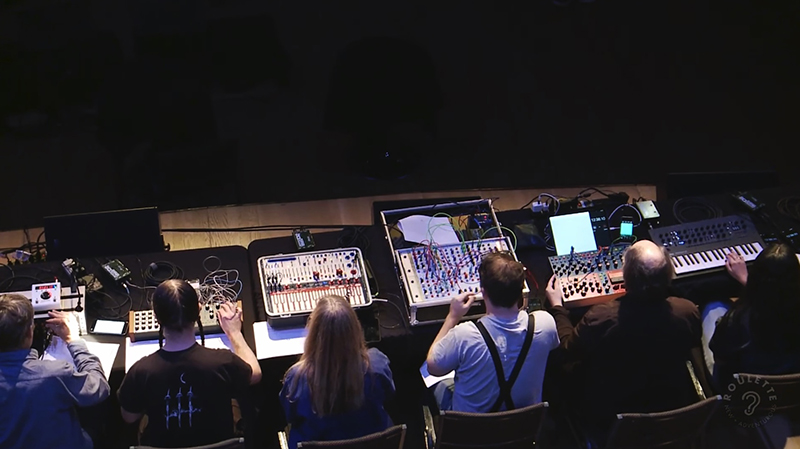
Marcia Bassett is a NYC-based improviser known for her innovative and unconventional approach to music. Her work explores areas of sound collage and audio-visual environments. Whether in collaboration or solo, Bassett pushes the boundaries of sound to create a heady sonic interplay of otherworldly narratives that are equal parts trance and critique. Co-founder of seminal bands Un, Double Leopards, GHQ, Hototogisu and frequent collaborator with Ursula Scherrer, Ted Gordon, Samara Lubelski, Margarida Garcia and head runner of the Yew label.
Abby Davis
Abby Davis is an engineer at Apogee Electronics. Born and raised in Richland, Washington, she currently lives in Brooklyn NY. She attended New York University where she studied music technology and computer science.
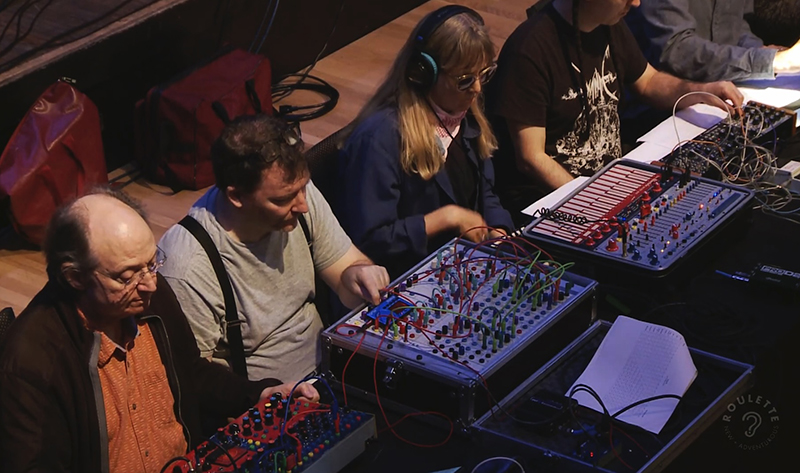
Miguel Frasconi is a composer and improviser whose instrumentarium includes glass objects, electronics, and instruments of his own design. His glass instruments are struck, blown, stroked, smashed and otherwise coaxed into vibration. He has composed numerous operas, chamber works, dance scores and performs with the acoustic band NewBorn Trio, and the electric trio Lampshade. Miguel has recently performed at the Electric Eclectics Festival in Canada, was in residence at Art Omi New York, and performed in Europe with vocalist Kristin Norderval. Miguel is presently working closely with Morton Subotnick, learning his most recent piece.
R. Luke DuBois creates music, art, software, and circuits, not necessarily in that order. His artwork explores the temporal, verbal, and visual structures of cultural and personal ephemera, using data-driven techniques to investigate time, memory, identity, and the meaning of portraiture in the United States in the 21st Century. An active visual and musical collaborator, DuBois is the co-author of Jitter, a software suite within Max/MSP for the real-time manipulation of matrix data developed by San Francisco-based software company Cycling’74. He appears on nearly twenty-five albums both individually and as part of various ensembles. He performs regularly using both digital and analog instruments, including Serge Modular synthesizers.
Chuck Bettis was raised in the fertile harDCore soil, nourished within Baltimore’s enigmatic avant garde gatherings, and currently blossoming in New York’s experimental realms. His unique blend of electronics and throat has led him into various collaborations with great musicians from around the globe. https://chuckbettis.com
David Galbraith is a composer, performer and media artist who lives and works in New York. He explores the couplings between art, music, technology and the body through his sound installations, video works, custom software and performances using self-built analog electronics. His compositions and performances have been presented at The New Museum of Contemporary Art, Tonic, The Stone, Art in General, and free103point9, among other New York venues. Galbraith’s visual work has been included in museum exhibitions at P.S.1/MoMA (New York), The New Museum of Contemporary Art (New York), and KW Institute of Contemporary Art (Berlin). Galbraith holds an M.F.A. from California Institute of the Arts (1996) and a B.S. from the University of Wisconsin-Madison (1988).
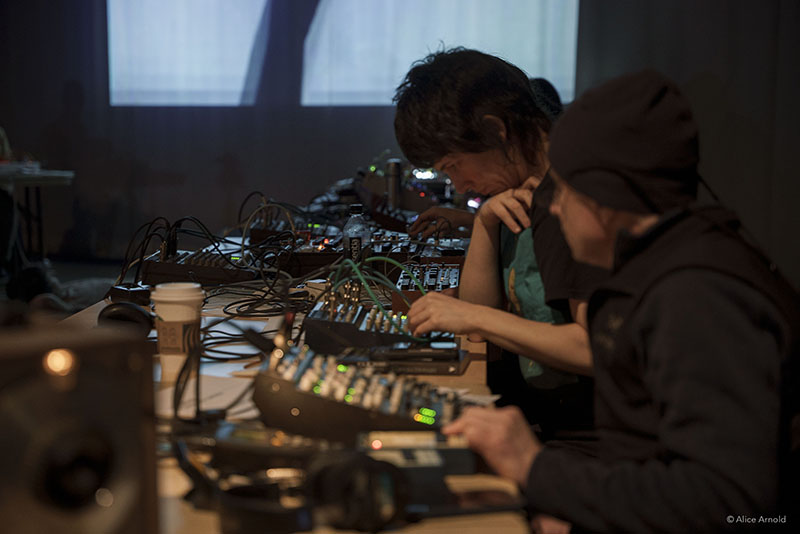
Musician and philosopher David Rothenberg wrote Why Birds Sing, Bug Music, Survival of the Beautiful and many other books, published in at least eleven languages. He has more than forty recordings out, including One Dark Night I Left My Silent House which came out on ECM, and more recently Just Leave It All Behind and Lost Steps. He has performed or recorded with Pauline Oliveros, Peter Gabriel, Ray Phiri, Suzanne Vega, Scanner, Elliott Sharp, Umru, Iva Bittová, and the Karnataka College of Percussion. In 2024 he won a Grammy Award as part of For the Birds, in the category of Best Boxed Set. Whale Music and Secret Sounds of Ponds are his latest books. Nightingales In Berlin and Eastern Anthems are his latest films. Rothenberg is Distinguished Professor at the New Jersey Institute of Technology.
Kamran Sadeghi is a composer, record producer, interdisciplinary artist, and curator based in New York City. His work incorporates sound art, multi-channel composition, architecture, moving image, modular synthesis, and field recordings. This layered practice explores the intersection of interior and exterior worlds—physical, cultural, and psychological. Born in Iran and raised in the U.S. after the Iranian Revolution, Sadeghi’s experience of cultural dissonance shaped a nonconformist perspective that resonates throughout his work.
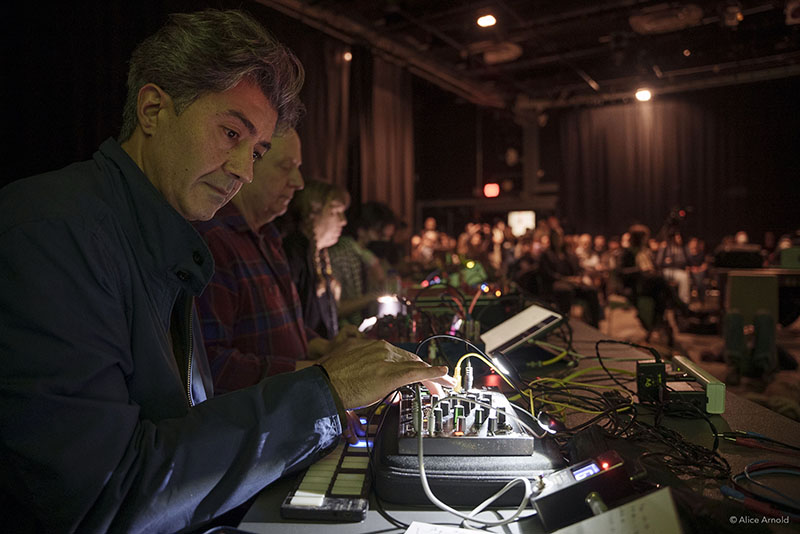
Luc Vitk is a Czech composer, improviser, and performer of accordion, hichiriki, drums, synthesizer, harmonica, voice, and dance. Their compositions center around sonification, while in their improvisation practice, Luc works with the characteristics of discrete spaces through the interaction between sound and movement. Luc’s new work focuses on the social-political dimensions of music in relation to everyday life and on the environment. They are a composition lecturer at Waipapa Taumata Rau, Aotearoa / University of Auckland, New Zealand.
Teerapat “Gof” Parnmongkol is a musician, composer, and audio engineer who plays the oud and sursingar. Based in Thailand, Gof work moves between mystical time and speculative sound.
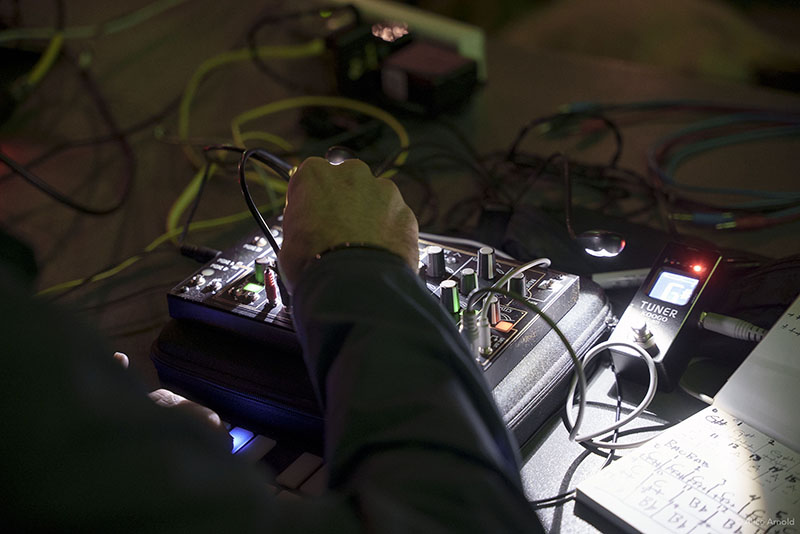
Monica Rocha is an audiovisual and performance artist based in Brooklyn. She’s interested in generating narrative and non-narrative scripts through collaborative movement, sound, and experimental forms of writing and sound making. She has performed at Harvestworks, Dada Bar, Roulette, and Artists Space.
Alex Zhu is a composer, musician, record producer, and sound designer based between Brooklyn, NY and Princeton, NJ. His musical path began in Baltimore, MD, and has since led him across the world, collaborating with a wide range of artists, musicians, writers, and producers. His work spans genres: from experimental and transgressive projects (such as Twig Harper) to internationally touring indie rock bands (Bambara, Future Islands, TOCCA), as well as collaborations in world and folk music with fellow NYU graduates, and even Grammy-winning artists such as Kimbra. Alex is a member of the indie rock project TOCCA, where he contributes guitar, synthesizer, production, and composition. Based in Princeton, NJ, Alex runs his own recording studio Zhutopia, centered around a pair of extensively modified Neve consoles, where he continues to produce, record, and explore new sonic ideas.
Crystal Peñalosa is an electronic musician and interdisciplinary designer based in New York. Her work focuses on self-compassion practices while engaging with authenticity and personal safety. She has released music through Soap Library and Topos Press, painting a future of self-actualization and independence for the CHamoru people, as well as producing self-released music. Crystal currently works as a Product Designer with the New Jersey Office of Innovation, whose mission is to improve the lives of New Jerseyans by solving public problems differently.
Laura Feathers creates soundscapes inspired by electronic music’s rich history. Having studied composition at the State University of Stony Brook, Laura’s many credits include playing with Hans Tammen’s Dark Circuits Orchestra since 2016.
Based in Brooklyn, Michael J. Schumacher has innovated in the area of spatialized sound and algorithmic composition since the 1980s, creating multi-channel, generative “Room Pieces” presented in galleries, museums, concert halls, public and private spaces. Schumacher’s compositions have been presented at GRM in Paris, Roulette, Issue Project Room, Artists Space, Ostrava Music Days, Transmediale, the MCA Lyon, The Hermitage in St. Petersburg, Klangraum Krems, The Dream House, etc. His music has been published by Superpang, XI Records, Sub Rosa, Entr’acte, Quecksilber and Sedimental.
Daniel Neumann is a sound artist, organizer and audio engineer. In his artistic practice he is working in hybrid installation-performance formats, in which a main focus is how sound interacts with space and how space and spatial perception can be shaped by sound. His work is presented internationally and represented by Fridman Gallery, New York. Curatorially he runs an event series [New Ear:: Spatial] that engages in spatial sound works and focussed listening.
Composer Ben Manley has worked extensively in non-commercial music and audio in New York City and has presented solo performances and installations across the country and overseas. He has collaborated with friends and colleagues, and has appeared with Composers Inside Electronics, Essential Music, and the Downtown Ensemble. As a curator, Manley has produced concerts of experimental music at Greenwich House Music School, Jack Tilton Gallery, and Brooklyn Music School, including House Mix: 19 Pianos, 19 Improvisers & 19 Microphones (a collective performance/recording/playback event), Electro-Whammy (w/ Ron Kuivila, Ben Manley, Matt Rogalsky), and say YES! to experimental music (w/ Jens Brand, Dan Evans Farkas, Ben Manley, Phill Niblock).
Multimedia art alchemist LARY 7 was born in Buffalo, New York, in 1956, and encouraged by his mother to mine junkyards for treasure from a young age. A former media studies student of Tony Conrad, Paul Sharits, and Hollis Frampton at the city’s public university, 7 was also educated in engineering, architecture, and filmmaking. He moved to Manhattan permanently in the late 1970s, where he used his technical know-how to launch a career as a commercial art photographer, working for major galleries and downtown friends alike, and has been a fixture of New York’s experimental underground ever since. Rejecting digital technologies because of their premeditated nature, 7 uses esoteric, often precarious analog equipment and instruments for his absurd, unpredictable presentations.
In addition to his solo work, 7 has collaborated with the likes of Conrad, Tom Verlaine, Swans, Jarboe, Jutta Koether, and Foetus.
In 2015, Anthology Film Archives celebrated the release of Danielle de Picciotto’s documentary Not Junk Yet: The Art Of Lary 7 with a three-day retrospective of his films. He retired from commercial photography after Hurricane Sandy and remains a tenant in the same East Village building he has lived in since the mid-’80s.
Noor Sabreen is a Palestinian sound technician and tinkerer based in NY. She works with interactive feedback systems using synthesizers and self-made software. Her work focuses on emergent patterns and interactions between sounds, spaces, and inhabitants.
Hans Tammen is just another worker in rhythms, frequencies and intensities. He likes to set sounds in motion, and then sit back to watch the movements unfold. Using textures, timbre and dynamics as primary elements, his music is continuously shifting, with different layers floating into the foreground while others disappear. This flows like clockwork, “transforming a sequence of instrumental gestures into a wide territory of semi-hostile discontinuity; percussive, droning, intricately colorful, or simply blowing your socks off” (Touching Extremes).
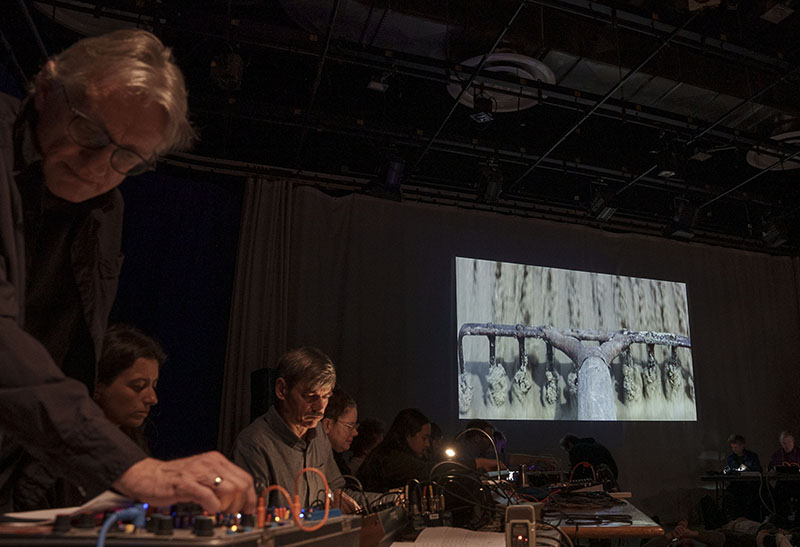
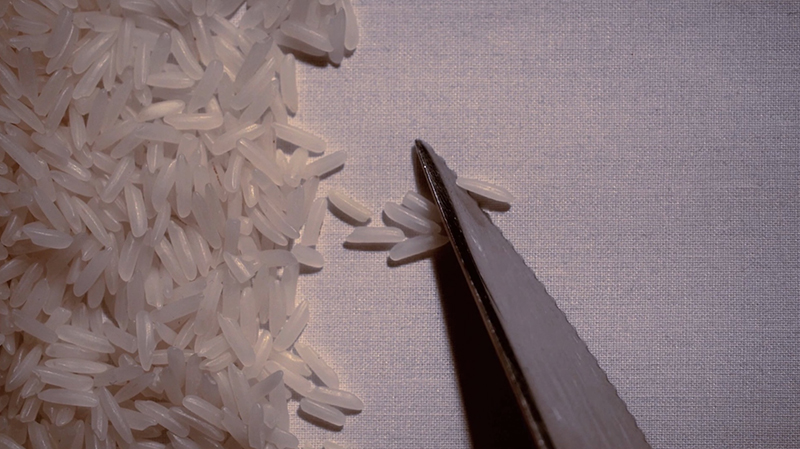
Visuals were provided by Katherine Liberovskaya.
You can watch the whole show here: https://tammen.org/Dark-Circuits-Orchestra-plays-Niblock-Cardew
Originally presented and livestreamed by Roulette Intermedium on October 5th, 2024.
Produced in part by Matt Mehlan – Artistic Director, Ian Bjornstad – Technical Director, Amanda Davis – Producer Artistic Programs, Sean Madigan – Production Manager, Jonah Rosenberg – Sound Engineer, Andrea Schiavelli – Sound Engineer, Mikaela Lungulov-Klotz – Livestream Operator, and everyone on the Roulette team.
Mixed and mastered by Hans Tammen.