David Lee Myers is an American artist whose work unfolds at the intersection of sound, process, and perception.
Known in music under the name Arcane Device, he has spent decades exploring feedback not as an effect, but as a primary material.
A living system that thinks, reacts, and evolves.
His electronic music is built from feedback loops that are carefully set in motion, then allowed to behave. Sound feeds back into itself, mutates, thickens, destabilises.
Control is never total.
Myers listens, adjusts, intervenes minimally, letting the system reveal its own logic. The result is music that feels physical and immersive, less composed than cultivated, shaped by attention rather than domination.
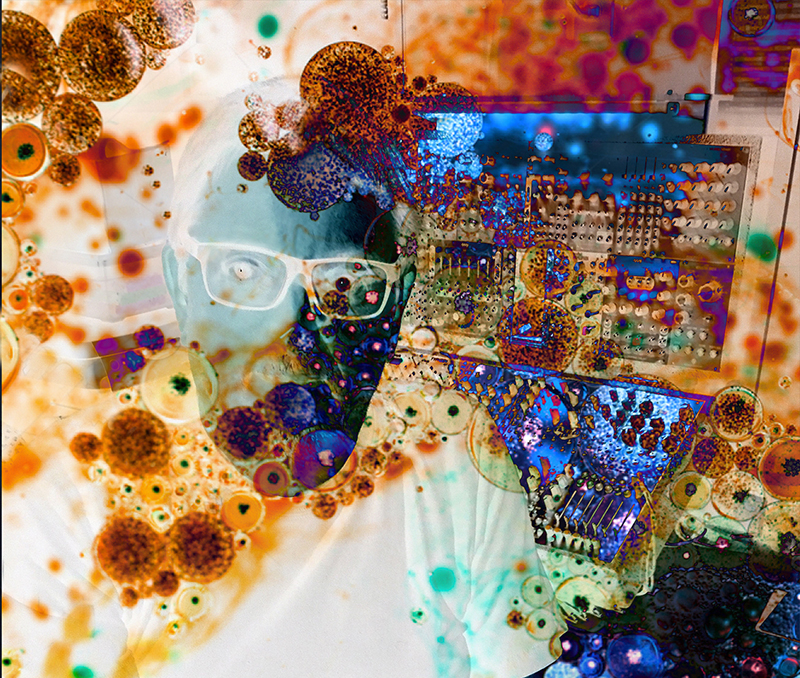
This same approach runs through his visual work.
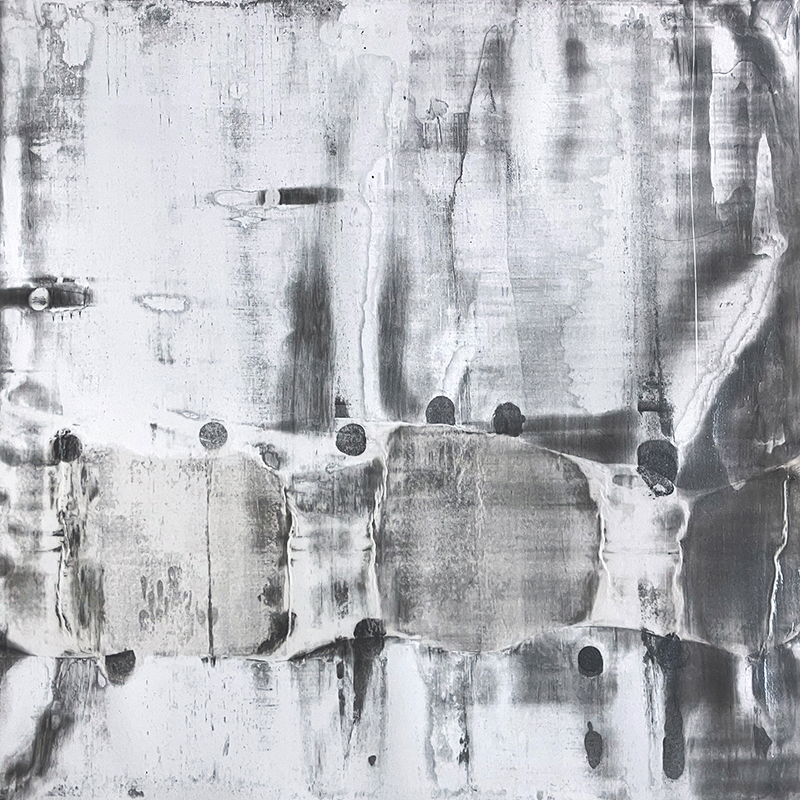
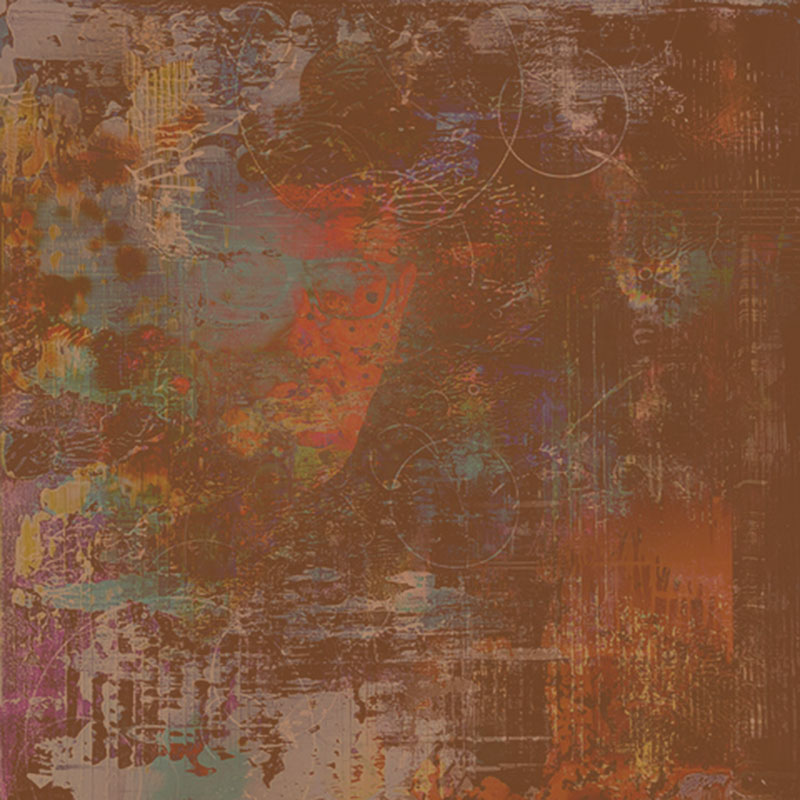
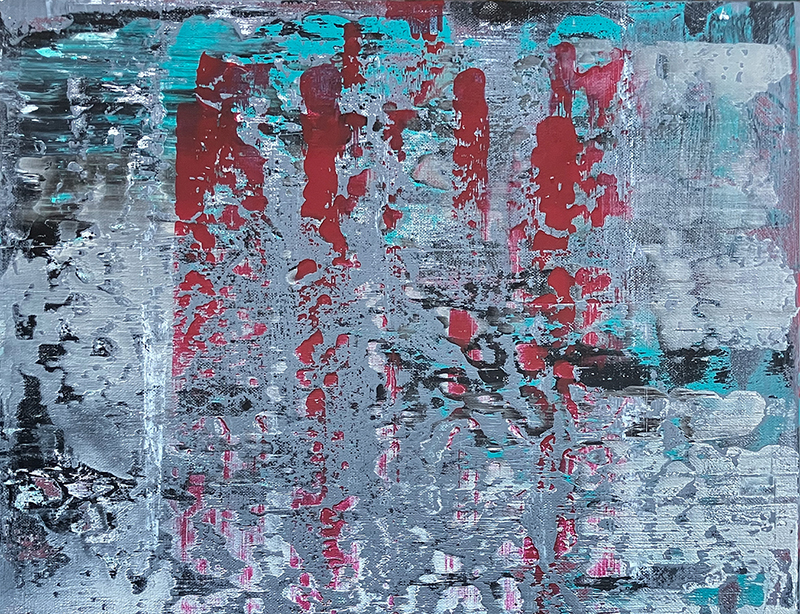
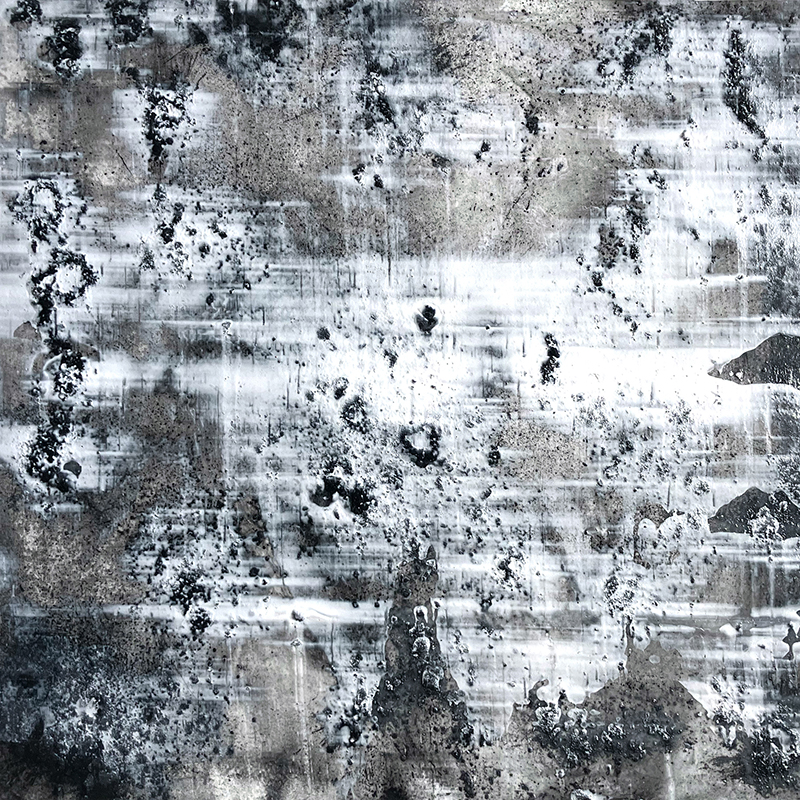
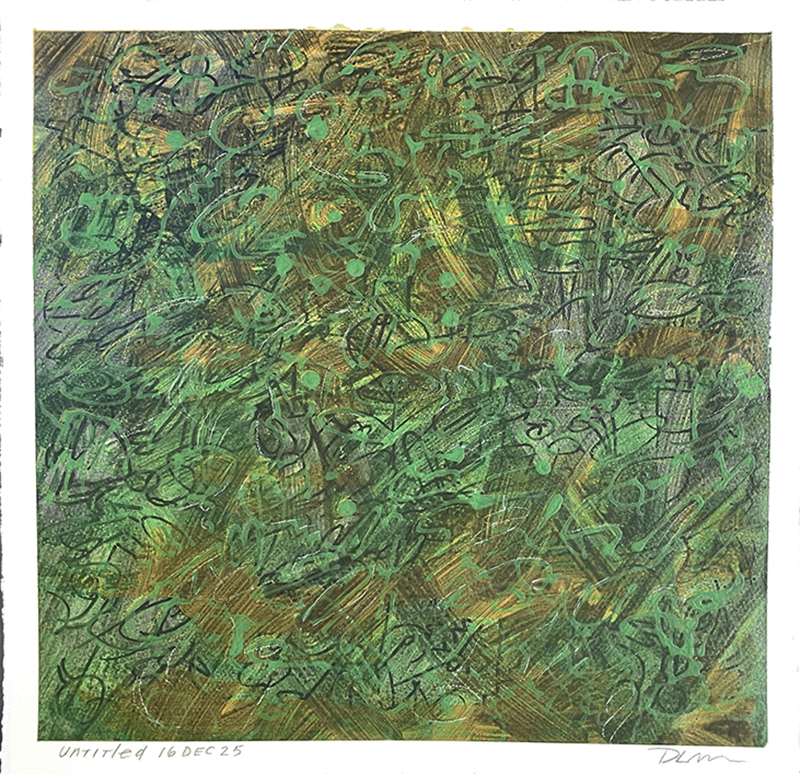
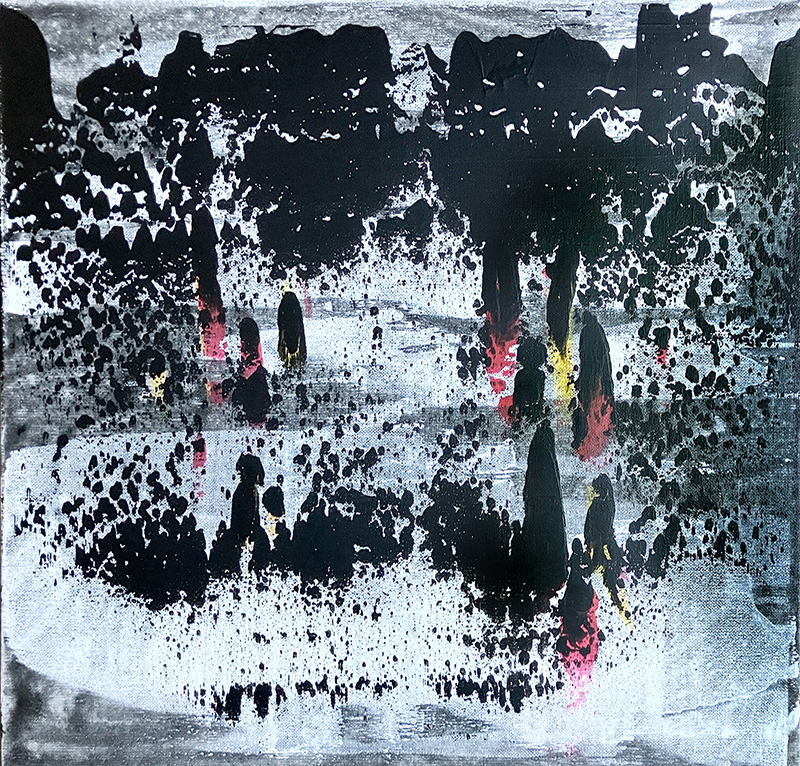
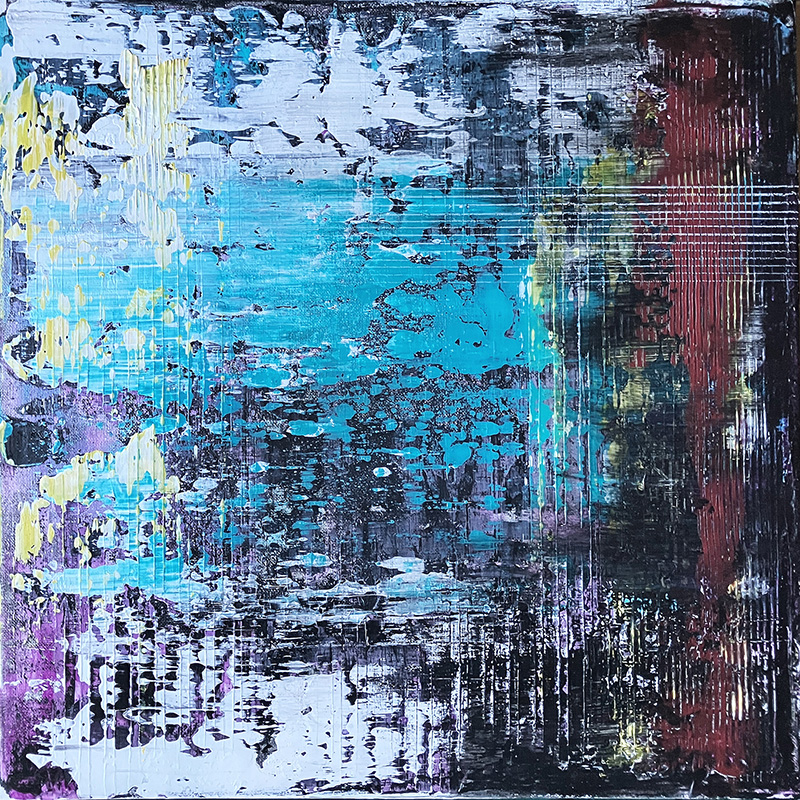
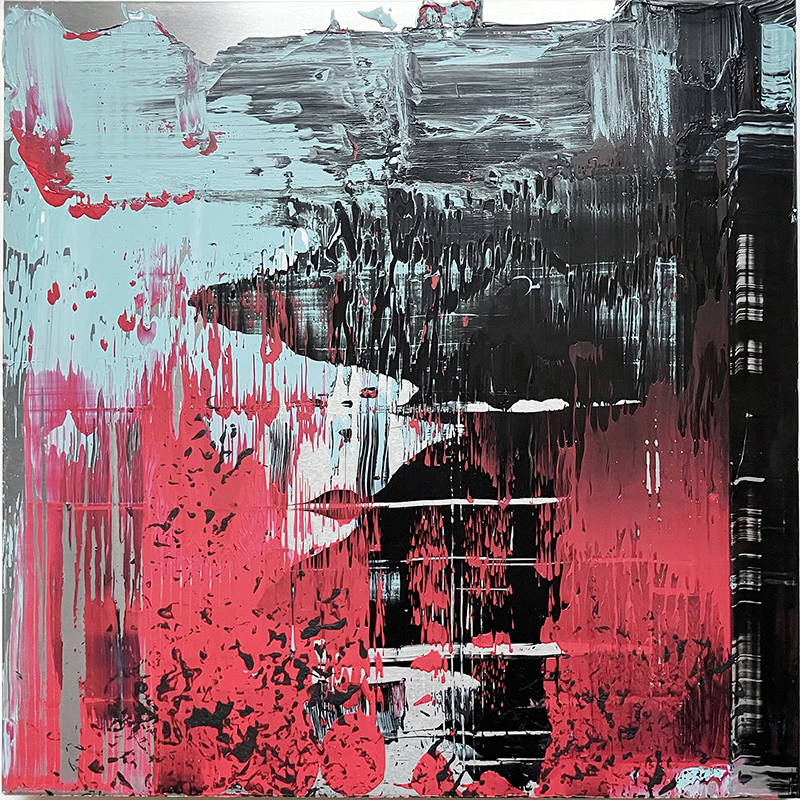
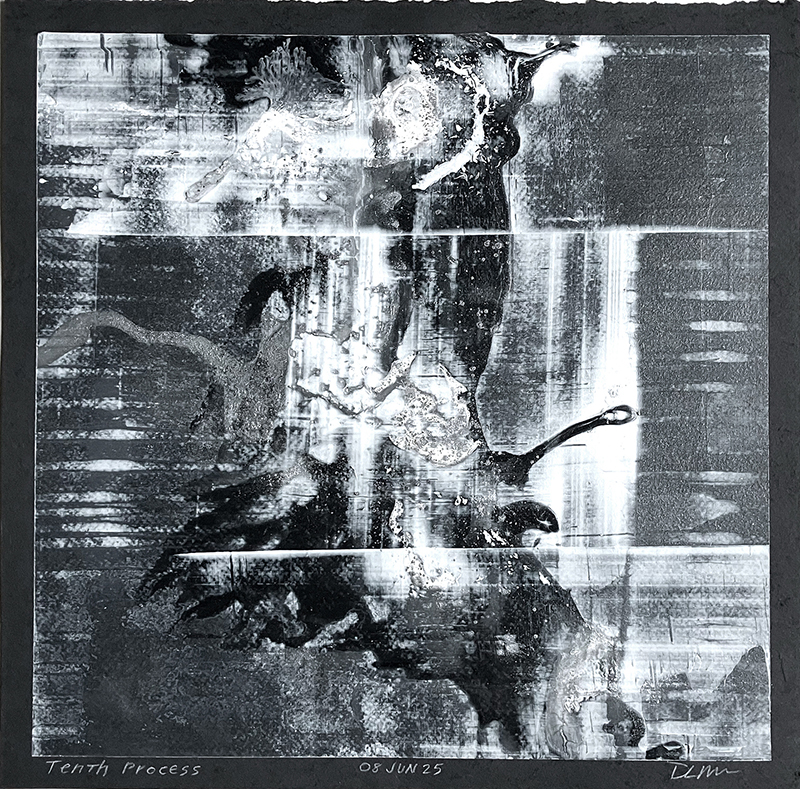
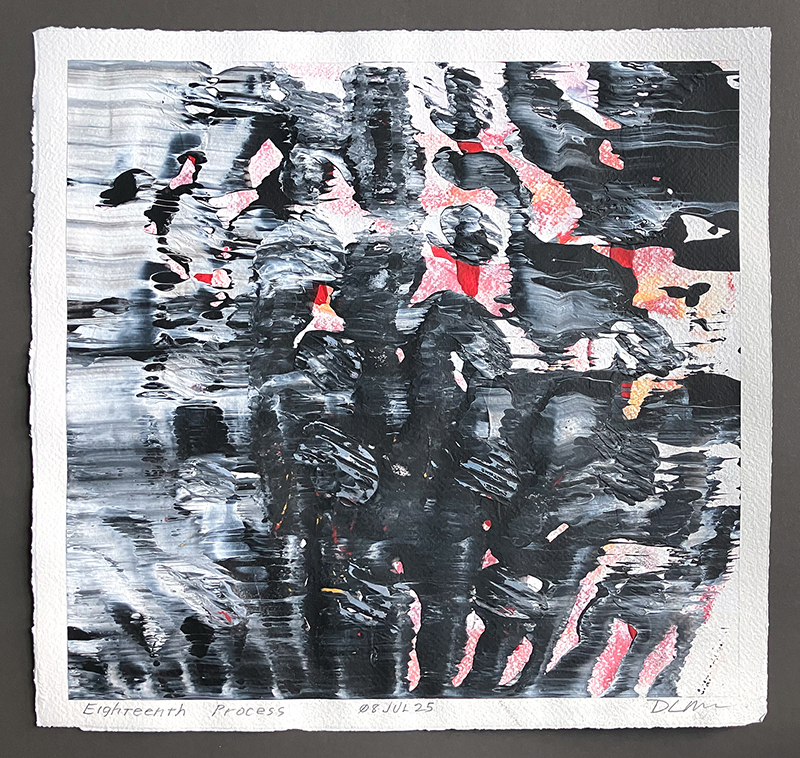
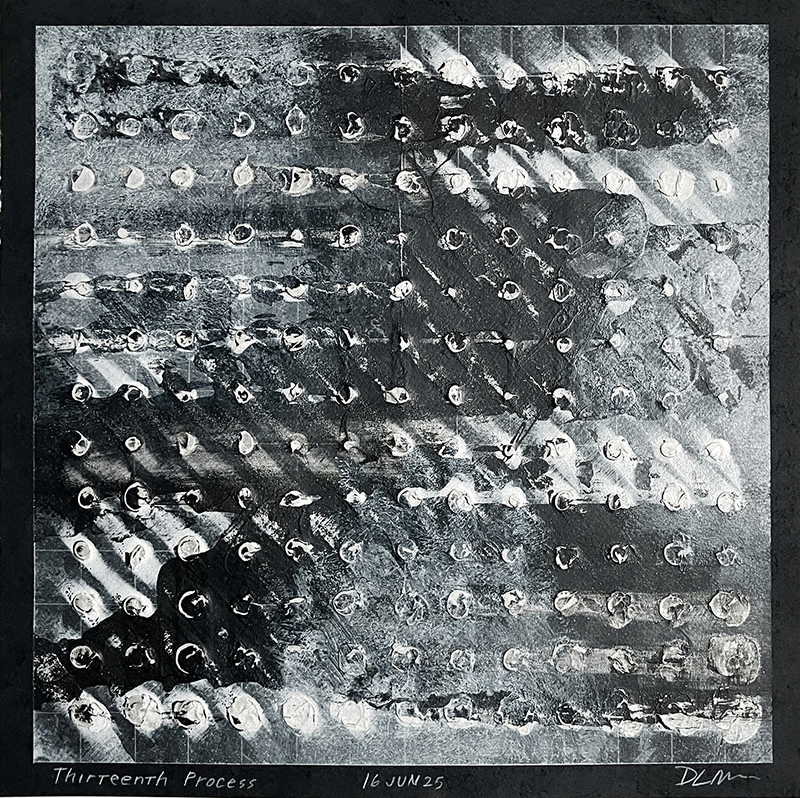
His paintings – some illustrating our Session – are not illustrations of sound, but parallel processes.
Each mark responds to what is already there.
Forms repeat, shift, erode, reappear.
Layers accumulate until the surface reaches a state of tension : dense, unstable, held in balance, feeling less like finished pictures than like moments taken from an ongoing process. Each mark seems to answer the one before it, creating a chain of actions and reactions.
Nothing moves in a straight line.
What happens on the surface loops back, changes, and returns.
There is a strong sense of repetition, but never exact.
Shapes reappear slightly altered. Colors thicken or fade, areas intensify while others break down.
The painting seems to test itself, as if it were listening and adjusting while it unfolds.
Rather than aiming for a clear image, the work builds density.
Layers accumulate, rub against one another, sometimes reaching a point of tension or imbalance.
The surface feels active, unstable, held in place just long enough to be seen.
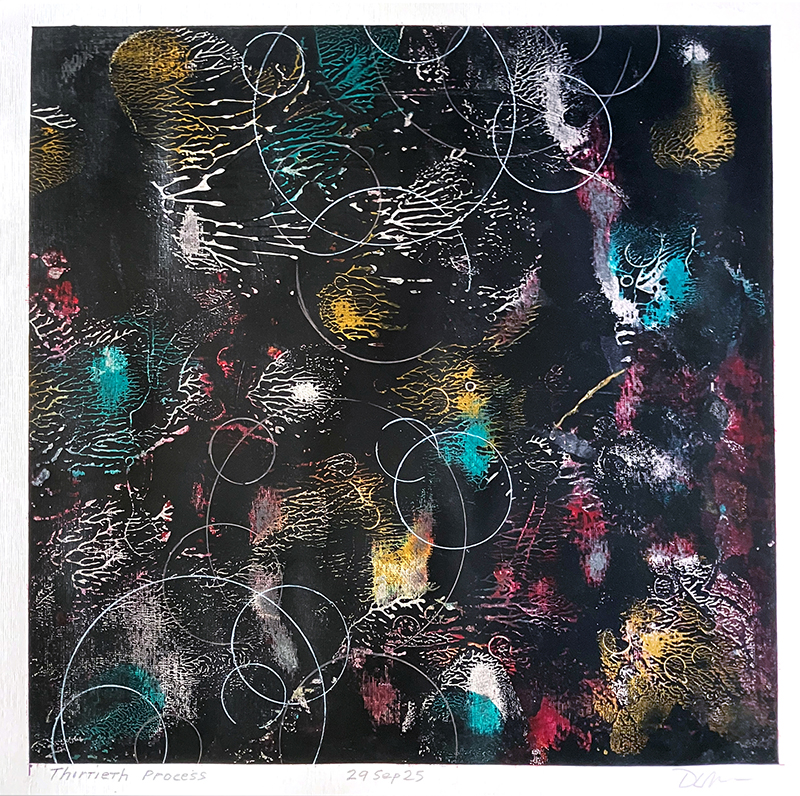
This approach closely echoes the logic of feedback in electronic music, where sound circulates, amplifies itself, and resists full control.
Across both media, Myers works with emergence. The artwork is not planned in advance, it is discovered through action and response.
What matters is not the image or the sound as an object, but the behaviour of the system that produces it. Feedback, in his work, becomes a way of thinking.
A refusal of linear progression.
A method for staying inside complexity without resolving it too quickly.
He had already graced us with that wonderful Session :
https://modular-station.com/modulisme/session/70/
David Lee Myers does not seek clarity or spectacle, he creates conditions.
And within those conditions, sound and image are allowed to find their own form : provisional, fragile, alive.
How would you describe the evolution of your relationship to sound art from your beginnings to today?
I think that in the beginning – decades ago – the idea of “sounds never before heard” played a rather large role in my interest and intentions. Of course for a long time now this description has been rather quaint, as there are no longer any totally unique sounds.
The many varied forms of synthesis, and of course sampling, has seen to this.
So over time my emphasis has become more the realm of composition.
I still focus on unusual and/or non-acoustic sounds, but they no longer are the focus they once were.
What does one do with the sounds?
If you had to define a mission or a deeper intention behind your music, what would it be?
I would hope that my music might pull the listener more firmly into the present moment.
I certainly do not wish to create more dreams and imagination.
It seems that a lot of music intends to take people away into some other space, or incline them towards dance moves.
I am more interested in increased presence.
In your view, what is the difference between creating sound and creating an immersive experience?
They are completely different.
Created sounds may be anything but an “immersive experience.”
When conjuring up sounds, some may foster immersion, so one may then pursue that direction.
How do you reconcile the unforeseen, what happens beyond your control, with your artistic approach?
I would say that the unforeseen and unexpected is my artistic approach.
Of course I don’t begin completely in the dark.
I may have a rough objective in what sort of sounds and patterns I wish for.
But ultimately many random elements appear and I attempt to take them in what I feel to be a desirable direction.
Takes a bit of luck sometimes!
Is there a form or an idea that has particularly obsessed you in your work over the years?
Feedback, of course.
I try to stay away from melodies and other conventional forms, and the chaos of feedback structures goes a long way there.
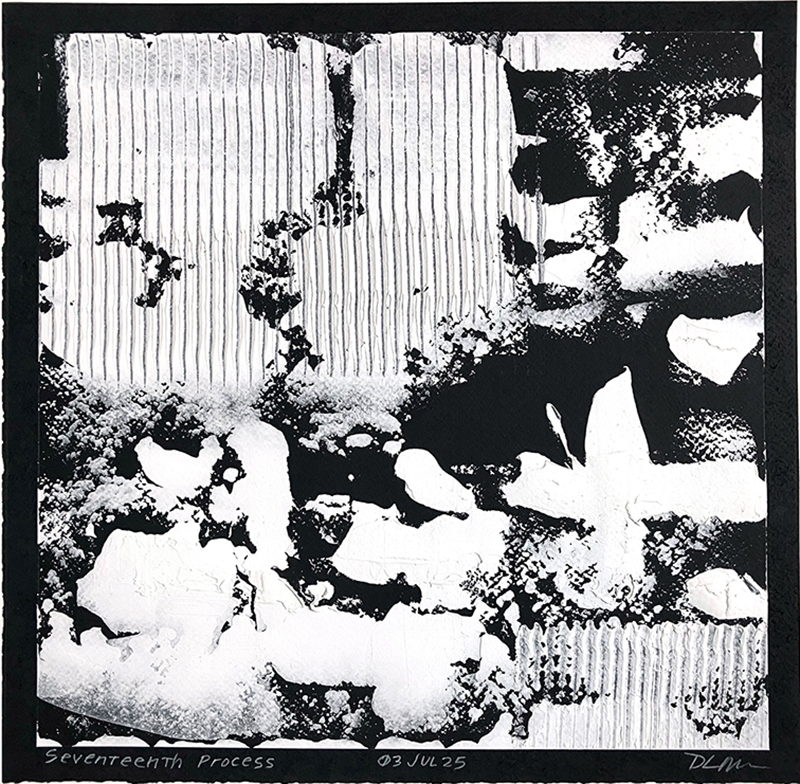
In your work with feedback, do you primarily see it as a physical phenomenon to be controlled, or as an autonomous system to engage in dialogue with?
How does this position influence the way you compose?
Feedback is both of these things, or better to say, they are the same.
The sounds and shapes appear as they will perhaps, and some degree of control is of course necessary, but there is certainly a give-and-take.
I’ve often likened the process to a chess game with an unhinged partner.
Feedback is often perceived as an extreme or uncontrollable effect. How do you build structures or musical forms out of something so unstable without neutralizing its sonic richness?
That can be a major challenge.
Over-controlling the sounds resulting from feedback systems can result in very unfeedback-style sonics, but none the less if the results work in themselves I rarely discard them on that basis.
I sometimes produce tracks that may disappoint some fans because they do not seem enough like feedback.
But to me, if it works, it works.
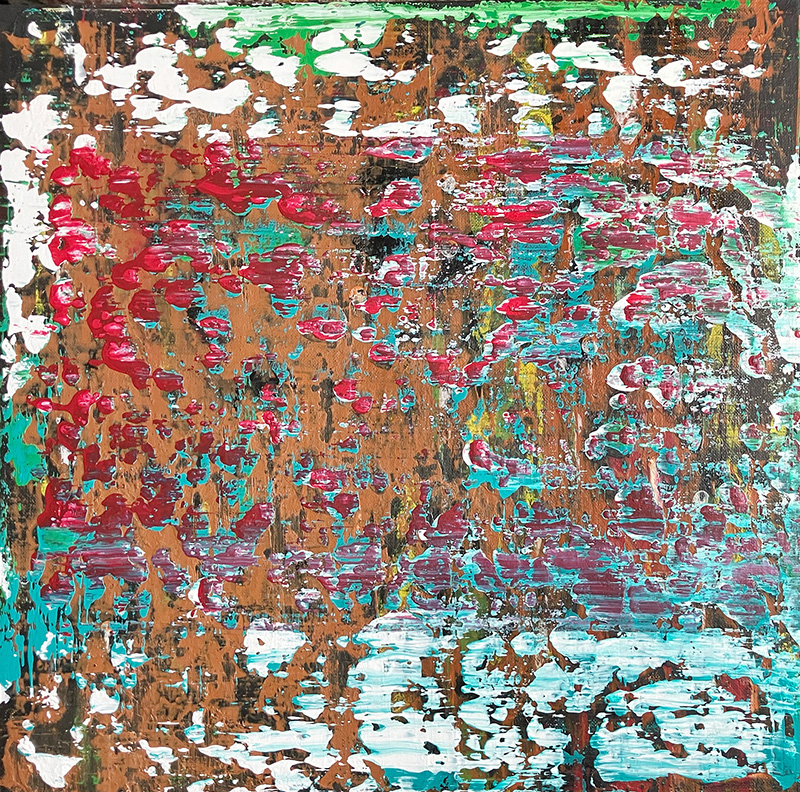
Your use of feedback strongly evokes cybernetics, where systems self regulate and generate their own behavior.
Do you see yourself more as the designer of the system, or as an observer who intervenes occasionally in its evolution?
Again, both of these descriptions apply.
I certainly design the system, but only very rarely am satisfied with the automatic product of the system.
More often than not I intervene quite a lot.
I must say that about half of my recordings are live improvised and half is the result of overdubbing etc.
Cybernetics involves feedback loops between control and instability.
How do you translate this tension into the musical form itself, such as duration, dynamics, and listening, rather than only into sound production?
Above all, listening is key.
My usual approach is “record once, listen back ten times.”
You might not believe how much of what I record gets discarded.
Just producing sounds cannot make music!
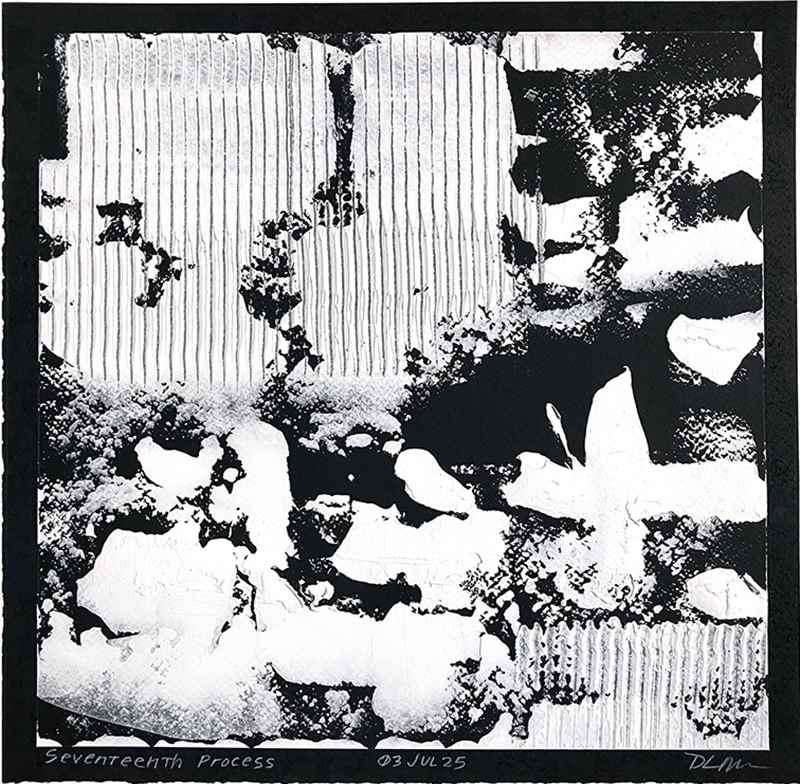
In your work, how do you decide when a piece is finished, especially when working with open processes, feedback, or unstable systems?
When it’s done, it’s done.
Sometimes after one pass I can say “that’s it!”, but more often I have to continue reprocessing and/or layering to arrive at that point. Then too, sometimes it seems as if I’m simply beating a dead horse and I have to let it go….
Can you describe a specific moment when the behavior of the sound or the system forced you to completely change your artistic direction on a piece?
I always begin with some sort of plan or idea of a hardware configuration which will produce a sound I have half imagined, but inevitably my chess partner will throw me an unexpected move.
In fact, it is this quality which has kept me interested in feedback for thirty-seven years.
I would have no hope of continuing without it!
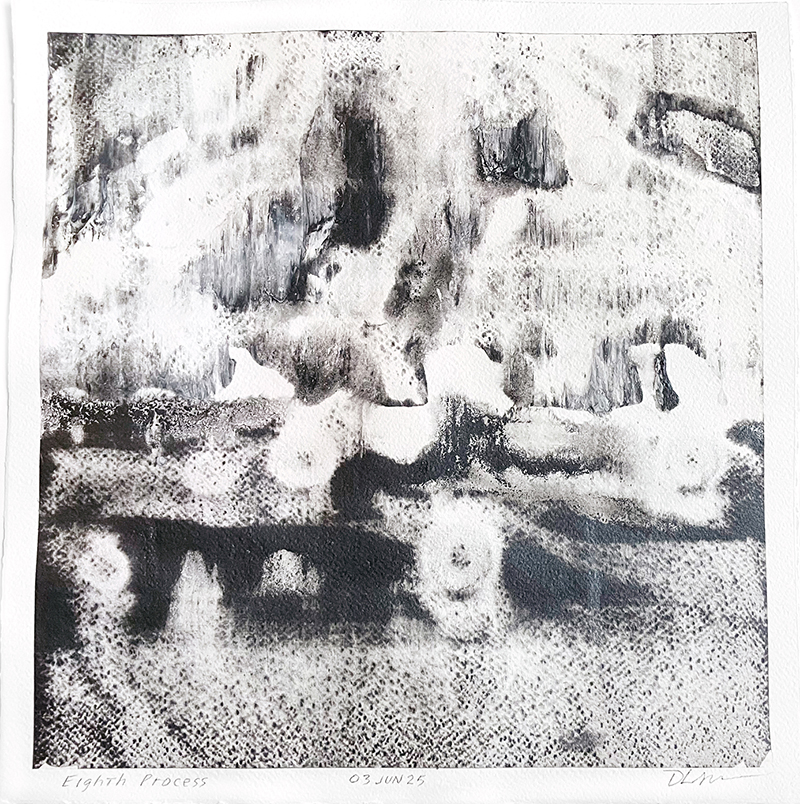
How do you choose the modules or machines you work with?
Is your approach more intuitive, or based on a precise conceptual reflection?
Once more I must say that both these approaches are in play.
I might be looking toward a rhythmic piece or an ethereal wash and obviously there must be some logic as to what modules and configurations are indicated to produce this, but almost invariably intuitive reflexes take over the show.
Can you tell us about a tool or module that you find intimidating, but still enjoy using?
Honestly if a module is too intimidating, before long I will cast it out.
I am not bothered by a piece of hardware which continually surprises me, quite the opposite!
But if I have to consult a manual every time I use something, it’s out of here.
I have low tolerance for menu-diving, and I’ve purged my system of almost any menu dependent items.
Even the popular and powerful Pamela’s Workout proved too irritating for me.
Give me knobs and switches please!
I suppose in a large sense I am an analog person, if only in the interface aspect.
What has been the greatest technical challenge you have encountered in the studio?
There seems to be inexhaustible sources of HUM.
Not so much in my racks or instruments, but down the line in interfaces, etc. Every once in a while it appears and I am forced to spend a day hunting down the origin and killing it.
Argh! I suppose I need an IT guy at such times, but I am it.
If you could design your own ideal module, what essential functions would it include?
That is a very tough question because module designers (there must be a million by now) are constantly coming up with such innovative and unexpected devices.
I can barely keep up with them, let alone dream up my own.
But what has held my attention most since I was a teenager has been time delay. I have owned dozens of such devices and my ideal module would have to incorporate delay in some fashion crossfading multiple delays, introducing some sort of weird modulations in the paths perhaps.
Actually that describes some modules I already have, so it looks like I should leave designing to the designers….
Which disciplines, outside of electronic music, currently inspire you?
I have been listening to a lot of Morton Feldman recently, so I might say late twentieth century acoustic avant garde music.
But outside of music altogether, obviously I’m inspired by abstract painting.
Currently I’m focusing on Jack Whitten and Gerhard Richter.
Some of their works seem to be what I’m hearing in the audio realm.
How do you find new ideas when you feel your creativity is stagnating?
I give it a rest, go on vacation as it were.
Do some reading, watch interviews with artists, physicists, or philosophers.
Something will vibrate eventually.
I think it is a mistake to try and force new perspectives.
One should simply open to anything and everything.
It has never failed me.
In your opinion, what place does experimental music occupy in today’s musical landscape?
I love to quote John Cage :
“I don’t make experimental music, I know what I’m doing.”Hah! Seriously though, I don’t really think it has a place.
This sort of endeavor is quite apart from what most people think of as “music”, and in fact from the beginning I have always called what I do as “Feedback Music” in an almost sarcastic way.
People who make these kinds of audio pieces are so far away from anything mainstream that I can’t put them under the umbrella of “today’s musical landscape.”
That’s not to say that I consider myself anything special.
We’re just something apart.
How do you react when someone tells you they interpreted your music in a way that is radically different from your own intention?
Quite honestly I don’t think this has ever literally happened to me.
But there was a time in the 1990s when I perceived my audience as being largely young men whose main interest was banging their heads into walls to the accompaniment of harsh sounds.
This led to me withdrawing for several years.
Is there a role you hope your audience plays when listening to your music?
Again, I would hope that my sounds might encourage listeners to enter the present moment.
Of course there will always be those who will say “that sounds like a soundtrack from a sci-fi movie”, but such unintelligent people I do not consider my audience.
If you had to present your work to someone who has never listened to experimental music, what would you say to convince them to listen?
Don’t think of it as music, just attempt to be patient and take it in as you might listen to the ocean, or a train passing.
How do you imagine your work ten years from now?
I don’t, because I will be dead.
If you were to embark on a project completely different from what you have done so far, what form would it take?
I can imagine a project using only voice, of course put through much processing and layering.
Unfortunately NYC is so noisy that I experience difficulty getting clean microphone recordings.
Most of what I do is purely electronic, so no problem.
What drives you to keep producing new work after all these years?
Yes, forty-five years or so.
I would say that I itch to hear something I have not heard before, produced by others or even myself.
If it’s not there, I have no choice but to try and make it myself!
https://www.pulsewidth.com/about.html