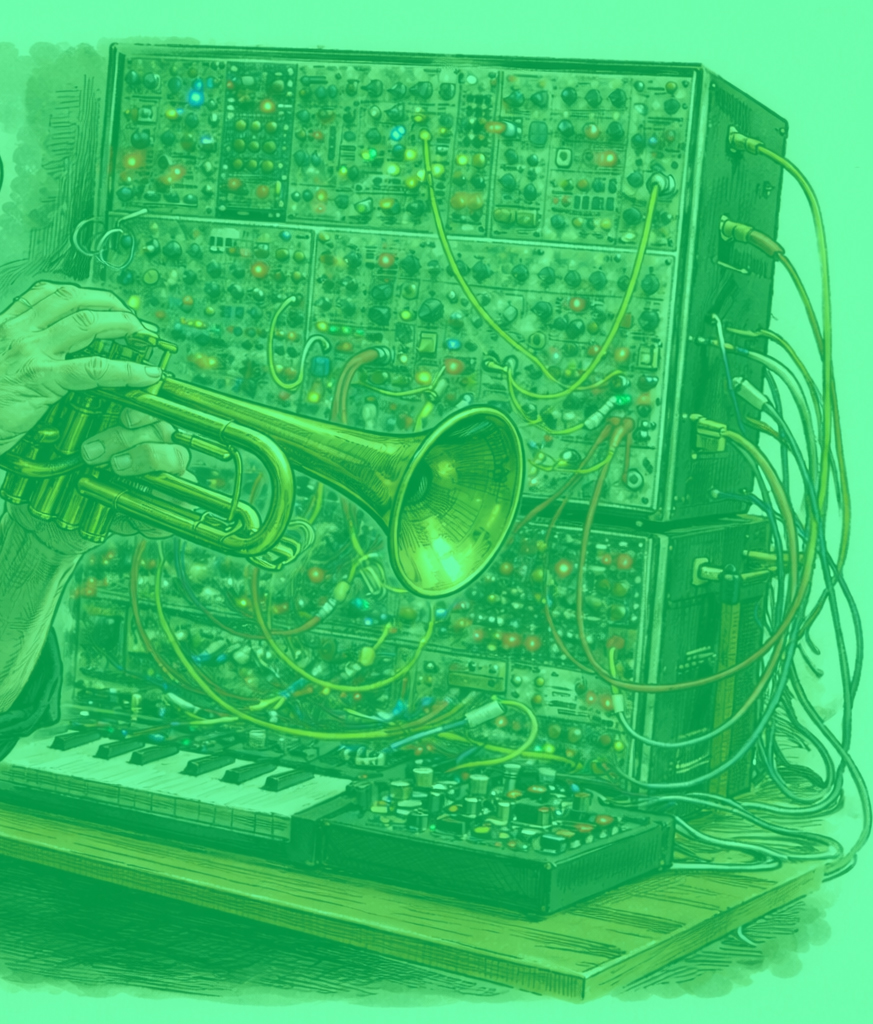
Conception - Layout : P. Petit / Cover Art : Proefrock
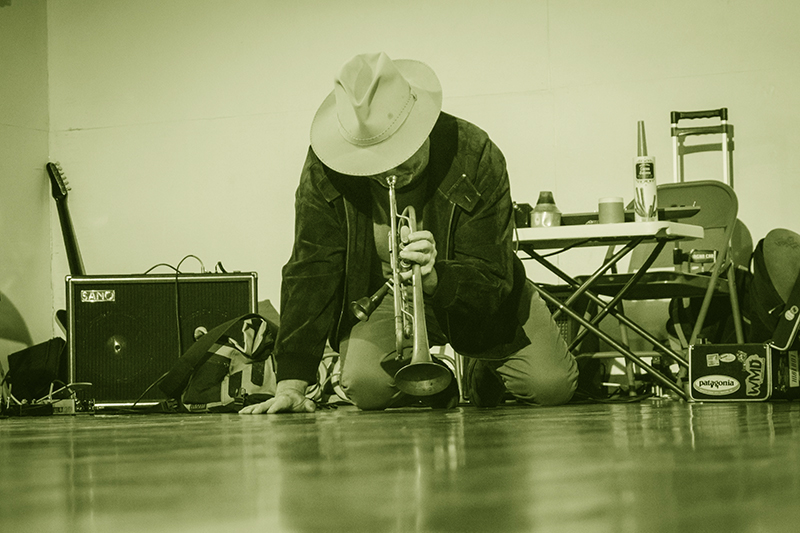
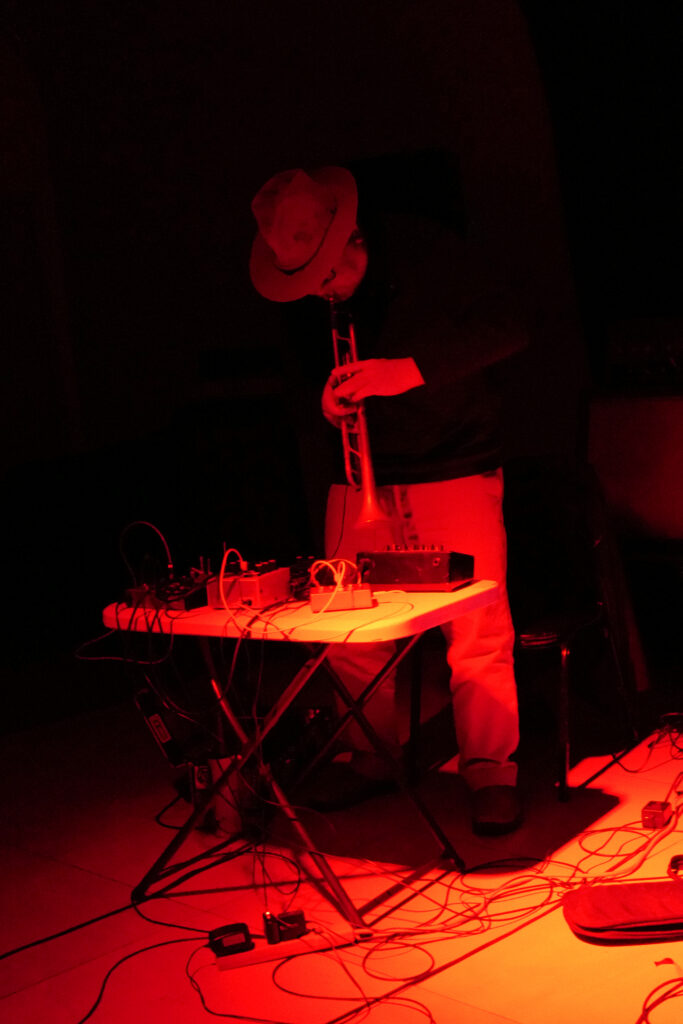
photo by Lenny Gonzalez, Oakland 2018
On this astonishing new album, Tom Djll transforms the trumpet into a volatile electronic organism, feeding breath, brass, and feedback through modular synths, spectral processors, unstable filters, and semi-sentient machines.
Rooted equally in AACM freedom, harsh electronics, and electroacoustic improvisation, these pieces move between ecstatic jazz invocation and collapsing circuitry, where melodies dissolve into swarms of metallic resonance, ghost frequencies, and fractured pulses.
Nothing here feels programmed or controlled: the music mutates in real time, listening to itself, destabilizing itself, constantly threatening to break apart.
At once deeply physical and radically synthetic, the album sounds like Louis Armstrong dreaming inside a failing cybernetic laboratory.
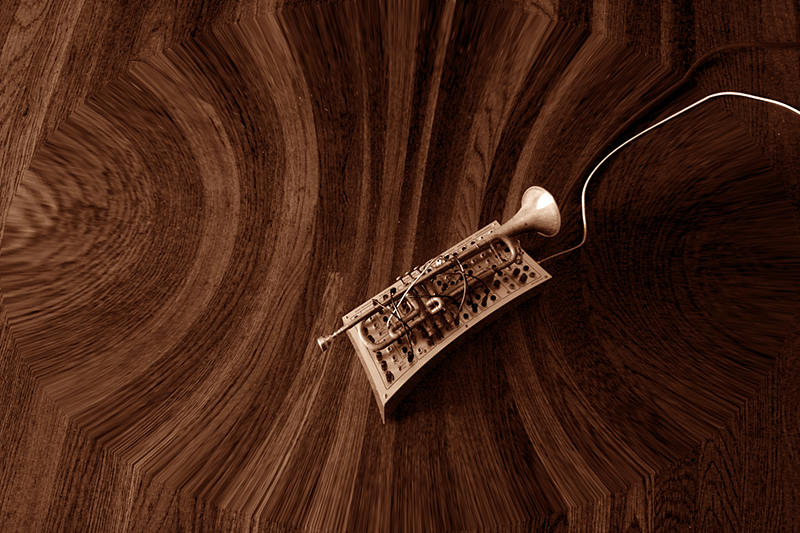
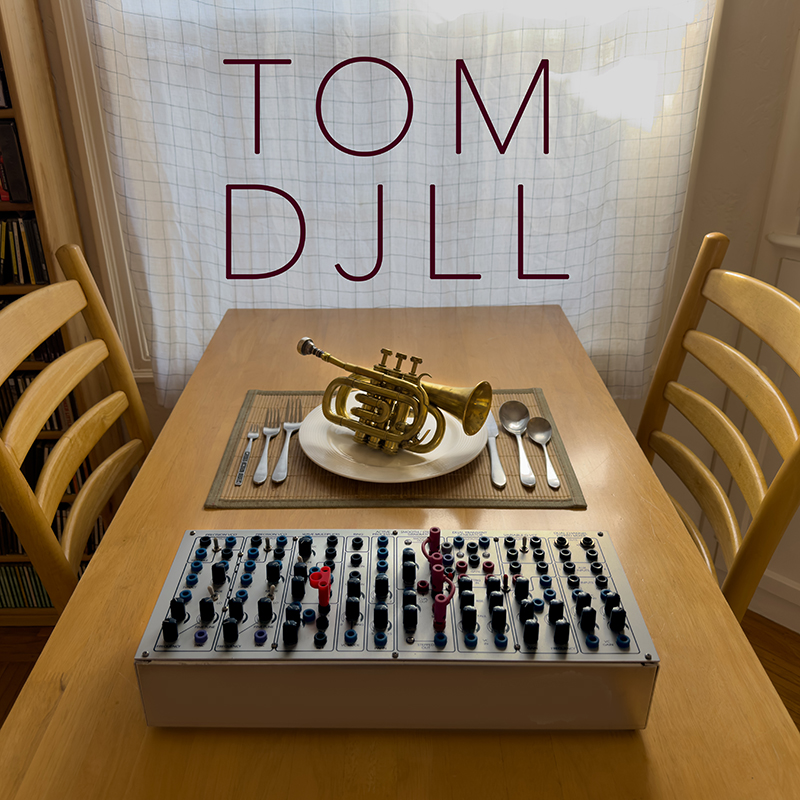
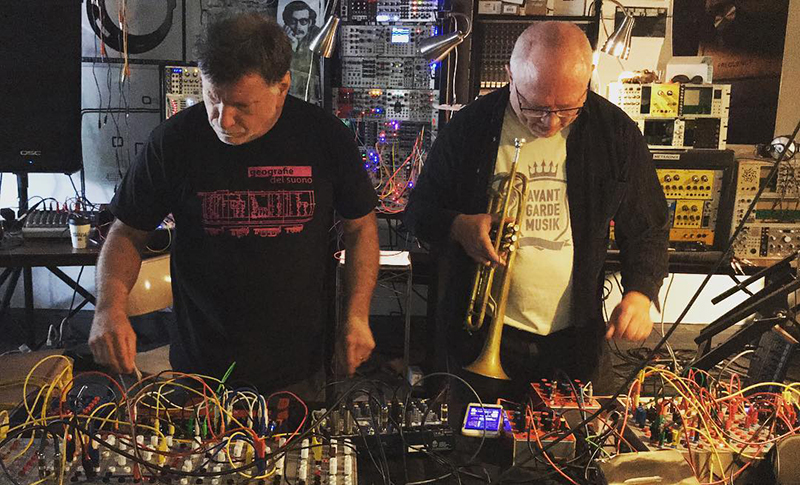
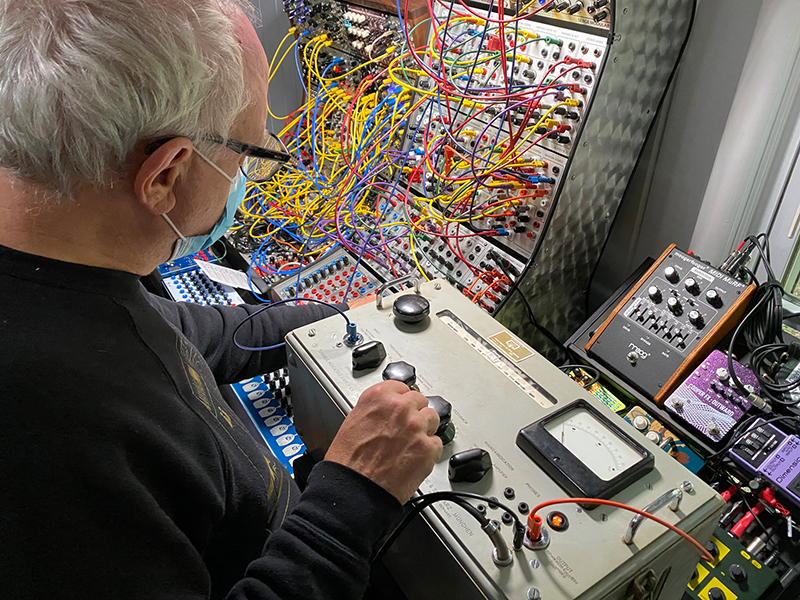
Trumpet in Serge bondage. Photo by Tom Djll
These tracks do not advance a thesis or submit to a single compositional logic. I prefer records that move through changing scenes, moods, and tactics rather than enforcing an overarching concept.
The one constant is the trumpet, present in every piece.
This music is dedicated to the people of Minneapolis, Minnesota.
NO KINGS. NO SECRET POLICE. NO BILLIONAIRES.
I began playing trumpet and electronic instruments at roughly the same time, around age twenty, and I have long thought of the horn as a kind of acoustic synthesizer: a resonant metal tube amplifying breath, pressure, noise, vibration.
Across this collection, the trumpet appears in multiple states : direct, granulated, filtered, reverberant, spectralized, dissolved into unstable electronic textures, or barely recognizable as brass at all.
Voice-irrigator – photo by djll, 2013
The spirit of this record owes much to the AACM musicians I encountered while studying at Creative Music Studio in the late 1970s: Roscoe Mitchell, Anthony Braxton, Wadada Leo Smith, George Lewis, Lester Bowie, Olu Dara, Richard Teitelbaum. Their influence is not quoted so much as submerged into the circuitry and breath of the music itself.
DEDICATION buries fragments of Roscoe Mitchell’s “Odwalla” beneath layers of granulated trumpet, spectral processing, and unstable electronic interference. The piece moves like memory breaking apart while attempting to preserve itself.
TRUTH IS HARSHING IN channels some distant ecstatic spirit of Albert Ayler. Here the trumpet is pushed into violent feedback systems, collapsing registers, dragging the music downward into enormous bass frequencies and insect-like swarms of sound. Ecstasy appears briefly, then implodes under its own weight.
TIPS & TIDS salutes Duke Ellington and Rex Stewart’s early experiments with extended brass techniques. Old jazz vocabularies are stretched through resynthesis and unstable signal-following systems until gesture itself begins to mutate.
TOMBO 2025 returns to my first released work, TOMBO (1991), revisiting the collision between trumpet and harsh electronics. Distortion, filtering, nonlinear circuitry, and unstable control voltages continuously threaten to tear the music apart from within.
In CATS ’N’ CASTANETS, nervous electronic chatter overtakes the foreground while the trumpet recedes into atmosphere, briefly abandoning its traditional role as lead voice.
BUDDY BOLDEN’S BLOOPS imagines a New Orleans second-line band stumbling through psychedelic collapse: drunken pulses, birdlike whistles, damaged fanfares, warped processionals.
JOYNT OF USHER drifts forward on semi-chaotic sequencing and long resonant trumpet tones extracted from earlier sessions, as though the music were recomposing itself from fragments of memory.
LEARNING AS WE GO takes improvisation literally: adapting in real time, following emergent information rather than fixed plans. Trumpet sounds dissolve into resynthesized reflections, interrupted by sudden electronic intrusions and synthetic debris.
VCS-FM emerged partly by accident. The trumpet began frequency-modulating the EMS VCS-3 filter itself, producing unstable non-harmonic tones whose intensity depended directly on breath pressure and volume ; lung-powered control voltage.
Around this, the synthesizer generates a loose accompaniment, hovering somewhere between ritual, malfunction, and exhausted ceremony.
I placed this track at the end because, to me, it sounds like a lonely march into oblivion.
– Tom Djll, Bay Areea, California, January 2026
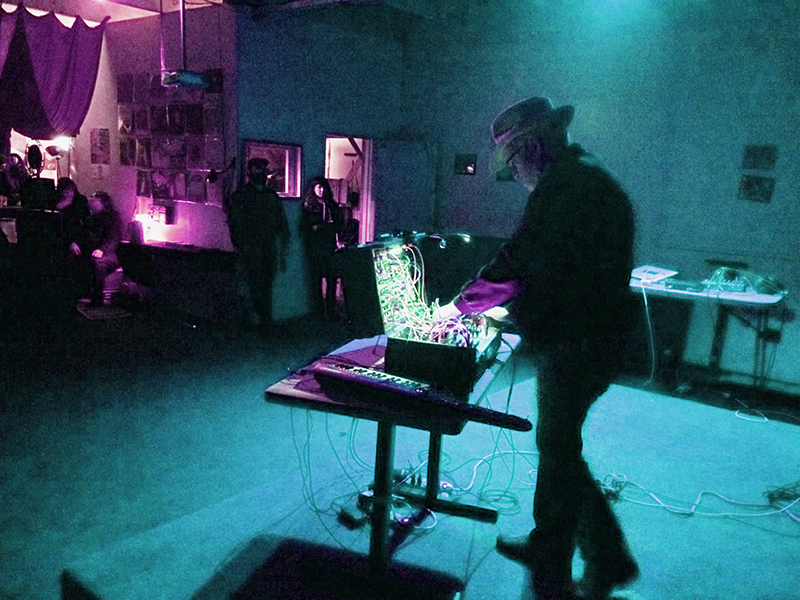
Djll at CNMAT – 2024
You started as a trumpet player within free improvisation.
What did the trumpet teach you about listening, breath, and time that still shapes your work today?
It’s a timely question, because in 2023 I was speaking with Axel Dörner and we discovered that we were both inspired to pick up the trumpet by the same Miles Davis performance, “Bags’ Groove.” In part because of the incredibly delicate, I would say intimate articulations he gives to each and every note, almost as if your lover is whispering in your ear.
I was mostly self taught on the horn, but I could zero in on details like that, and realized, when you play a wind instrument, your entire body is called upon to make every microsecond of the sound you create — to prepare for it, to start it up, to shape it, give it dynamics and timbre, and then to bring it to a close.
Every microsecond is your responsibility.
And you need your entire body to be involved to be successful at this. All this is BEFORE you even attempt to fit what you’re playing into what’s happening in the moment.
Electronic music largely skirts these physical constraints (but of course adds others). The study and practice of electronic music has made me realize (somewhat late in life, I admit), that music is all about TIME.
Before electronics entered your practice, what kind of relationship did you have with silence, space, and collective playing?
I didn’t concern myself with silence when I was young. Seems fairly typical of young men, who are more often excited by noise, speed, and violence. From a very early age, however, I was deeply engaged with sonic phenomena as well as music. I was adept at mimicry and performing, and when I got access to a piano I immediately started picking out tunes. I would say my talents were modest to begin with, but I kept working on them and have gotten to a place where I can match pitches and even complex chords.
This is technique, and nothing more.
The real heart of music is, for me, in the social interactions — also a lifetime study.
It took me about four years, after studying at CMS, to really figure out that silence is the fundamental frame in which music is situated, where the ecosystem of sound flourishes.
Silence makes sound possible.
I learned this through hard lessons, playing with some taskmasters, friends and mentors, great teachers like Roscoe Mitchell, Richard Teitelbaum, Pauline Oliveros, and my friend Ross Rabin. They wouldn’t let me get away with my bullshit and hyperactivity. I was confronted with demands for micro-listening that I hadn’t known before.
When you’re in a group of musicians, it’s a social situation, and you need to be respectful — that’s the precursor for good listening. In a truly trusting, respectful and open group engagement, there are no judgements, no mistakes or wrong notes. Everything is welcomed, even disruptions. When I heard ALTERATIONS (David Toop, Steve Beresford, Terry Day, Peter Cusack) their music showed the way to incorporate disruption into a higher standard of improvised music playing.
It was a thrill to finally meet Toop and Beresford in 2017 in London. I even got to play a few times with Toop when he visited California about a year after that. He is a sublime master of economy, of doing a lot with scant instrumental resources: sticks and leaves, a piece of paper… a tube. His gear table looks like the floor of a Neanderthal’s cave, hah!
In 1997 I encountered “lowercase” music for the first time, seeing Bhob Rainey and Greg Kelley in their trio nmperign (they were a trio for half the gig — the percussionist split during the set break). I even played with them, and from about 2000 to 2005 I did some touring with Bhob and Jack Wright. These experiences resulted in some seismic disruptions in my musical growth. At this time I wasn’t using any electronics, instead concentrating on expanding my range of sounds on the horn.
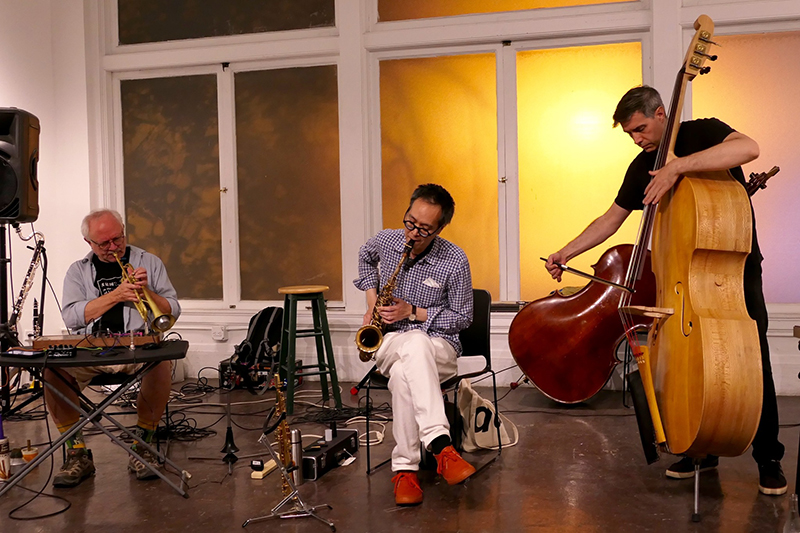
Djll, James Fei, James Ilgenfritz, Luggage Store Gallery, San Francisco, 2023 – photo by Rent Romus
The Creative Music Studio was an important place for you.
What stayed with you from that environment, not in terms of technique, but in terms of attitude or ethics?
I was 22 years old, naïve and carefree.
When I went to CMS, in a ten-day “New Year’s Intensive” with the Art Ensemble of Chicago, I first had to face just how serious the practice of music was. “As serious as your life,” as Valerie Wilmer’s book has it. I went back in the summer of 1979 for a five-week workshop led by Roscoe, which brought in Anthony Braxton, Wadada Leo Smith, George Lewis, Gerald Oshita, and others. The teachers I met at CMS had been fighting for their artistic lives and freedom with an urgency and seriousness that a person like myself – young, white, male, complacent, comfortable, insulated – found, in turns, confusing, shocking, threatening, challenging, and ultimately inspiring.
That inspiration has lasted through the decades. And ultimately, I had to face the fact that their path was not my path, as defined by what these AACM masters called “The Tradition.” That was their music, and I had to find my own music.
That took many more years. Still, here I am 47 years later, and I still hear the lessons from my time at CMS sustaining and informing my sound.
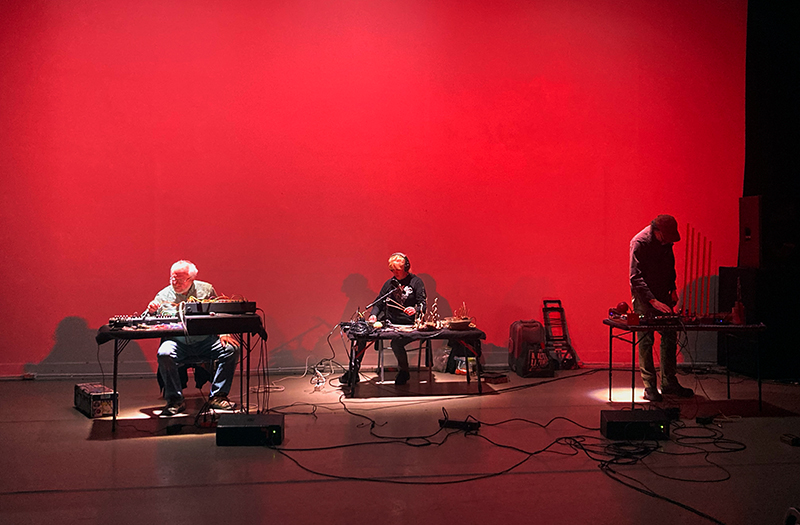
with Suki O’Kane, live at the Makeout Room, San Francisco, 2024
At what moment did electronic sound stop feeling like an external tool and start feeling like a continuation of your musical body?
I had an almost synesthetic relationship with waveforms almost from the very beginning. I could see them in my head, dynamically changing and interacting.
There was a Synthi 100 at my college, and I spent two periods of a few weeks with it, separated by about a year’s time. There’s nothing worth listening to from those sessions, but I did learn some of the basics.
By the time I began assembling my first Serge system some four years later, I was concurrently making waveform drawings and incorporating wave-phase studies in my visual art. The Serge is a superb instrument for making electronic sounds felt in your body. As soon as I could integrate the trumpet and other instruments (I had a Farfisa compact duo, several horns – including a trombone – plus a few gongs in my arsenal) by themselves, or processed through the Serge, I felt I had arrived at some new place that was mine. I began thinking of the trumpet as an “analogue lip synthesizer.”
Do you remember your first encounter with modular synthesis, not the machine itself, but the sensation it produced in you?
I was never interested in “synthesizer music” or groups making it – Tangerine Dream or Hawkwind or Kraftwerk – so I didn’t go to any electronic music concerts. I did see Eric Drew Feldman playing with Captain Beefheart and the Magic Band, in 1980 or 81. Unbelievable show.
He had a Serge system onstage! (I didn’t know then that he was working at the San Francisco Serge factory in lower Haight-Ashbury.)
A more “classical music” oriented electronic act, The McLean Mix, performed at my school in about 1978, an experience I will never forget! They were LOUD — and unhinged. For sure, I wanted to do that!
Before that, my first fully realized listening experience with electronic music wasn’t with modular, but Stockhausen’s KONTAKTE. I still feel that nothing in the field has surpassed it, in terms of timbral and dynamic expression. It’s like sound carved out of magnetic rocks.
Brainwaving: photo by Tom Djll
Your approach to modular systems doesn’t seem oriented toward control or composition, but toward interaction.
Quite correct. Also, I’ve spent a great deal of time pursuing a hybridization of electronics and trumpet. This approach first came to a head in the early 1990s on my first published disk, MUTOOTATOR. I was controlling a digital delay using CVs from the Serge, then sending those sounds back into the Serge for filtering, ring modulating, what have you. It was wild!
Today I have many options toward achieving compelling trumpet-electronic combinations. The elements of my “compositions” are often different combinations of signal pathways and/or instruments. You’ll see that right away in my YouTube channel posts. In 2022 I had the good fortune to get ahold of a made-to-order Synthi VCS-3 II “Cornwall” which takes me back to where I began on the Synthi 100.
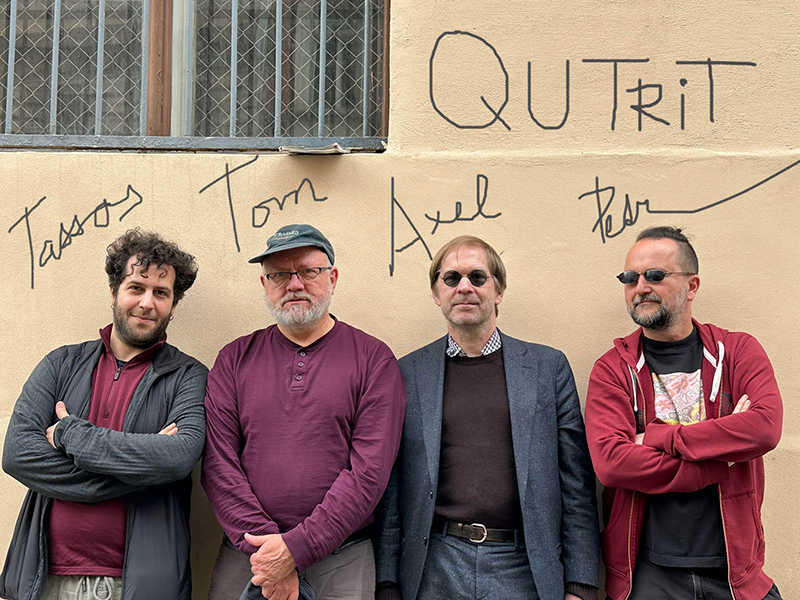
In May 2023 I had the opportunity to tour the Czech Republic with three masters of trumpet+electronics: Axel Dörner, Petr Vrba, and Tassos Tataroglou as the quartet QUTRIT. Petr organized it and we had a fantastic string of gigs. None of us were doing the same kinds of processing, so it’s easy to tell us apart on the recordings (easy for me, anyway). It was obvious to me that this field still had enormous potential for new discoveries in expression.
Kind of a shame that we never did find a label willing to put out that music.
What attracts you in systems that resist mastery?
Surprise.
My friend Tim Perkis says, “Surprise is what makes music worthwhile.”
A lifetime of improvisational music practice has conditioned me to seek surprise in my work. Right now there’s a burst of instrument design, from Germany, USA, China, Japan, UK, from makers of weird little self-contained “surprise boxes” that break all the rules.
There’s also a late-coming recognition today of the tremendous contributions of the late Rob Hordijk, in the field of chaotic circuits. I would place him alongside the transformative engineer/masters Moog, Buchla, Tcherepnin, and Cockerell.
How do you think the trumpet and the modular synthesizer speak to each other in your work?
Is it a dialogue, a translation, or a shared field of vibration?
I would say it’s sometimes a dialogue — it’s hard to get away from the foreground/background dichotomy in this scheme of instrumentation — and sometimes a shared field of vibration.
That’s a good way to put it.
Breath plays a central role in trumpet playing.
Is there an equivalent of breath in your electronic practice?
In terms of the way electronics occupy the body, no, I don’t feel an equivalence. Dance music producer, I’m not. The trumpet gets inside you in an unmistakably visceral way: the air column is vibrating not just inside the instrument, but into your mouth, throat, lungs… The vibrations take in the entire body. I don’t feel that ‘inside-ness’ with electronics. Maybe that’s a drawback, implying a ‘headspace’ preoccupation. I maybe pay attention to details and technical matters too much. I tried very hard with this set of compositions to keep some kind of musicality at the forefront, although my idea of ‘musicality’ is still pretty far out there compared to most people.
with Tim Perkis. 2011, Berkeley CA
Improvisation is often misunderstood as freedom without structure.
For you, what actually holds an improvisation together?
“To plan as one goes” is often given as the classical definition of improvisation. To do improvisation well is relentlessly demanding. One must bring to it a very precise balance of materials and feeling, and most of all, PRESENCE. The first rule of the warrior’s code is: Show Up. Stay on the scene. Good listening grows out of sincere, committed, ongoing presence.
At my age I seem to have gathered more knowledge and technical ability, but having those things doesn’t make the doing of improvisation easier. Since I have experienced so much compared to when I was in my twenties, I can deploy a daunting index of critical standards with which to second-guess my work — which takes one out of the moment; you’re no longer present when you’re in your critical mind. That has to be left out of the equation, until later, when you’re listening back and evaluating. In my twenties I had more blind (stupid) confidence in what I was doing, plus the bright spark of discovery was showing the way. It’s no longer possible for me to access that spirit, but there are still happy accidents.
What holds it together? That’s easier to answer when analyzing a group performance. One can feel a group coalescing, and quite often, in the best circumstances, the audience is contributing to this coalescence. That’s a real thrill to experience — it’s just the best. For a solo improvisation, I guess it’s more of a journey. Along the way, you meet different versions of yourself, and strike up a conversation… This is getting into rhetorical territory that I find difficult to believe in, honestly. “The reason we keep doing more music is because we can’t say anything meaningful about the music we have already played!” I have heard this, or variations of it, said more than once.
The music in this collection is composed from largely improvised tracks. Having said that, I feel that upon reaching a plateau of complexity, a patch becomes a program — thus, it follows that a program might become the entire composition. One which is realized by the player manipulating the parameters of the patch/program.
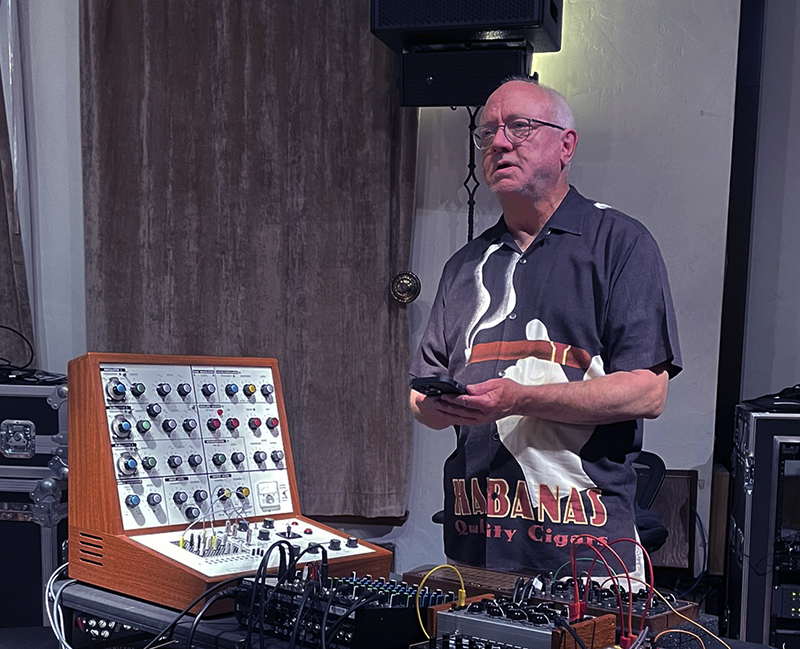
Gino Robair, Djll at Robotspeak Synth Shop, San Francisco, 2018, photo by Amanda Chaudary
You often work in contexts where listening is more important than visibility.
How do you see the relationship between sound, presence, and disappearance?
Listening is where music starts. Moreover, music is composed by the listener, in their mind. I do sound art, but I don’t ever think about “making music” while I’m doing it. My presence is embodied in listening, which tells me what to do. I play regularly in the Oakland Reductionist Orchestra, where sounds can rise out of nothing and disappear in the most beautiful way. It’s a listening-based group, usually around 12-15 players. I stick to the horn for that. Much of the playing uses extended techniques, so it all sounds “electronic” at any given moment. The result is, among other things, a living sonic environment where one’s identity disappears — like being a frog in a pond, surrounded by hundreds of other night creatures, all sounding en masse.
Focusing attention on disappearing sound can take the listener into a state of transcendence. Time becomes suspended; it no longer seems to flow. Artists like Eliane Radigue and Morton Feldman have led the way in this research. In the improvised sphere, Thomas Lehn is exemplary for so many reasons, not least his ability to conjure extraordinarily detailed and extended spaces of presence and disappearance.
I can’t say enough good things about Lehn.
Chris Cooper, Tom Djll at Peacock Lounge, San Francisco 2023
Do you feel that electronic instruments have changed the way we improvise together, or only the surfaces of sound?
Without a doubt, electronics have changed the way ensemble play happens.
There are instruments which tend to remove the player from immediacy, from reacting instantly. That’s a problem. I try to avoid such instruments for live improvisation. As we talked about earlier, many of the devices I use now are mysterious and/or unpredictable, they add an element of surprise and even danger to the action.
Sometimes an unintended action can move the music into an exciting new direction.
I’m invested in a new project with a young trumpet player who doesn’t use electronics, Ari Brown. He’s got a fine technical background, and he’s into having electronics process his playing. I am thereby relieved of having my attention split between the horn and the electronics. The resulting duo interplay is unlike any other situation I’ve encountered in musical improvisation. And it’s great fun. I hope to release some of this music in 2026.
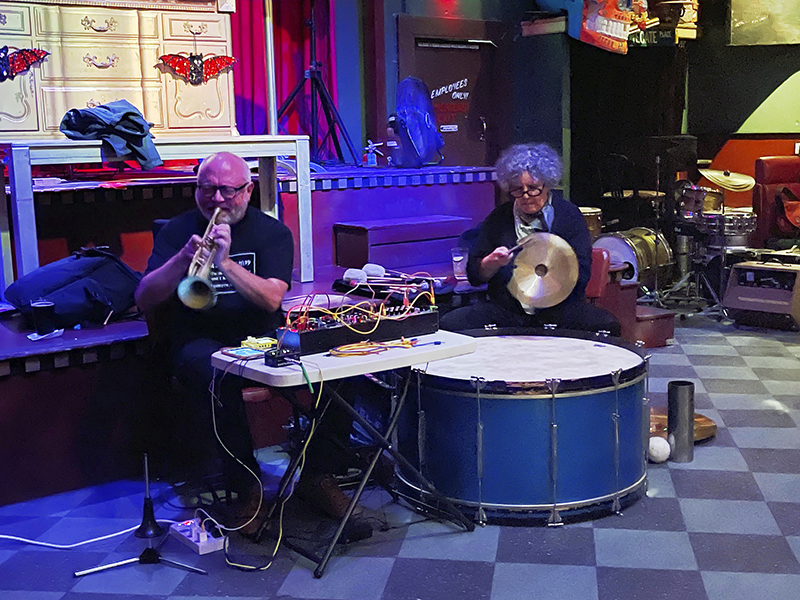
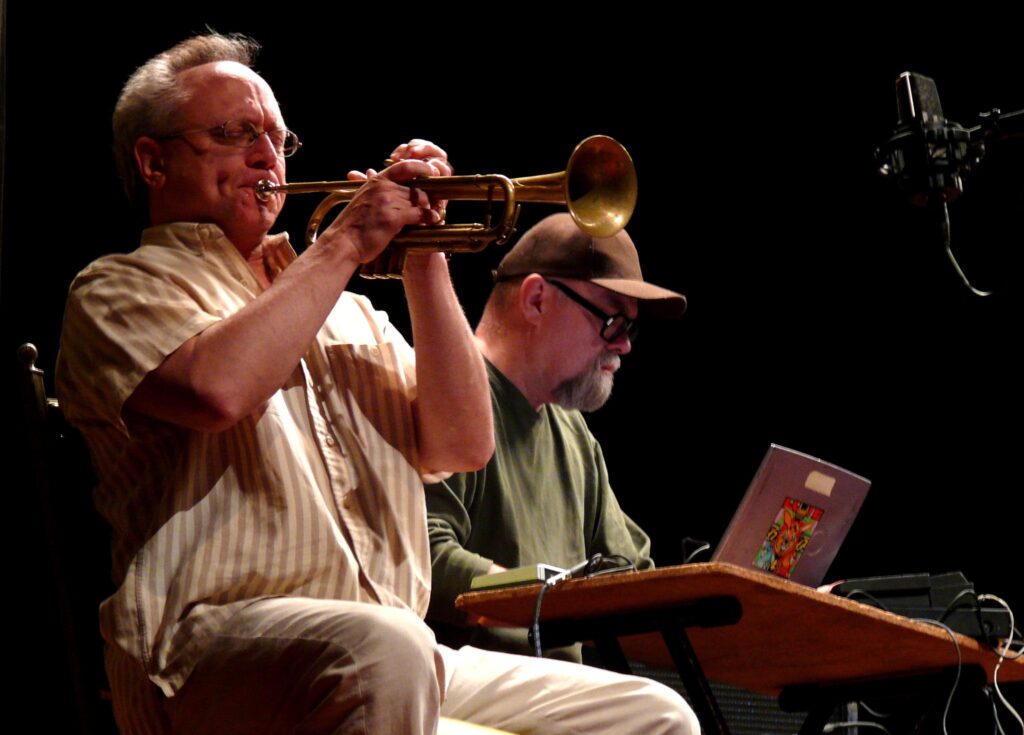
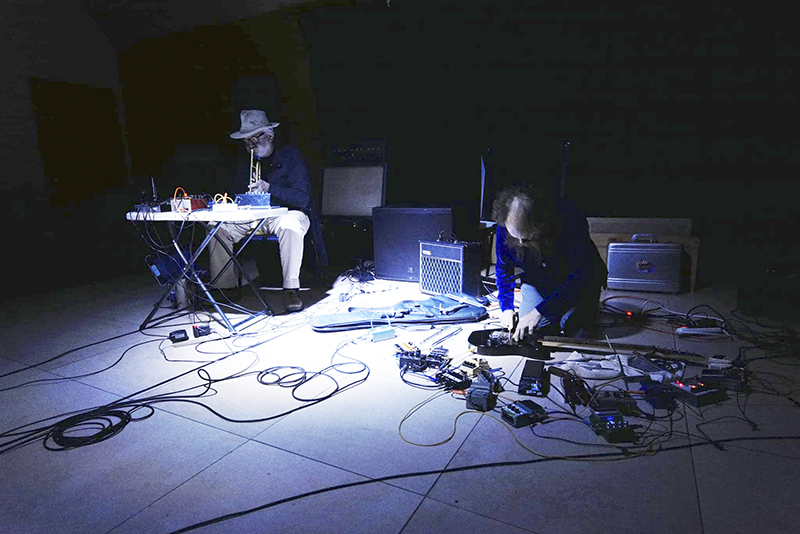
Djll, Cheryl Leonard, Bryan Day, Oakland, 2025
When you play today, what moves first: the memory of the instrument, the situation, or the sound itself?
Very often, it’s the unending need to find something new.
Discovery.
Implied within that directive is the urge to not repeat myself (realistically, that’s unavoidable). Honestly, that can be another problem, in that I don’t always develop things that could use more refining.
What influences – musical or not – continue to feed your work quietly, without being immediately audible?
Although I don’t believe in the efficacy of “political art,” the situation in the US currently brings a level of background noise in the social sphere that cannot be shut out.
We can’t plug our ears to it. Since the performing of music is also a social practice, we can’t be inattentive to these outside influences, because of course they’re not really “outside.” Just being compassionate (listening) and respectful (playing with others) are today oppositional political stances.
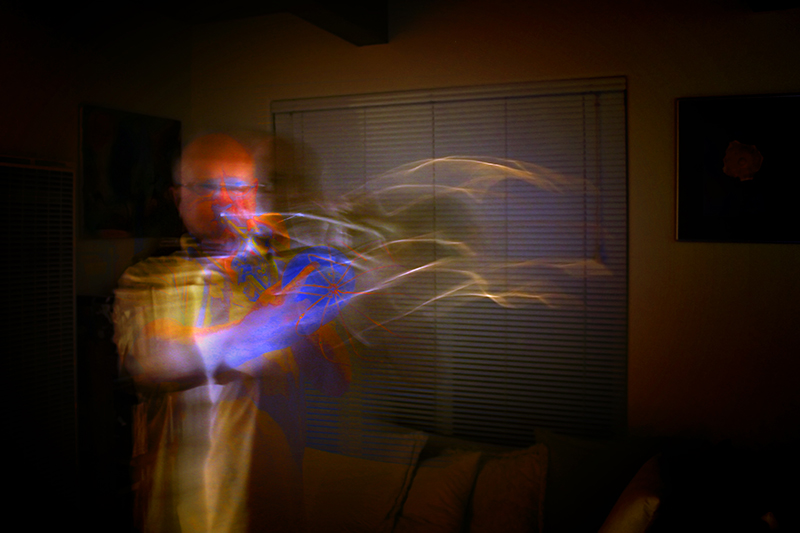
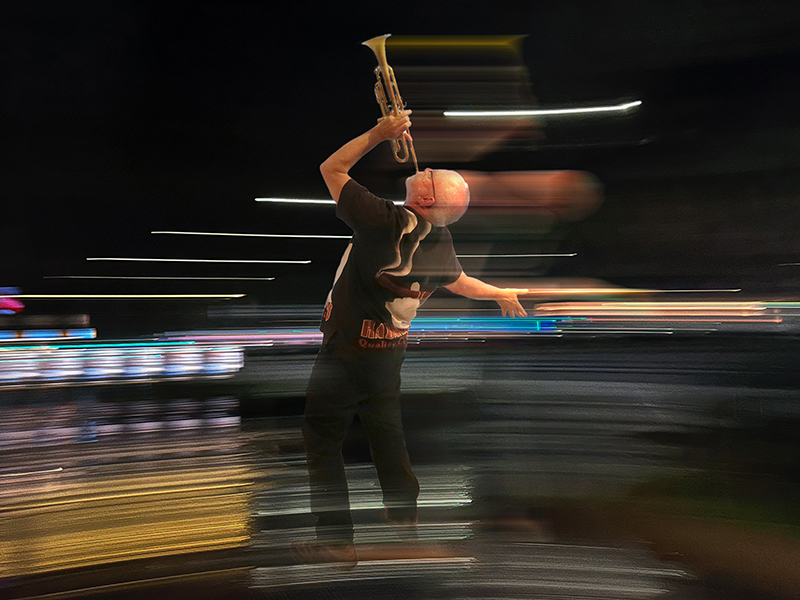
heavenly blowblur – photo by TD
Is there something the trumpet still knows that electronics cannot replace?
I’m sure of it.
But it won’t just come out and tell us.
It must be given the right kind of massaging.
If you had to describe your practice not as music, but as a form of attention, what would it be attentive to?
That’s a great question.
The answer is: TIME.
Djll solo at Life Changing Ministries, West Oakland, 2015
Tom Djll moves through improvised music, electronic experimentation, and electroacoustic composition with the restless curiosity of a sonic explorer dismantling systems in real time.
He first studied electronic music with Stephen Scott at Colorado College, working on the legendary EMS Synthi 100.
In 1978–79 he attended the Creative Music Studio in Woodstock, studying with major AACM figures including Roscoe Mitchell, Anthony Braxton, Wadada Leo Smith, George Lewis, and Karl Berger.
Throughout the 1980s and early 1990s, Djll immersed himself in the unstable circuitry of the Serge Modular Music System. During this same period he also worked with Pauline Oliveros and her Deep Listening practice, an influence that continues to resonate beneath even his most abrasive sonic environments.
Djll has increasingly returned to analog electronics, modular synthesis, and unstable electroacoustic interfaces, building dense environments where trumpet, circuitry, feedback, and noise mutate into volatile hybrid forms.
Inspired in part by the late instrument designer Rob Hordijk, his recent work explores chaotic sonic ecosystems balancing improvisation, machine behavior, and acoustic resonance.
His collaborators include Gino Robair, Tim Perkis, Suki O’Kane, Karl Evangelista, Rova Saxophone Quartet, Axel Dörner, and the trio EUPHOTIC with Cheryl Leonard and Bryan Day.
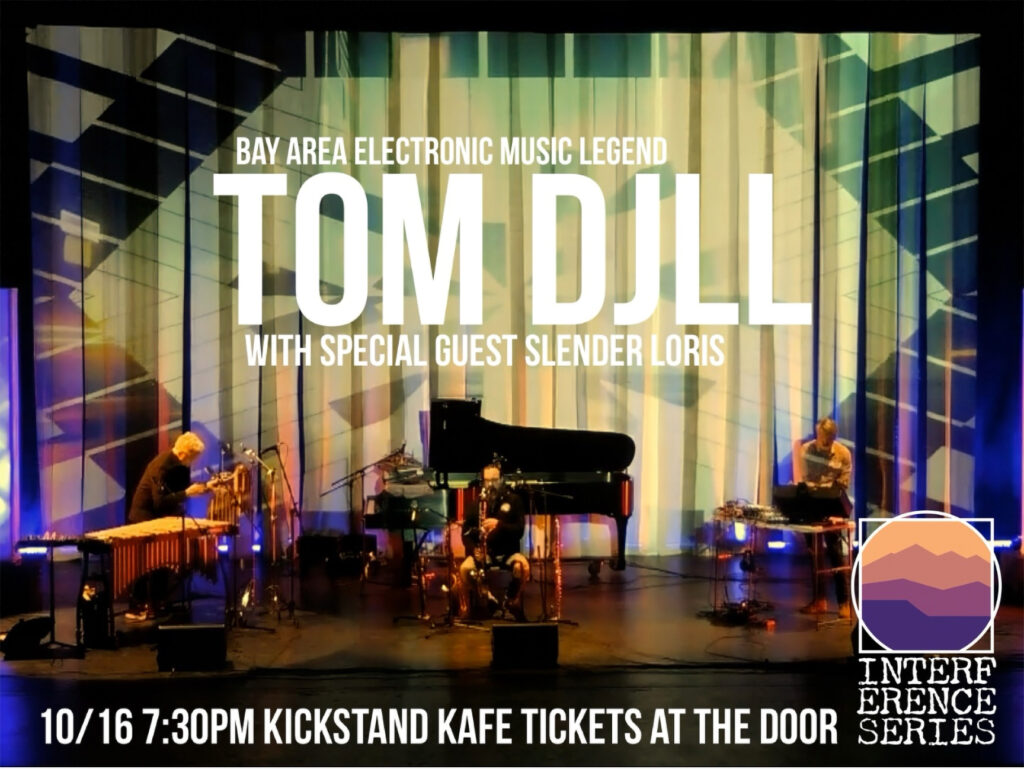
flyer for performance, Flagstaff, Arizona, October 2024
Instruments used on these recordings:
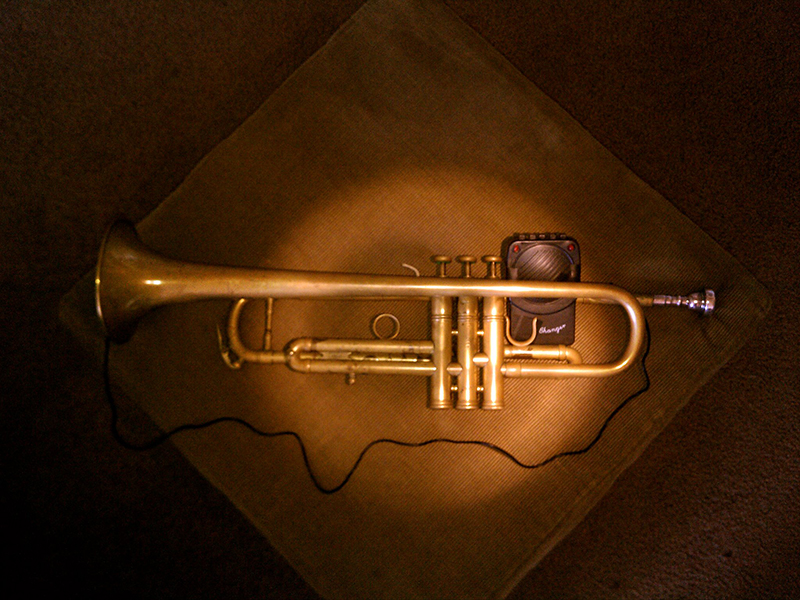
Benge 3x Bb Trumpet (Burbank), Serge Modular Music System, EMS VCS-3 II “Cornwall”, Original Rob Hordijk Blippoo Box, Macumbista Benjolin, After Later Audio Benjolin V2, Meng Qi Wing Pinger, Lorre-Mill Double Knot V3, Tilde Instruments Röntgen, MadKidsEmpire SEOFON, Metasonix Crapulescent, Kesako Player & Reverb, Clee Radio Cage, Landscape NOON, BugBrand Crossover Filter and PT Delay, Rossum Panharmonium, Make Noise: Spectraphon, Morphagene, Bruxha, Erbe-Verb, Mimeophon, XPO, QPAS; Instruo Arbhar, Torso S-4, Geiskes DEP2a, Bastl SoftPOP, the GrainProc iPhone app, and Nick Collins’ CONCAT sampler/concatenator (operating on an iPhone 6).