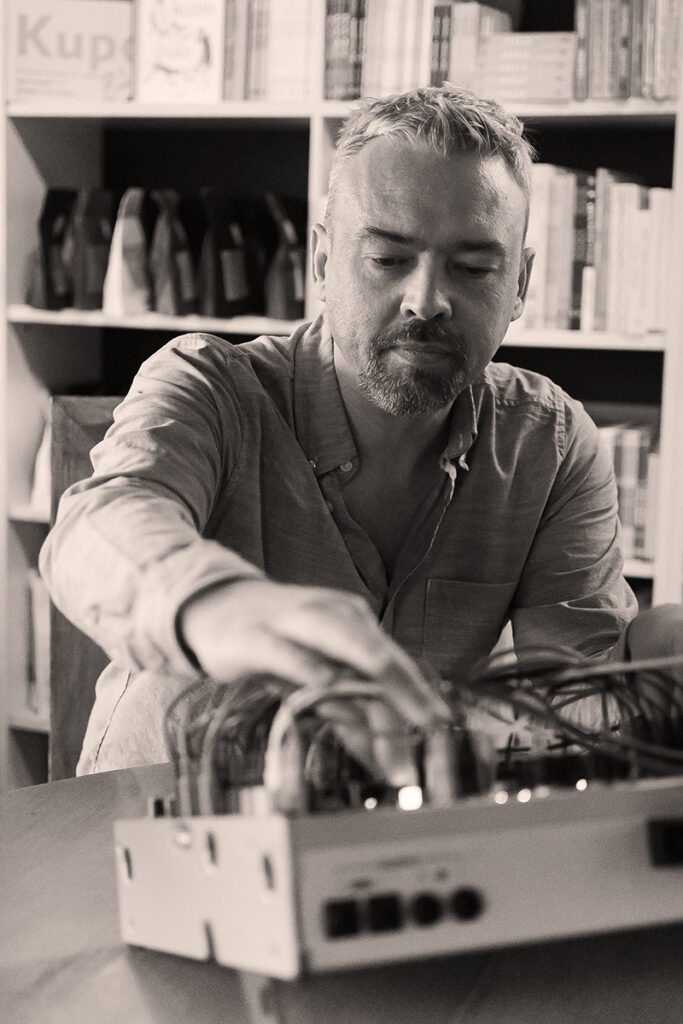
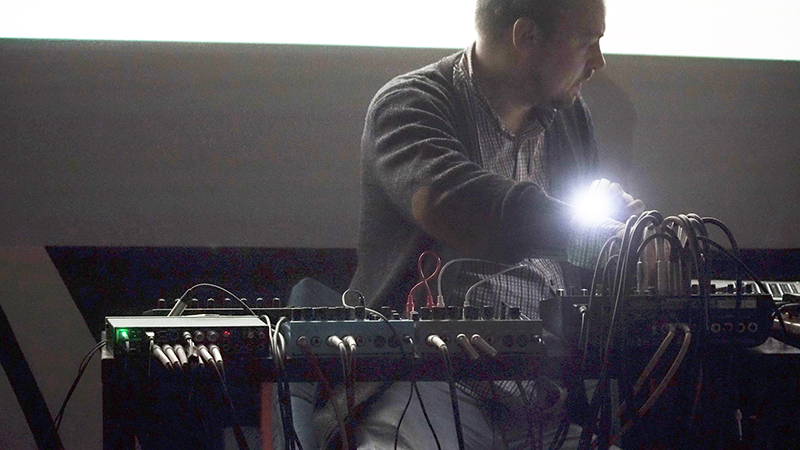
Working under the alias Innovative Landscapes Laboratory, Ukrainian composer and sound artist Taras Opanasiuk has developed a body of work that sits at the intersection of electroacoustic composition, experimental electronics, and sonic research. As both an artist and the founder of the Sublime Retreat label, he has established a practice rooted in exploration, transformation, and attentive listening.
Opanasiuk approaches sound not as atmosphere but as material: something to be shaped, destabilized, and continuously reconfigured. His compositions unfold as evolving environments where field recordings, modular synthesis, acoustic sources, and electronic processes interact within fluid and often unpredictable structures.
This approach places his work within a lineage that extends from musique concrète to the experimental traditions of European electronic music and sonological research. Rather than relying on narrative development or fixed compositional frameworks, Opanasiuk is drawn to processes, emergent behaviours, and the subtle transformations that occur when sonic materials are allowed to interact over time. In this respect, his work often feels closer to the exploratory spirit of figures such as Gottfried Michael Koenig than to more conventional notions of ambient composition.
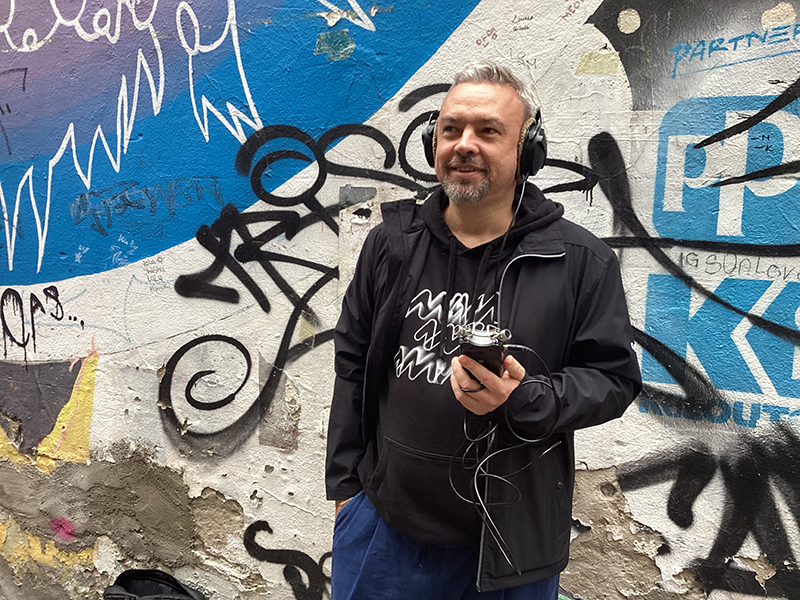
Field recordings play a significant role in his practice, though rarely in a documentary sense. Environmental sounds are fragmented, transformed, and woven into larger electroacoustic structures where the boundary between recognisable source and abstract form remains deliberately unstable. Modular systems occupy a similarly important position, functioning less as instruments than as dynamic environments capable of generating unexpected relationships and behaviours.
The result is a music of movement and emergence, one that privileges process over statement and transformation over resolution.
Through Innovative Landscapes Laboratory, Opanasiuk continues to explore sound as a living, evolving field.
An ever-shifting space where matter, memory, and perception remain in constant negotiation.
What have you been working on lately, and do you have any upcoming releases or performances?
I currently have several projects in progress. Some are already finished, others are still developing, while a few exist only as vague ideas for future works.
Among them are an album based on samples by William A. Davidson, a split release with Moan, and a collaboration with clarinetist Monika Bugajny.
I am also working on a new live set in which I am experimenting with different ways of building multi-layered soundscapes, with potential live performances later this year.
What do you usually start with when composing?
It varies from piece to piece. When I have a concept for a record, I usually begin by researching sounds, patches, and tools that might fit the idea, and then I start experimenting and creating initial drafts. Quite often, during this process, a new idea emerges that no longer fits the original concept. In such cases, I put it aside and return to it later—and sometimes it becomes the foundation for an entirely separate project.
I also often revisit recordings of my modular improvisations and discover fragments that inspire me further.
In fact, this is how “Spontaneous Dimensions” was born.
In general, I’ve found that the best ideas tend to appear unexpectedly—when I stop chasing a particular sound or forcing constraints, quiet my mind, and become more attentive, listening carefully to what I am playing or to the recorded material itself.
How do you see the relationship between sound and composition?
As I am deeply influenced by the avant-garde and electroacoustic legacy of the twentieth century, I can answer with a quote by Edgard Varèse, who described music as “organized sound.”
For me, sound or the sound object is the fundamental building block of a composition.
Timbre, pitch content, spatial positioning, and the transformation of all these parameters become the driving forces behind both the structure and the development of a piece.
How strictly do you separate improvising and composing?
These are quite different practices for me, although they constantly interact with and influence one another.
As I mentioned before, a recorded improvisation session can often become the seed for a new composition. Likewise, a particular composition may provide the initial sonic material from which I begin improvising.
In an ideal improvisational state I try not to think in terms of structure, but instead follow instinct and allow the sounds to unfold naturally.
During the compositional process, I tend to focus on developing a narrative, defining sections, structures, layering, and editing. At the same time, it can be very valuable to break through creative blocks by introducing something unexpected: placing unrelated sounds into the context to shift its perspective and reframe the material. In that sense, composition can also become a kind of controlled improvisation, where intuition is allowed to intervene within a structured framework.
Do you find that you record straight with no overdubbing, or do you end up multi-tracking and editing tracks in post-production?
It depends, but quite often I record several takes while exploring a patch, or I do one longer session to generate source material.
In post-production, I then work extensively with the recorded sounds: editing, rearranging, and reshaping them until the composition begins to take form.
At that stage, I may return to the modular system to record new material, or extract sounds from the piece itself and load them into samplers, manipulating them further to generate additional layers and ideas.
What type of instrument do you prefer to play?
Do you tend to use pure modular systems, or do you bring in outside effect and devices when playing or recording?
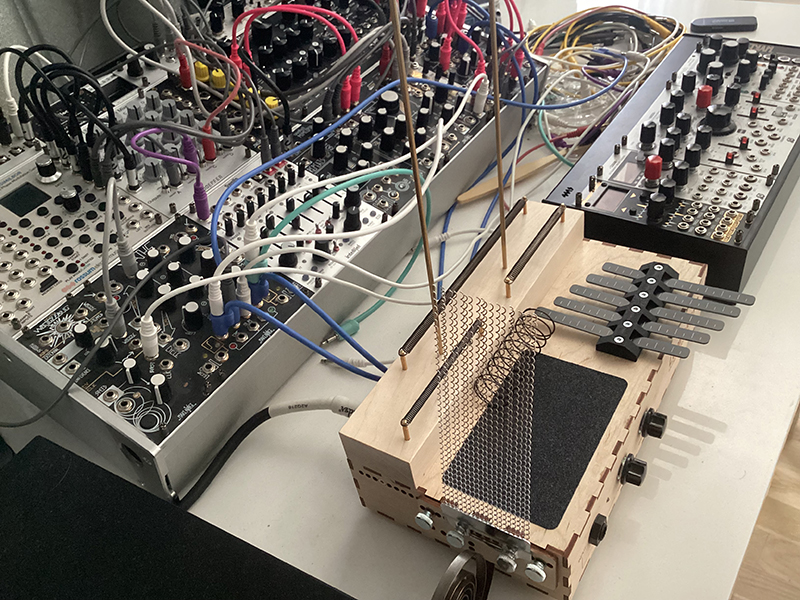
The modular system itself is my main instrument. Patching and turning knobs feels very much like playing for me, so it is especially useful to have controller modules that allow for more direct, hands-on intervention.
Lately, I’ve also been working with a sound box based on a contact microphone, which I enjoy playing in different ways. Of course, it also serves as an input source for the modular system, extending its sonic possibilities.
Obviously you are interested in gesture, physical move to create the music, right? What is your favorite way to achieve such expression?
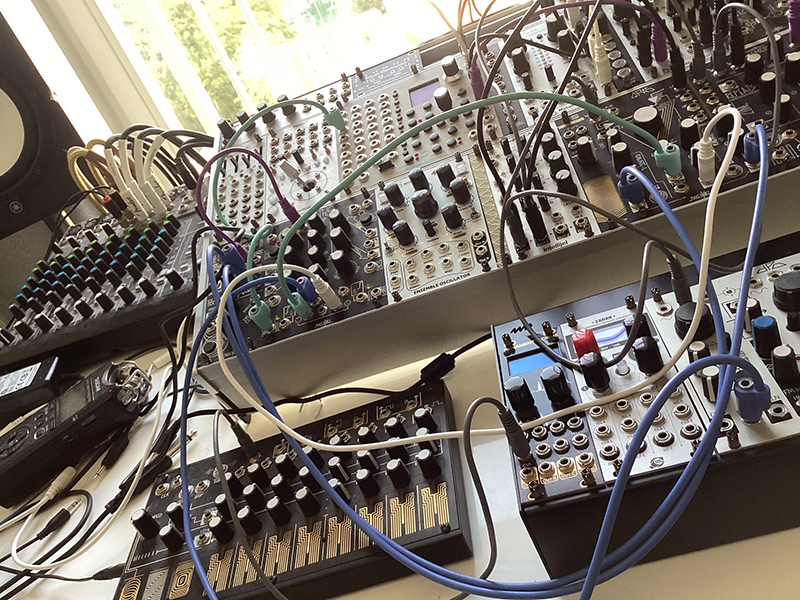
The first time I encountered the idea of “gesture” in a modular context was in a video by Make Noise, where they demonstrated this approach using their Tape and Microsound Music Machine. In that example, Make Noise Morphagene was modulated through animated control of parameters such as speed, splice scanning, and others.
This approach is clearly inspired by musique concrète techniques of working with physical tape, where the idea of gesture originally comes from. I have used this concept extensively with the Morphagene, but I also apply it more broadly wherever modulation is possible—especially when building patches that combine multiple parameters controlled through coordinated movements.
In this context, controllers such as the joystick from Intellijel are particularly useful, as they allow for expressive, performative control over complex parameter interactions.
How were you first acquainted to Modular Synthesis? When did that happen and what did you think of it at the time?
What was your first module or system?
When did you buy your first system?
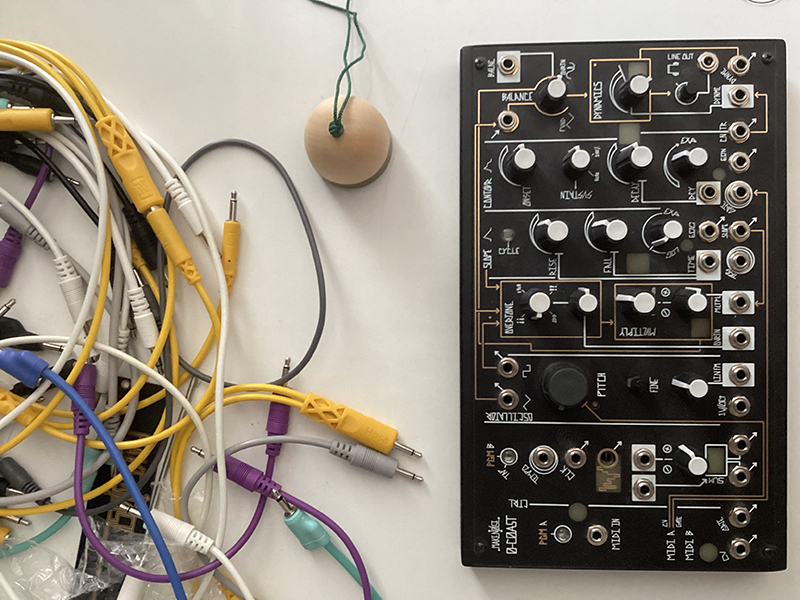
I had heard about modular systems from friends and also seen them at stalls during music festivals. At that time, I considered them somewhat too “geeky” for me. This changed when I visited SchneidersLaden in 2017 to buy a desktop synth. While I was there, another instrument immediately caught my attention: the Make Noise 0-Coast. I spent a long time playing with it, exploring and studying its behavior. It felt unusual and not quite what I had originally been looking for, but it kept drawing me in through curiosity and a kind of playful engagement with sound and patching.
In the end, I bought it.
It became my first modular synth and remains one of my most beloved instruments to this day.
That moment marked the beginning of a journey, or perhaps the start of falling into the rabbit hole of the modular world.
The 0-Coast is also featured in many tracks from this Modulisme session.
How does it marry with your other « compositional tricks »?
How has your system been evolving?
The Make Noise 0-Coast was initially part of a setup consisting mainly of desktop synths and effects pedals. Everything was connected and “glued together” through a mixer, often using send effects. At that time, I was mostly playing ambient music, and I particularly enjoyed feeding the 0-Coast into reverbs and delays.
Later, I acquired my first Eurorack system, a Tape and Microsound Music Machine. I eventually expanded it into a larger case and began building my home studio around this foundation. This marked a clear shift toward a more experimental direction and the exploration of denser, more unusual soundscapes.
It also coincided with my growing interest in the avant-garde and electroacoustic music of the twentieth century.
At this point, I began intentionally bringing these compositional approaches into the modular environment. That initial system turned out to be a very natural match for this direction and became a solid foundation for further exploration.
Your compositional process is also based upon the use of acoustic instruments that you process or combine with Electronic. How do you work to marry that Electronic with your acoustic matiere?
There is no single rule here, but generally it is about building sonic narrative where both acoustic and electronic sounds interplay together. Transformation of both types of materials happening along this narrative also play an important role as well as subtle layering to blur them together..
How long did it take for you to become accustomed to patching your own synthesizer together out of its component parts?
I would say that this learning process never stops: exploring how modules of different purposes come together, playing with signal paths and modulation routings, trying different patching approaches, and observing how modules interact with one another.
At a certain point, I became more confident in understanding which combinations of modules suit specific needs and which setups work better for particular goals, but this learning continues as long as I develop new ideas or open up new directions.
For example, I recently started using a matrix mixer and was surprised that I had overlooked it for so long, as it significantly changed the behavior of a particular setup.
What was the effect of that discovery on your compositional process?
On your existence?
It had a huge impact on my compositional process and brought about a kind of paradigm shift. Coming from a background of composing within a DAW, I naturally tended to think in terms of a multi-track system where both the sound material and the structure were constructed. Working with modular synthesis completely disrupted that mindset and, in a way, liberated me from it.
The process of playing with modular is not confined by any predefined framework. It can be an instrument, a tool for producing strange and unexpected sounds, a new way of improvising and performing, a laboratory for experimenting with concepts, a means of creating an entire composition, or simply something to explore with no specific goal at all.
In that sense, it can even become a kind of spiritual or therapeutic practice.Another major shift was in my understanding of sound and music themselves.
Coming from a background rooted in Western classical music theory, I was used to thinking of music primarily as a system of pitch relationships. Modular synthesis allowed me to move beyond that paradigm and begin to perceive sound more as a material or substance that can be sculpted in countless ways.
The key element here is voltage control, through which timbre, spatial qualities, rhythm, and harmonic content can all interact dynamically. This is where the ideas of the “sound object” and “organized sound” truly become tangible. That doesn’t mean modular synthesis cannot be used for tonal music. Rather, it offers a unique freedom and a deep level of control over every parameter of sound, allowing you to connect and shape them through intricate voltage relationships.
In the end, the physical interaction with the system adds an entirely new dimension. When you patch and perform, a kind of symbiosis emerges between you and the machine. At that point, modular becomes a more intuitive and direct form of expression as a performer.
This also connects to the question of its influence on existence itself. For me, any creative practice is deeply intertwined with life and rooted in existential questions in some unexplainable ways, so it becomes an essential part of my identity.
In that sense, modular synthesis has revealed new dimensions and strengthened the link between creativity and existence. As often as I use modular for specific artistic projects, I also find myself simply playing with it aimlessly, with no goal other than the experience itself. Even when nothing is recorded and no tangible result is achieved, I often come away from these sessions with a deep sense of satisfaction. There is a grounding quality to the experience that, for me, is difficult to compare to anything else.
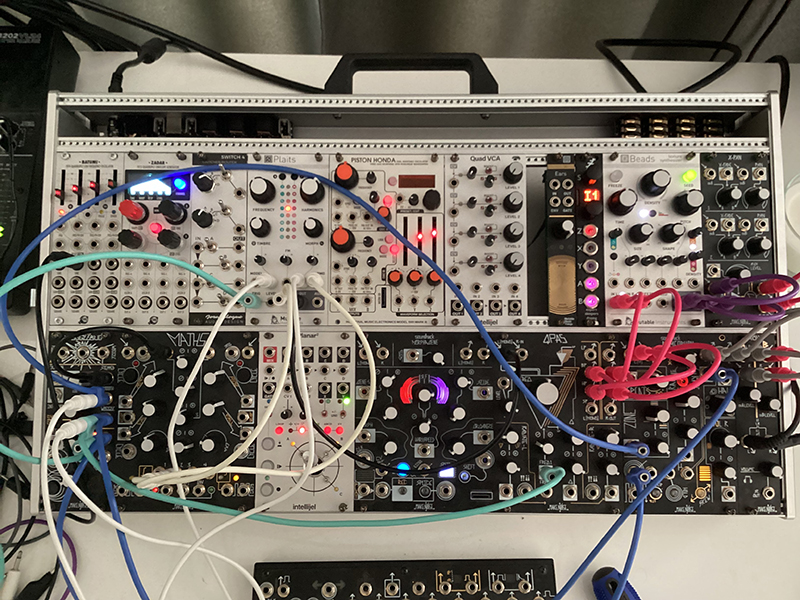
Quite often modularists are in need for more, their hunger for new modules is never satisfied? You owning an impressive amount of gear, how do you explain that?
Instrument building may actually be quite compositional, defining your sonic palette, each new module enriching your vocabulary. Would you say that their choice and the way you build your systems can be an integral part of your compositional process? Or is this the other way round and you go after a new module because you want to be able to sound-design some of your ideas?
I don’t think I own that much, especially compared with people who have thousands of modules. In the early phase of my modular journey, I was also often driven by so-called GAS (Gear Acquisition Syndrome). I would buy modules out of curiosity, or based on what I imagined they could bring to my system.
However, sometimes you are initially impressed by a module, but later realize it doesn’t get used very often and ends up sitting in a box. That’s fine—as it may still become useful for a specific project at some point. At the same time, some modules simply stick and become core tools that I return to frequently.
After the initial “discovery” phase, I now buy modules much more rarely, and usually with a specific system or setup concept in mind. At this point, I feel I have enough modules to build different cases for different purposes—for example, a setup for live performance, one for experimental patching, or one dedicated to particular sound generation approaches.
Do you prefer single-maker systems, knowing your love for BugBrand or Metasonix, or making your own modular synthesizer out of individual components from whatever manufacturer that matches your needs?
The latter. I do have a certain sentiment for particular module makers, such as Make Noise, Intellijel, and XAOC Devices.
At the same time, I remain open to whatever is out there. Even if I’m no longer driven by GAS, I still enjoy discovering new modules and ideas, for example by browsing platforms like ModularGrid and seeing what is emerging in the scene.
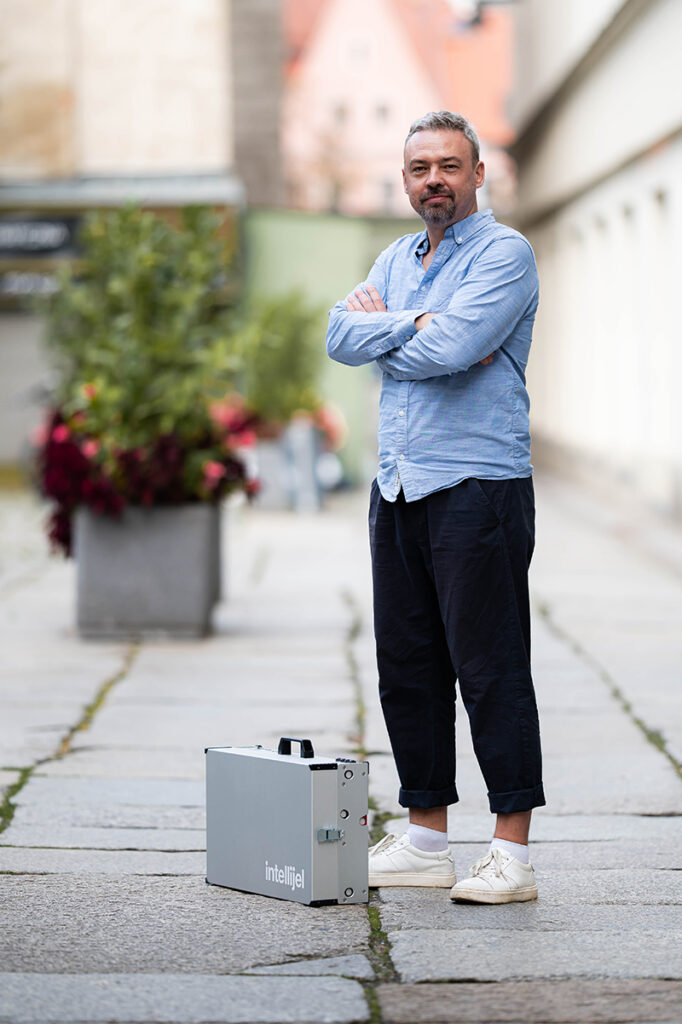
Would you please describe the system you used to create the music for us?
Can you outline how you patched and performed your Modulisme session?
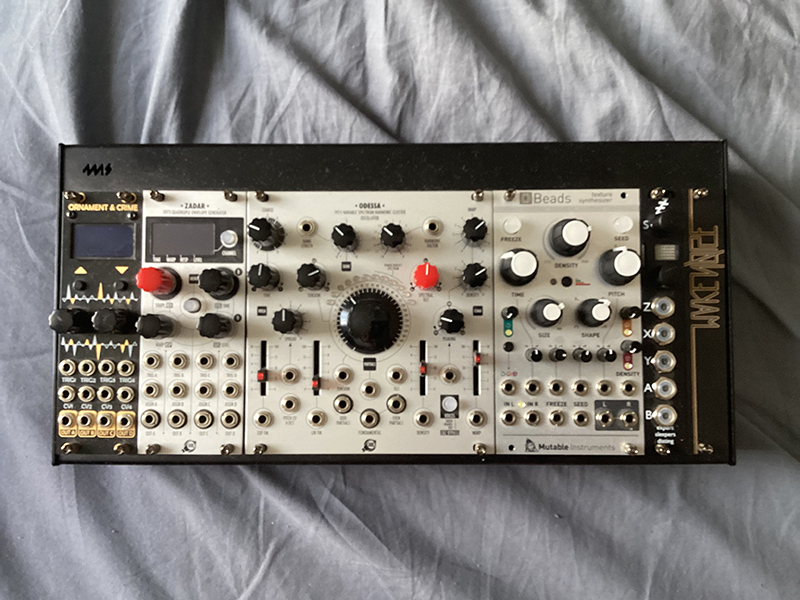
The concept behind the Modulisme session is to create “sound images” of imaginary alien phenomena—something extraterrestrial, otherworldly, or simply beyond clear definition. The initial idea started with a track called Cryosyn, which emerged from an experimental transformation of sounds generated by MI Plaits. The composition felt simultaneously organic and artificial, almost like a kind of liquid crystal—suggesting something alive yet unfamiliar. It carried the impression of an unknown form of nature.
It reminded me of the encounter with extraterrestrial beings in a novel by Ted Chiang (later adapted into the film Arrival), where the creatures exhibit ambiguous behavior and a completely alien mode of communication.
That association inspired me to develop the concept further and create a series of other compositions.For each track, I began with a vague mental image and selected modules based on that intuition. Quite often, this process led to unexpected results that sounded very different from what I initially imagined. And that was perfectly in line with the exploratory nature of the session.
As a starting point for each piece, I would typically assemble a compact system in a 64HP Pod case, choosing a sound source, modulation, and effects modules. When needed, I also patched additional modules from a larger case.
As sound sources, I frequently used XAOC Odessa, Make Noise 0-Coast, Make Noise DPO, and Morphagene. For example, Odessa thanks to its additive synthesis was particularly suited for creating those futuristic, sci-fi textures, so it appeared in multiple compositions.
One of my favorite modules is the Make Noise Mimeophon, which I used extensively as a processing tool, especially for generating complex, multi-rhythmic structures.
Ultimately, the real “glue” behind everything was modulation—often a combination of intricate patching for automated movement and direct, expressive human gestures.
Finally, everything was assembled, layered, and edited during post-production in a DAW.
Do you pre-patch your system when playing live, or do you tend to improvise on the spot?
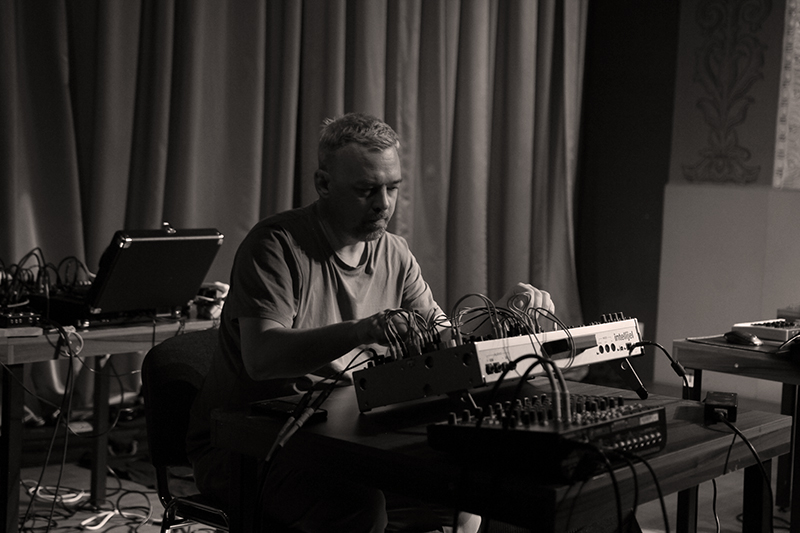
I usually prepare some pre-patching for routing and basic modulation, while leaving enough space to improvise and shape the flow in real time. Striking this balance is essential when designing a live performance system—between pre-patching, automation, and the elements I want to control directly.
Which module could you not do without, or which module do you use the most in every patch?
I’d say modulation sources like Wogglebug and Maths, along with VCAs and mixers, are essential.
Of course, I also need sound sources (VCOs, samplers) and effects, but those tend to change depending on the patch.
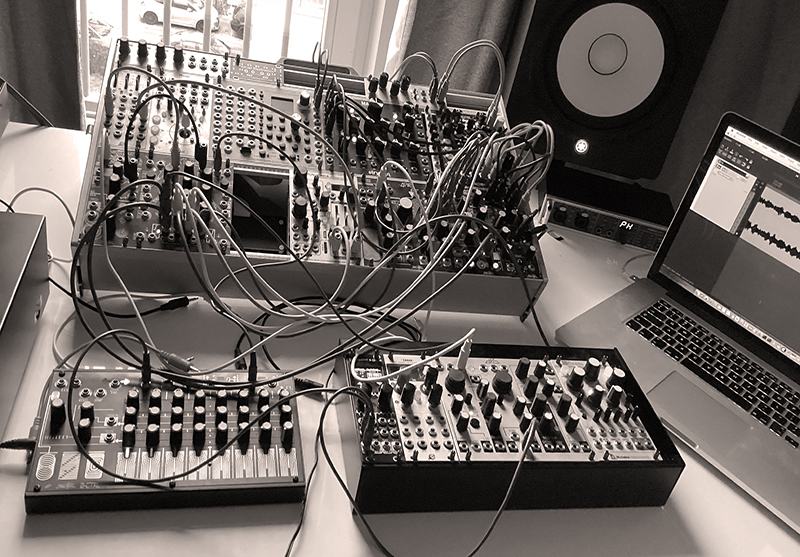
What do you think that can only be achieved by modular synthesis that other forms of electronic music cannot or makes harder to do?
I think that today’s technologies, whether hardware, software, or a hybrid of both, are so advanced that you can achieve almost any sonic result in multiple ways.
What modular synthesis uniquely offers, however, is the ability to arrive at unexpected outcomes very quickly. The freedom to patch modules in unconventional ways — even beyond what their designers originally envisioned — can push you out of your habitual patterns.
It becomes less about executing a predefined idea and more about discovery. Even if it doesn’t always lead to something entirely new, the process itself is deeply engaging and often sparks fresh directions.
Another important aspect is the possibility of building your own instrument, tailored precisely to your needs, especially for performance. Instead of relying on fixed, pre-designed synthesizers, you create a system that reflects your personal workflow and artistic intent.
Ultimately, modular synthesis provides a strong sense of ownership and individuality. By shaping both the system and the way it is patched, you create sounds that are inherently personal, unlikely to be replicated by anyone else, because they emerge from your unique configuration and interaction with the instrument.
Have you used various forms of software modular (eg Reaktor Blocks, Softube Modular, VCVRack) or digital hardware with modular software editors (eg Nord Modular, Axoloti, Organelle), and if so what do you think of them?
I’ve used VCV Rack a bit, as well as Arturia’s Moog V. Both are excellent tools. Moog V in particular is great for understanding how that classic system was structured.
That said, since moving to a Eurorack setup, I rarely return to modular software. There’s something uniquely liberating about the physical experience: holding a cable, making a connection, turning a knob, and immediately hearing the result.
What would be the system you are dreaming of?
I don’t think in terms of a single defined system. As I mentioned before, I tend to reconfigure my setup depending on the goal or project. Ideally, I would like to have several cases of different sizes, each with a specific set of modules dedicated to different purposes, so they can be adapted with minimal effort.
As for modules, I’m particularly drawn to designs where form and function are in harmony—interfaces without menu diving, where everything is immediately accessible and each function has its own dedicated control. In that sense, my “dream system” would consist as much as possible of modules built around a clear, hands-on, one-knob-per-function philosophy.
Are you feeling close to some other contemporary Modularists?
Which ones?
Which pioneers in Modularism influenced you and why?
From contemporary artists, I find inspiration in many Modulisme sessions, so it would be too many to name individually. Often, something resonates with me strongly one day, only for something entirely different to take its place on the following one.
Beyond the artists featured in Modulisme, I often return to the work of Jim O’Rourke, particularly his Steamroom releases. I appreciate the unbound, free-floating nature of those soundscapes.
As for pioneers, I draw inspiration from electroacoustic composers who did not necessarily use modular systems. There are many to name, but among them are Bernard Parmegiani, Beatriz Ferreyra, Luc Ferrari, and Jaap Vink. I am also drawn to many early electronic records created outside academic circles—many of which I continue discovering through the Early Electromix series you feature on Modulisme.
A lot of value, for me, also comes from releases on the Metaphon label, particularly works by Nicole Lachartre and Fernand Vandenbogaerde.
In addition, I look toward improvising live performers, again not necessarily within the modular domain.
Recently, I’ve found myself returning to the legendary Gruppo di Improvvisazione Nuova Consonanza, especially their 1975 album Nuovo Consonanza.
Any advice you could share for those willing to start or develop their “Modulisme”?
Everyone develops their own approach, so it’s best not to treat my advice, or anyone else’s, as a strict rule.
That said, I would suggest simply starting with something. Do a bit of research, of course, but don’t spend too much time trying to design your first large system. You won’t really know how everything works together until you begin experimenting.
Even a small setup can be incredibly rewarding and a lot of fun. From there, you can expand gradually, guided by your own experience and curiosity. It’s a wonderful journey, there’s no need to rush.
Take your time and enjoy each step along the way.
https://sublimeretreat.bandcamp.com/
This Session was mastered by Jos Smolders.