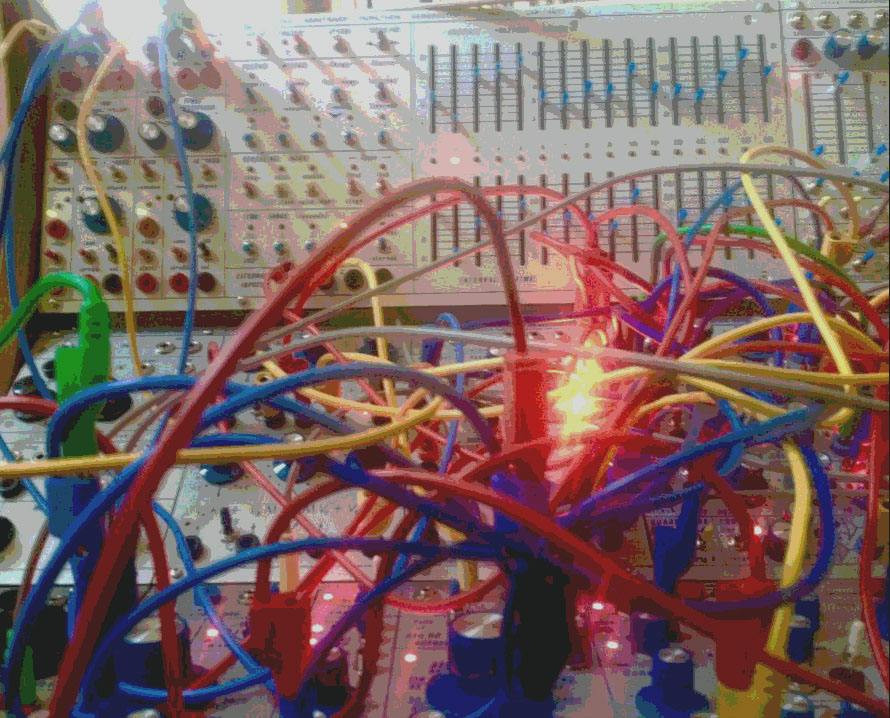
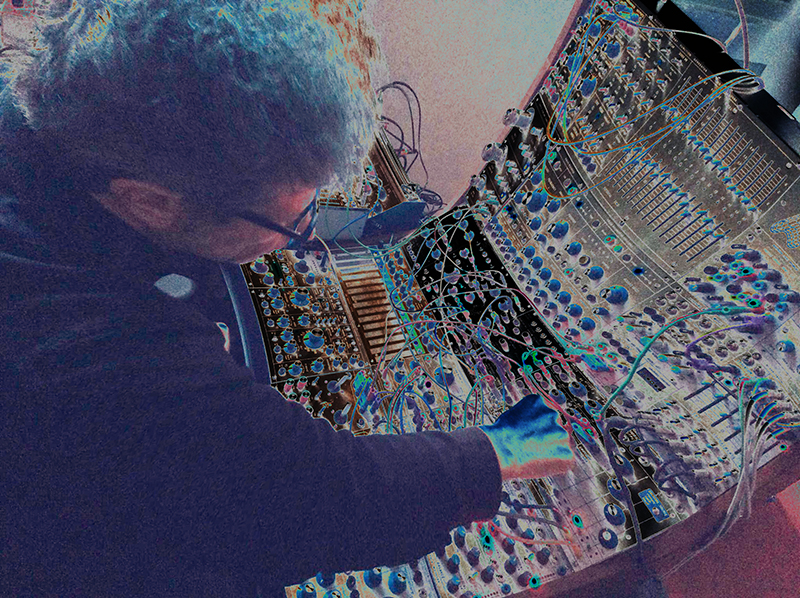
The modular synthesizer is a lightning rod planted in the heart of the night.
A shaft of copper, cables, and aluminum plates reaching toward the invisible, ready to capture what the air carries, what the world holds back, what the cosmos lets fall like a slow rain of electricity.Every module is a resonance chamber for lightning.
Every cable, a vein stretched between two tensions.
Every oscillator, a fictive heart waiting for the shock of a new charge.The modular operates like a miniature weather system, a storm whose internal architecture has been laid bare.
When you patch, you open a passage, a corridor through invisible matter.
You trace a route for a force to move through you.
You set a trap for light.Before it, you are not a composer: you are a human lightning rod.
A body connected to an organism larger than yourself.
Your hand guides, certainly, but it also follows what exceeds it.
It yields to accidents, to micro-charges, to tiny deviations.
Every breath you take, every hesitation, every slightest tremor ripples through the network of cables, as though the system were amplifying your own electric field.In those moments, the modular does not simply produce sound…
it discharges an atmosphere.
It releases what until then had stagnated in the room, in your mind.
It transforms inner fog into frequencies, the turmoil of the world into pulses.
It is no longer an instrument, but a machine for intimate storms.Some notes emerge like slow flashes of lightning, others like subterranean rumbles.
Sequences rub against one another, becoming ionized.
It is as though the modular, too, were waiting for something to strike.
For an intuition, a memory, a wild impulse to trigger the fall of a sound.And when it happens, when the network is perfectly tuned, when hand, machine, and atmosphere are in phase,
the modular becomes an axis standing between two worlds.
A vertical apparatus: the abstract sky of electrical tensions and the concrete earth of your own body.It draws in the storm in order to channel it, to transform it into rhythm.
The sound is no longer manufactured.
It is captured.
Guided.
Transmuted.
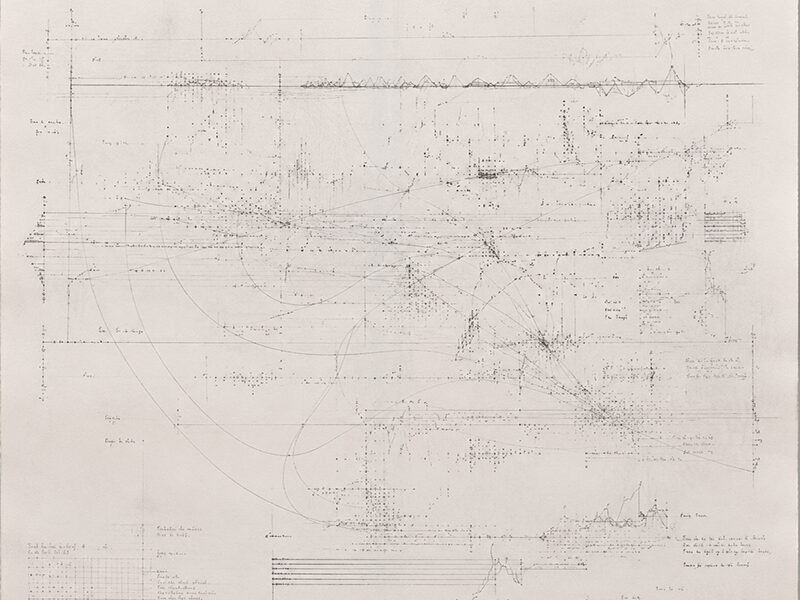
Lightning Field 01: Constraint
The volume of the founding decision.
The acceptance of a voluntary limitation.For decades, I have listened to works built entirely from synthesizers, electronic processing, or modular systems. I am drawn to their ability to create spaces that belong to no real place, to bring unheard sonic materials into existence, to transform electricity into landscape.
Yet when I compose, I almost always end up opening a window onto something else.
My piano frame, a prepared guitar, percussions, voices, or field recordings.
Sooner or later, acoustic or concrete elements find their way into the setup.
As if I needed that encounter between different worlds in order to consider a piece complete.Works made exclusively with modular synthesizers often remain in my archives.
I listen back to them, sometimes rework them, but they rarely make the transition to publication.
Lightning Field emerged from this contradiction.For once, I wanted to move in the opposite direction. To deny myself the usual escape routes. To accept the limits of a given framework and discover what they might reveal. To compose pieces that are entirely electronic, without acoustic instruments, without field recordings, without any material other than that generated by my Buchla and Serge systems themselves.
This Lightning Field series gathers the results of that experiment.
Each volume explores the same territory.
Not the synthesizer as a technological machine, but the phenomena that pass through it.
Tensions, resonances, instabilities, accidents, drifts, impulses.
The modular appears here less as an instrument than as an active field through which forces circulate.
Forces to be listened to, guided, and sometimes simply accompanied.A series of pieces built from electricity, its turbulences and transformations.
Attempts to capture a state, a pressure, a moving charge, and give it an audible form.
Philippe Petit. MAY 2026.