I hear her before I name her.
A tremor moves between notes. A breath brushes the microphone. Somewhere between electronic circuitry and pop reverie, a melody appears and slips away.
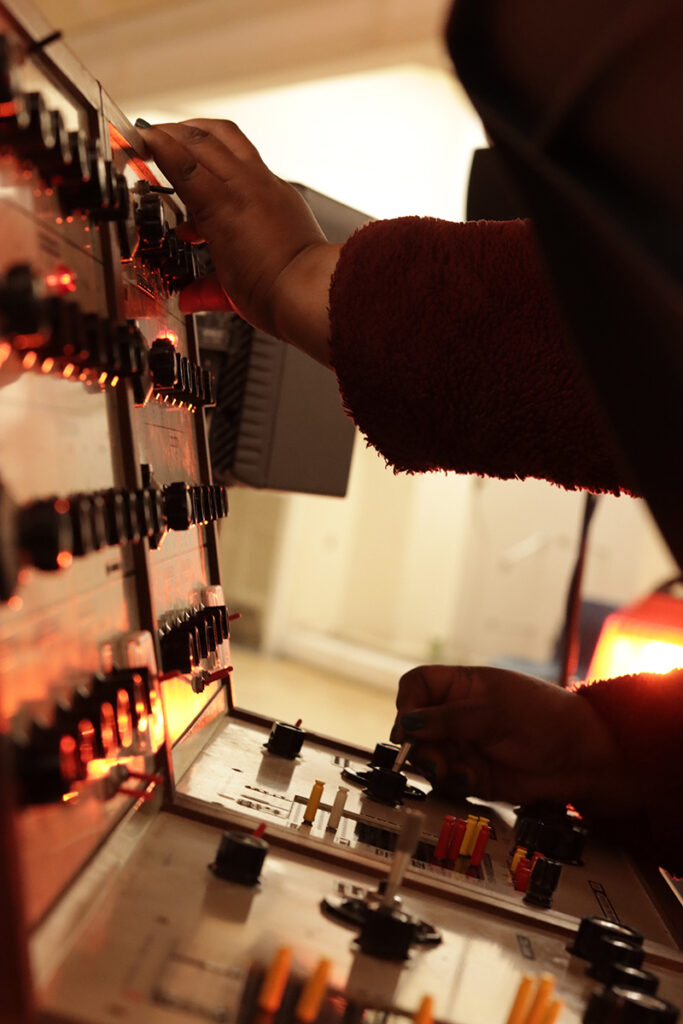
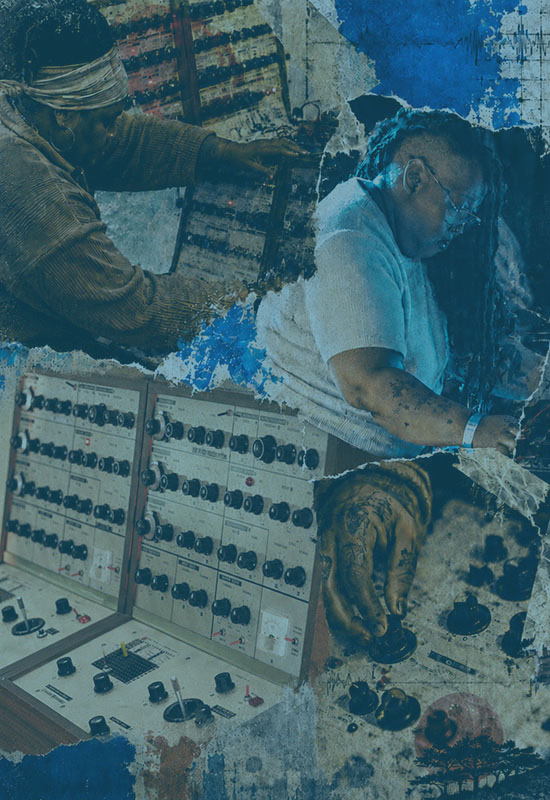
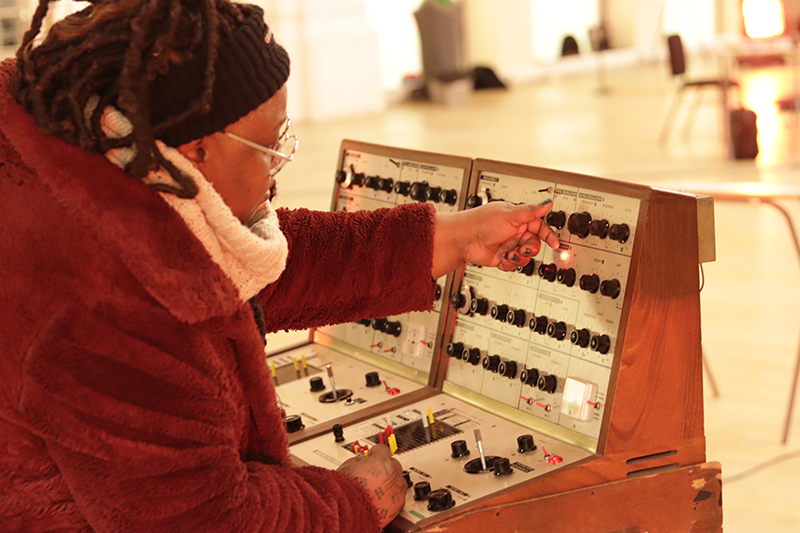
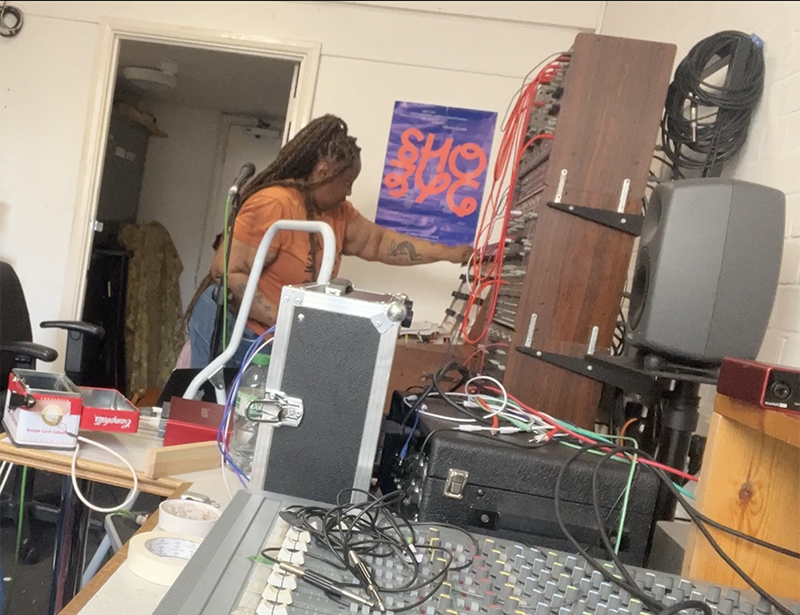
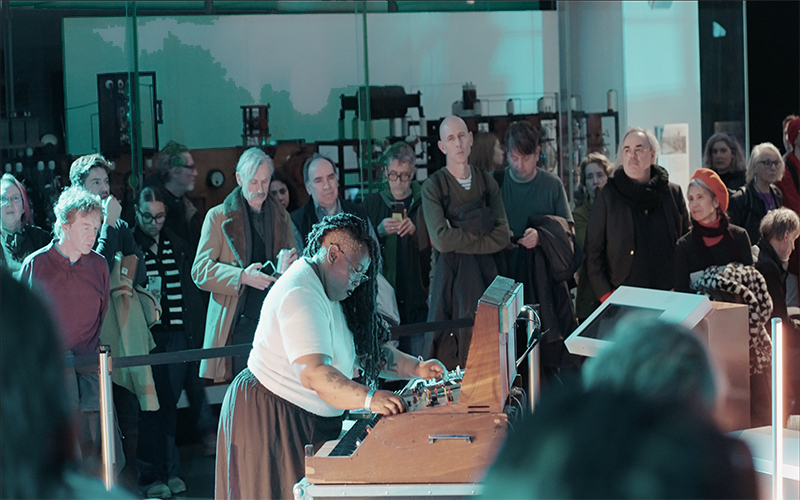
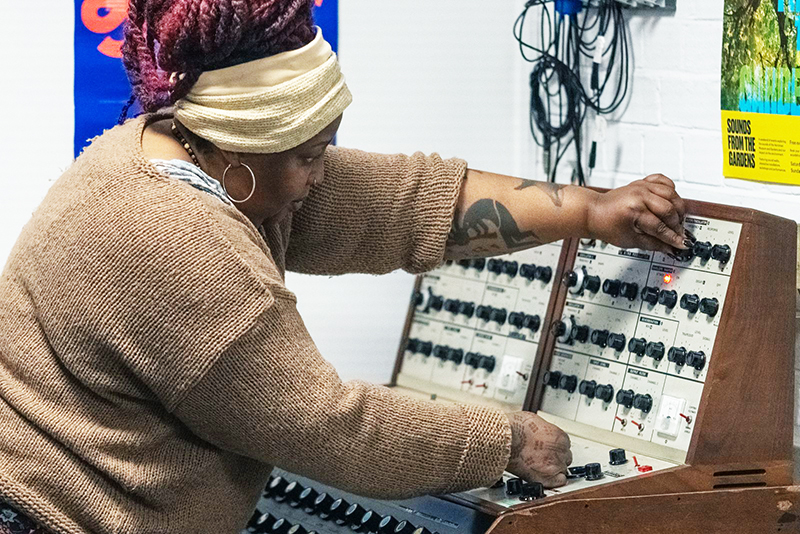
Trudi Veremu, aka Thelma Rose, follows where things lead. Her relationship with the EMS VCS4 began at Goldsmiths, with an instrument most people considered too difficult to approach. She stayed. Hours became days. She measured, documented, drew maps, learning her way back through a machine that responds with its own unpredictable logic.
The VCS4 suggests. Trudi answers.
A connection shifts, a frequency moves, something unexpected appears. She follows it.
Improvisation becomes discovery. On I AM FOREVER and YOU ARE MY KNOWING, yeah, the VCS4 moves towards percussion and pulse. In Saturn Tapes, she processes other musicians live, while granulation stretches fragments into wider landscapes.
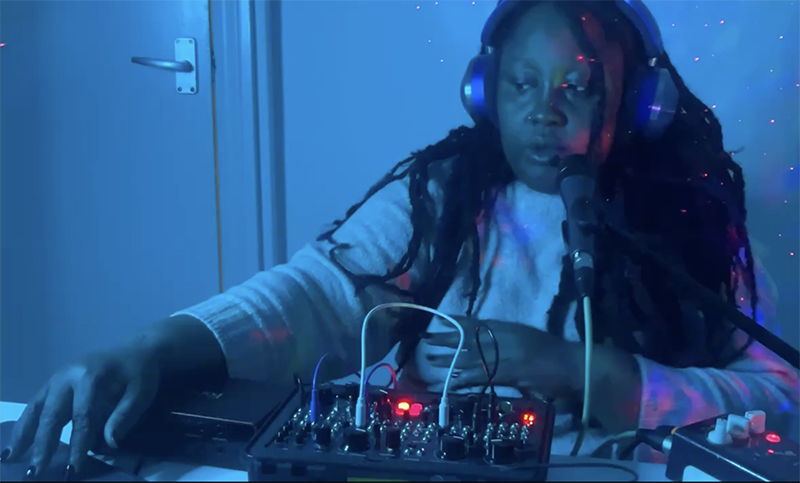
Then there is the voice. Singing came first. A phrase arrives carrying melody or lyric, and the electronics open another path around it. Voice and circuitry share the same field, alongside images, textures and movement.
Eliane Radigue offers one guiding principle. Stay with the smallest detail. Give it time. Follow it wherever it leads.
Trudi takes that patience into electronic music, Black British experience and diasporic memory. Her forthcoming project Other Signals extends this movement, bringing Black artists across electronic, experimental and alternative music into focus.
The VCS4 carries a long history. In Trudi Veremu’s hands, it acquires another one.
Blues Rewired.
What have you been working on lately, and do you have any upcoming releases or performances?
Recently I’ve been working on a project called Saturn Tapes, which I perform with Niamh Gallagher, Aisling Gallagher and Joanna Ramsay-Patel, who’s also my musical partner in Digital Roses. We recently presented work at PureGold at Goldsmiths, and some of the pieces you’ve heard come from those sessions.
Digital Roses has also just finished our new album. We’re deciding whether to release it through a small label or independently, and looking for the right home for the music.
We just had a debut performance at Boomtown Festival this year with Digital Roses in the Pomegranate Parlour, and our next major performance is at Cable Electronic Music Festival. I’m also curating and producing Other Signals, an Arts Council and Goldsmiths University-funded project celebrating Black artists working across electronic, experimental and alternative music in May. I’m excited to bring those artists together because we are still often underrepresented within experimental electronic music.
What do you usually start with when composing?
If I’m writing for myself, it almost always begins with a sound. Before anything else, I’m a vocalist, so often I’ll hear or sing a vocal phrase and everything else grows from there.
Sometimes it begins with the synthesizer. With the VCS4, I’ve spent a lot of time teaching myself what each part of the instrument does. I’ll discover one sound that captures my attention and build a piece around it.
For me, sound comes first. Composition is what happens afterwards. It’s the process of shaping what I’ve discovered into something meaningful, deciding where the music wants to go, what instruments belong there and what I want to communicate.
The sound is the inspiration. Composition is the craft.
How strictly do you separate improvising and composing?
Not very strictly.
Improvisation is essential to my process, especially with the VCS4. It’s how I discover new sounds and ideas. If I’m singing, improvisation is often where melodies and lyrics begin to emerge. I like giving myself room to respond instinctively rather than trying to control everything.
Composition comes afterwards. That’s where I become more deliberate, refining, shaping and deciding what stays. I often think of it like carving a sculpture. You begin with something rough and gradually reveal the piece that’s been hiding inside it.
How does recording differ from live performance?
It depends on the project. When I’m improvising, particularly with Saturn Tapes, what you’re hearing is usually a live performance with no overdubbing. I’m interested in capturing that moment as it happened.
When I’m writing songs, I almost always end up multitracking and editing afterwards. The VCS4 pieces can eventually become fully produced songs, so those naturally involve layering, production and post-processing.
Live performance is different. I’m thinking about the relationship with the audience rather than recreating the recording exactly. I want to leave room for singing, improvisation and interaction.
Your work blends electronic music and visual performance. How do these two dimensions feed into each other?
For me they’re inseparable.
Whenever I hear a sound, I almost immediately imagine images, textures and movement. The experience is almost synesthetic. Sometimes a sound feels crunchy, creamy or soft before it becomes an image.
Those sensations shape the visual world around the music, and the visuals in turn influence what I’m looking for musically. The two are constantly feeding one another.
Can you tell us about your artistic journey and what led you toward analogue synthesis and experimental music?
I started out in the Bristol music scene, surrounded by trip-hop, dub, drum and bass and electronic music. Quite early on I was signed as a songwriter, which gave me the opportunity to work with a range of artists and producers. That was really my introduction to electronic music.
I later explored digital production through GarageBand, Logic and other software. At the same time, artists like Björk made me increasingly interested in sound design and in creating entirely new sonic worlds.
My relationship with analogue synthesis really began when I came to Goldsmiths and encountered the EMS VCS4. Until then I’d never imagined it would become such an important part of my practice.
How were you first acquainted with modular synthesis, and what drew you to it?
I was introduced to modular synthesis around three years ago through the EMS VCS4 at Goldsmiths.
It was actually the instrument that very few people wanted to use because it had a reputation for being difficult. That meant I could spend uninterrupted time with it.
As someone who’s neurodivergent, time is incredibly important. I learn through repetition and by building a relationship with something over long periods. The VCS4 gave me that opportunity, and what began as curiosity gradually became an obsession.
How does modular synthesis connect with your other compositional approaches?
I think I have two main approaches.
The first is allowing the instrument to lead me somewhere unexpected. The VCS4 is wonderfully unpredictable, so it constantly suggests directions I wouldn’t have found on my own. In that sense, it feels like collaborating with another creative voice.
The second comes from Joanna Ramsay-Patel, who introduced me to granulation. That completely changed how I think about working with recorded material. You can begin with a single sound and create an entire landscape from it. ++The improvisation gives me unexpected material, and granulation allows me to expand and transform it.
What do older machines like the VCS4 offer that digital tools don’t?
For me, the VCS4 offers character and unpredictability.
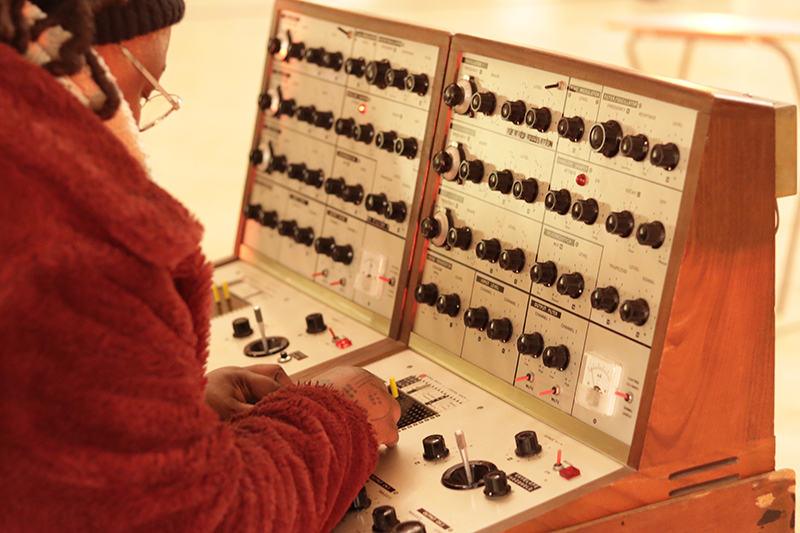
It’s an instrument that was built over sixty years ago, with imperfections and a physical presence that are part of its identity. Digital tools often behave exactly as expected, whereas the VCS4 constantly surprises me.
Those surprises become opportunities. They push me towards places I wouldn’t have consciously chosen.
What role do technical constraints play in your creative process?
The biggest constraint is actually time.
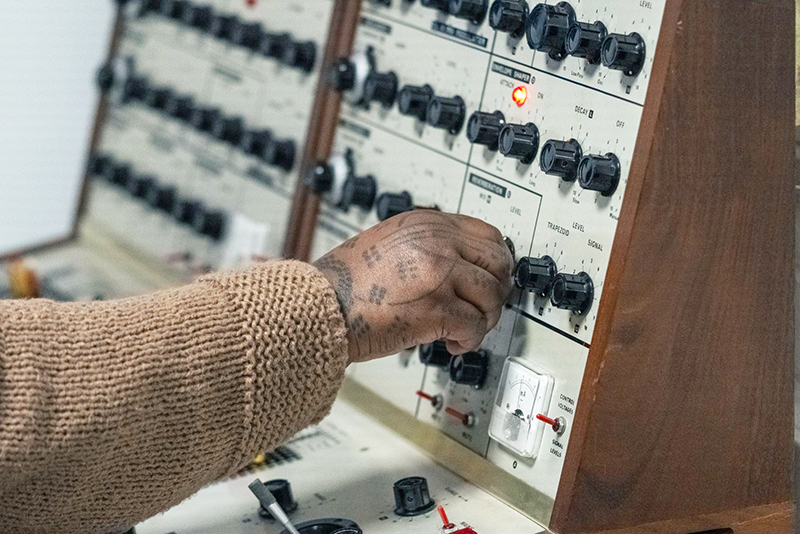
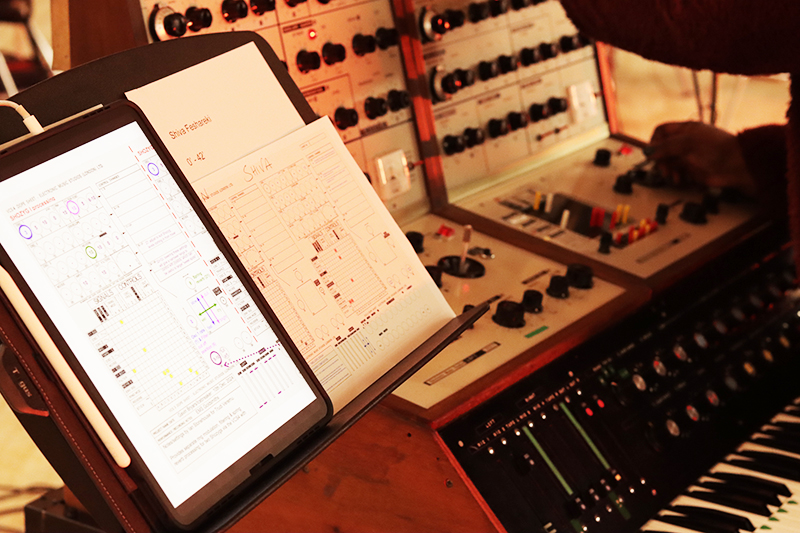
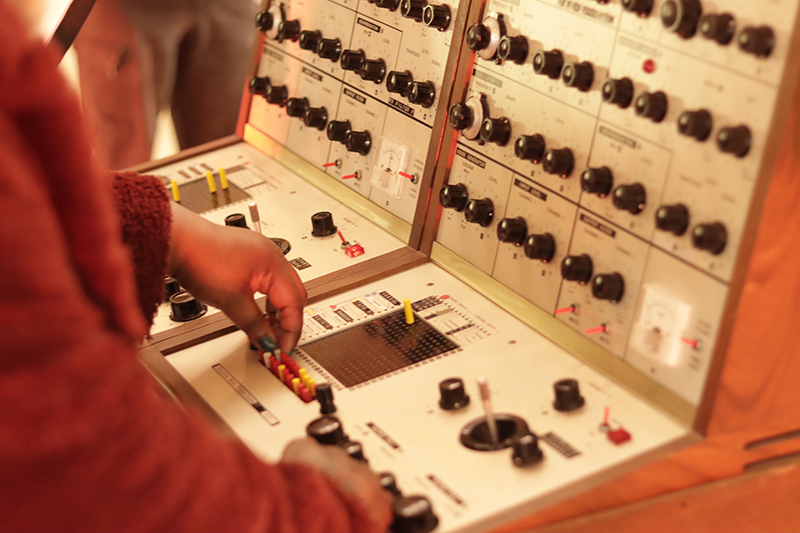
Working with the VCS4 requires a huge amount of documentation. I spend a lot of time measuring, making notes and creating my own maps so I can find my way back to particular patches. It sometimes feels like navigating with longitude and latitude.
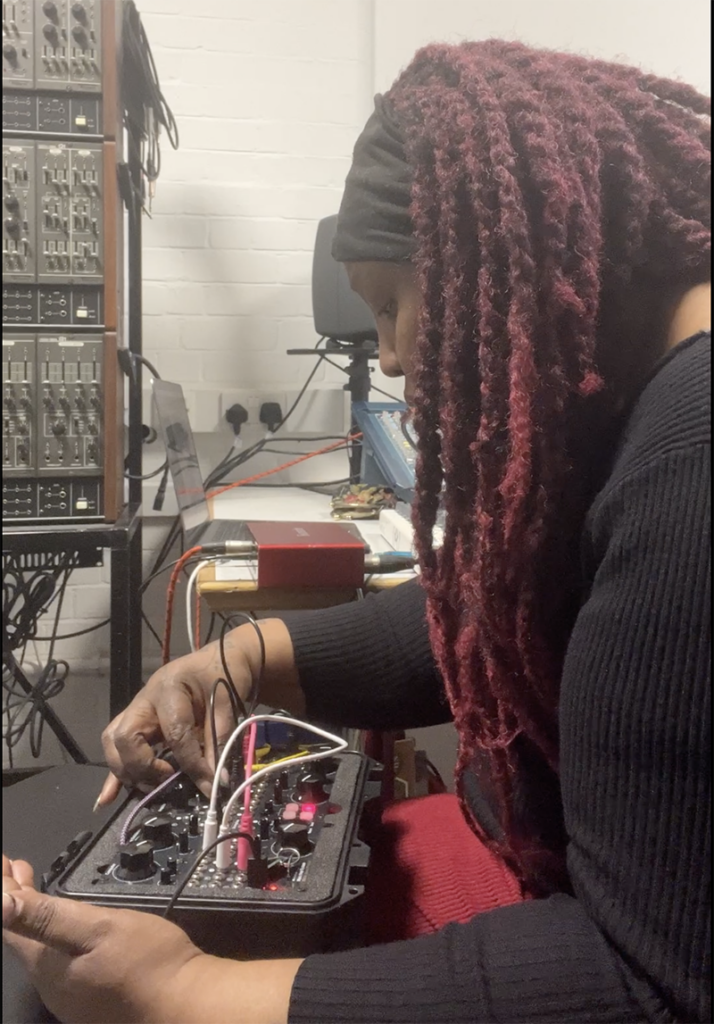
If I’m collaborating with other musicians and want to recreate a particular patch, I might spend three or four days documenting everything beforehand. That discipline has become part of my creative practice.
Your performances are often immersive. What kind of experience are you trying to create for the audience?
I want people to fall into the music.
The visuals aren’t simply there to accompany it. They’re another way of drawing the audience deeper into that world. I’m interested in creating an experience where people can drift somewhere else for a while.
One of the most memorable concerts I’ve attended was by Eliane Radigue. Everyone sat in a circle with their backs to one another, surrounded by a multi-channel speaker system in darkness. It stopped feeling like a concert and became something much more immersive and physical.
That experience has stayed with me.
Can you describe the system you used to create your Modulisme session?
The first piece is The Conversation, which I originally created with the Japanese Butoh dancer Renka. It was one of my earliest explorations of the VCS4. There’s relatively little granulation. Instead, I used spectral stretching across different frequency ranges to extend and transform the material.
The Saturn Tapes sessions are much more collaborative. I perform on the VCS4 alongside Joanna Ramsay-Patel, who creates low atmospheric textures, Niamh Gallagher on viola and Aisling Gallagher. Together Aisling and I built FauxZyg, our interpretation of Hugh Davies’ Shozyg. Ian Stonehouse also performs on his own reconstruction of the Shozyg.
During those performances, I often process the other musicians live through granulation and other treatments, so I move between performer, collaborator and producer as the music develops.
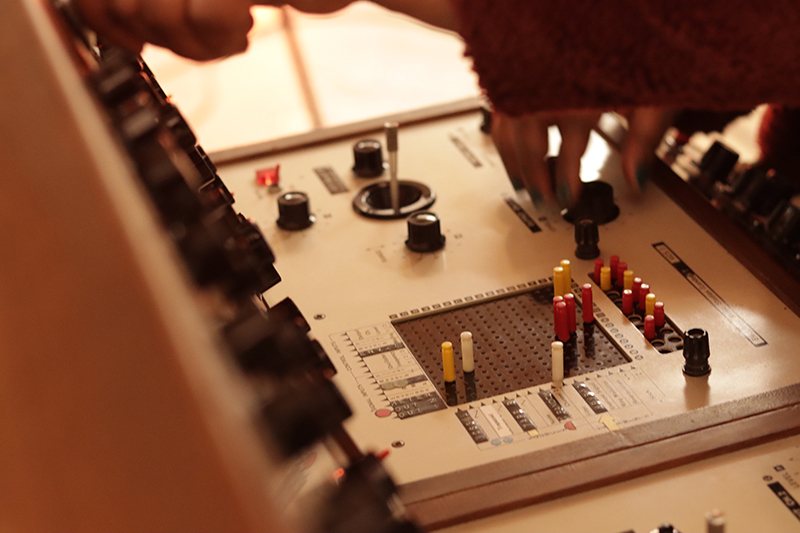
On I AM FOREVER and YOU ARE MY KNOWING, yeah, I’ve been pushing the VCS4 towards percussion and pulse, using it almost like a drum instrument rather than approaching it through the melodic or abstract traditions it’s usually associated with.
Percussion fascinates me because it sits at the root of so many human traditions. I’m interested in asking what happens when a rare British synthesiser is stretched into that territory. Rather than asking the VCS4 to reproduce its own history, I’m asking it to speak through another one.
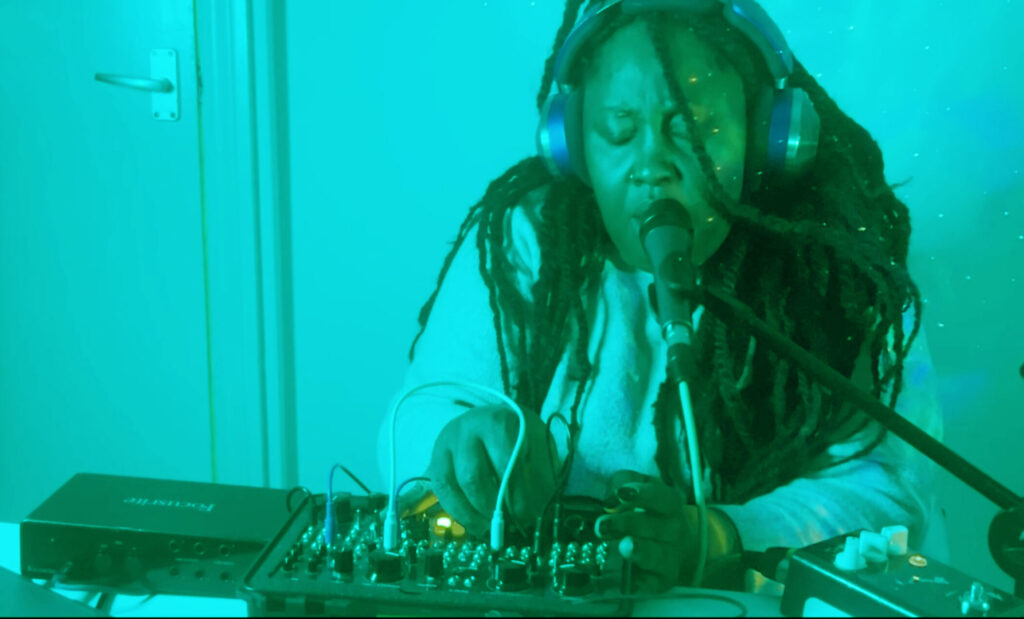
The final piece, Losing Track, is much more stripped back, featuring the VCS4, granulation, occasional sounds from Portal by Arcade, and my voice, primarily processed with a Voice Live Touch.
In Digital Roses, how does collaboration work in practice?
It usually begins as a merging of perspectives.
Some of our songs, like Boy Speak and Under the Sea, came directly from improvising together, so what you’re hearing is genuinely what happened in the room.
Other songs begin with something I’ve already written, and Joanna helps me develop and transform those ideas. I’m fundamentally a songwriter rather than a producer, so I often arrive with a strong framework that we then expand together.
There’s definitely creative tension in the process, but we enjoy it. People often tell us our music combines elements that shouldn’t work together, yet somehow they do. I think that’s become part of Digital Roses’ identity.
Your work explores technology, memory and temporality. Are these conscious starting points?
Memory probably is, because it’s often the emotional engine behind my work.
The other themes usually emerge afterwards. Temporality became important as I reflected on my relationship with the VCS4 and my wider interest in decolonisation. I became increasingly aware that people who look like me are still underrepresented within experimental electronic music.
Technology became part of that conversation too. I’ve become interested in who gets access to technology, who gets recognised for creating it and who has historically been left out.
When you describe your music as “Futuristic Blues”, what does “futuristic” mean to you today, given that the electronic technologies you work with already have such a long history? And what does “blues” refer to in your definition?
Blues has always been a technology of making something new from what history leaves in your hands.
What could be more blues than rewiring? Blues itself emerged through transformation: Black people in the diaspora making new musical languages from what survived, what was remembered, what was available and what was encountered. African rhythmic and vocal traditions, work songs, spirituals, and field hollers existed alongside and interacted with European, Irish, and Scottish ballads, fiddles, guitars, and other borrowed or adapted instruments. These things were not simply preserved intact. They were bent, recombined and made to express a new reality.
That is what “rewired” means to me. It doesn’t mean that the technology itself is new. Quite the opposite. I work with electronic technologies that already carry long histories, particularly the EMS VCS4. I am interested in rewiring the relationships around that technology: how the instrument is used, what musical language it enters, who operates it, and what it is being asked to express. The technology is not new, but the route through it is.
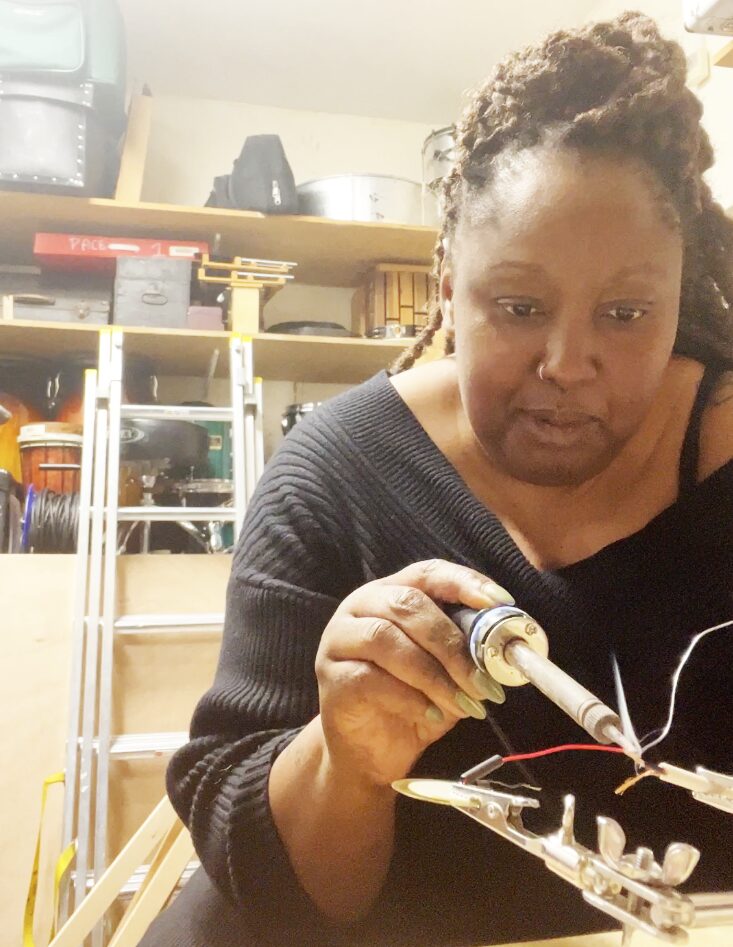
I take this historic British synthesiser and ask it to speak through my history, my voice and my way of composing. I don’t use the VCS4 simply as an effects machine or electronic decoration around a song. I treat it as a compositional instrument, generating rhythm, harmony, texture and movement, then reshaping and recirculating its sound through FM synthesis, granulation, distortion, echo and reverb. So “rewired” also means taking an existing electronic lineage and routing it somewhere else.
“Blues” refers less to a fixed genre than to an emotional and sonic inheritance. For me, it is lament, vulnerability, repetition, tension, spirituals, gospel, dissonance and the ability to transform difficult or uncomfortable feelings into something expressive. My voice doesn’t sit above the electronics. Voice and machine move through one another, and neither remains untouched by the encounter.
So Blues Rewired describes what happens when a voice shaped by the blues, spirituals, and gospel encounters a one-of-a-kind British synthesiser, and both are asked to become something else. The histories remain audible, but the circuitry, authorship and emotional language are rerouted.
You say, “The technology is not new, but the route through it is.” What does that new route allow you to express that you couldn’t express through a more traditional blues vocabulary? And does working with the VCS4 change your understanding of your own musical heritage in return?
The new route does not replace a traditional blues vocabulary so much as extend its emotional logic into another material language.
For me, blues has always been a form of alchemy. It takes memory, displacement, inherited sound, borrowed instruments, spiritual practice, grief, repetition and survival, and transforms them into something new. That process matters to me as much as any particular musical form.
The VCS4 allows me to take that impulse somewhere else. A sung phrase can express loneliness, grief or tension, but the synthesiser can give those emotions another body. Loneliness can become space. Anxiety can become instability. Grief can stretch into a drone. Granulation can fracture a sound into memory-like pieces, while echo and reverb allow something momentary to leave a longer shadow.
The VCS4 is particularly important because it is neither neutral nor predictable. Temperature, circuitry and the relationships between its oscillators can alter what happens. I have to listen and negotiate with it. Each time, I decide what kind of instrument it will be: rhythmic, melodic, textural, environmental, or several at once.
That feels familiar to me. As a Black person in the diaspora, my identity has never fitted neatly into one category. I am Zimbabwean by ancestry, was raised with a strong American identity, and much of the Black musical language that formed me came through African American culture. I’ve also lived across different countries and had to reconstruct parts of my African identity rather than inherit them through a single continuous lineage.
So I’m drawn to an instrument that also sits between categories. The VCS4 is a prototype whose purpose is not completely fixed. I too move between singer, songwriter, sound artist, synthesist and increasingly instrument-maker.
Working with it has changed how I understand my own musical heritage. I used to think of blues primarily as something inherited through voice: lament, spirituals, gospel, repetition and emotional directness. Now I understand it more deeply as a diasporic technology of transformation.
Black diasporic music has continually created new languages from fragments: what survived displacement, what was remembered, what was encountered and what could be adapted. Taking an old British electronic instrument and routing it through my own history does not take me away from blues. It brings me closer to its essence.
So when I call the work Blues Rewired, I don’t simply mean blues music made with electronics. I mean what happens when two histories meet and are routed somewhere unexpected.
The technology is not new, but the relationship is. The route is new. And for me, rewiring itself is part of the inheritance.
You say that the VCS4 gives emotion “another body.” What happens to your voice when it enters that circuitry? Does the machine extend what you are already expressing, or can it lead you somewhere you could not reach through singing alone?
To answer your question, I should clarify what I mean by my voice “passing through” the machine, because technically, that is not usually what happens. There is only one piece where I actually process my voice through the VCS4. Most of the time, my voice and the VCS4 remain separate signals, which can then be processed with granulation, reverb and other treatments.
What has changed is the role I allow my voice to occupy. Coming from songwriting and soulful singing, I was used to thinking of the vocal as the lead, with the music supporting it. Working with the VCS4 has unsettled that hierarchy. I increasingly treat my voice as another instrument within the environment. It does not have to sit above the composition or explain what the music means.
I often describe the unprocessed VCS4 as a kind of fog on the ground, with layers of granulation, distortion, echo and reverb accumulating around it. My voice can enter that landscape almost as another layer of weather. A lament, a sustained note, a fragment of melody or even the grain of my voice can make that fog thicker rather than necessarily becoming the focal point.
I also do not equate lamentation with misery. For me, lament is a form of release. It is the ability to express something so thoroughly that it can move through you rather than remain trapped inside. That can include grief, longing, joy, anger, tenderness, memory or contradiction.
The experimental world the VCS4 opens up gives me room for the full breadth of that expression. A feeling does not have to arrive in one fixed emotional state and stay there. It can stretch, distort, dissolve, fracture, become beautiful, unsettling, tender or enormous.
The machine does not simply process the voice. It changes the world in which the voice exists, and that expanded world allows the feeling to become more complete.
Do you see the VCS4 as a tool, a collaborator, or even a performer in its own right?
Absolutely. I think of the VCS4 as a collaborator rather than simply a tool.
I have to work with the instrument rather than control it. I think about the temperature of the room, how long it’s been switched on and what mood it’s in, because all of those things affect how it responds.
It has its own personality, and that relationship is a huge part of my creative practice.
How important are failure and unexpected results in shaping your work?
Almost everything I make grows out of unexpected results.
Improvisation teaches you to let go of the idea that something has gone wrong. Sometimes what feels like a mistake doesn’t make sense until months later, when you suddenly realise where it belongs.
I’ve come to believe there isn’t really failure in experimental music. There are only discoveries that reveal themselves at different times.
Do you pre-patch your system when playing live, or do you tend to improvise on the spot?
With the VCS4 I almost always pre-patch. Otherwise absolutely anything could happen, or equally, nothing could happen at all.
Once the patch is established, though, I still improvise within it. Sometimes I’ll deliberately connect something unexpected just to see where it leads.
Occasionally someone else has been using the VCS4 before me, and rather than resetting everything I’ll build my own patch around what they’ve left behind. Those moments often produce some of the most interesting discoveries.
Which artists have influenced your practice?
I’m influenced by much more than music alone.
I’m fascinated by Daphne Oram’s writing, particularly her ideas about how people understand and navigate space through music. That connects directly to my interest in archaeoacoustics and the way music carries memory, history and place.
Björk has also been hugely important because she’s shown that experimental ideas don’t have to exist outside contemporary music. She creates work that’s adventurous but still deeply human and emotionally engaging.
If I had to name the artist whose work resonates with me most closely, though, it would be Eliane Radigue. I love the patience in her work, the atmosphere she creates and the way she allows a single sound to unfold over time.
Outside electronic music, I’m also inspired by Benjamin Clementine, who blurs the boundaries between songwriting, performance and experimentation. I’m drawn to artists who aren’t afraid to build their own language.
Which pioneer in electronic music has influenced you most, and why?
Without question, Eliane Radigue.
Of course I’m inspired by the worlds she creates, but it’s also her story that resonates with me. She pursued electronic music at a time when many people dismissed her as simply a pretty face, and she did so while raising a family.
As a mother myself, I find that incredibly inspiring. She reminds me that your creative life doesn’t have to follow someone else’s timetable or expectations.
John Cage has also been a huge influence. What I admire most is his willingness to question everything. He treated experimentation as a way of thinking rather than simply a musical technique, and that attitude has stayed with me.
How do you approach the relationship between music and space in your performances?
Space completely changes how music behaves.
I’ve always loved reverb and acoustics, and I’m continually surprised by how dramatically different a piece can feel depending on where it’s performed.
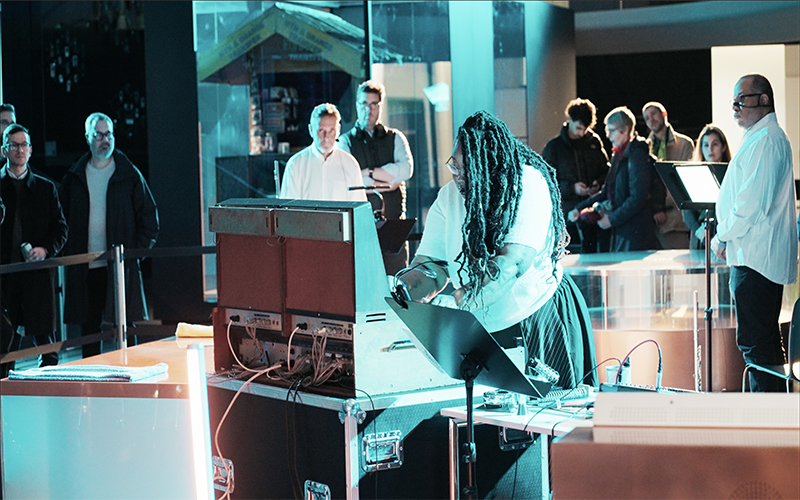
The VCS4 itself is a large and demanding instrument, so it naturally limits the spaces I can take it into. But every now and then I have the opportunity to perform in places like the Great Hall at Goldsmiths, and hearing the instrument breathe in a space like that is extraordinary.
One of my long-term ambitions is to build an instrument inspired by the VCS4 that allows me to explore many more architectural and acoustic environments.
What role does the audience play in your performances?
As someone who’s neurodivergent, I can actually be quite shy.
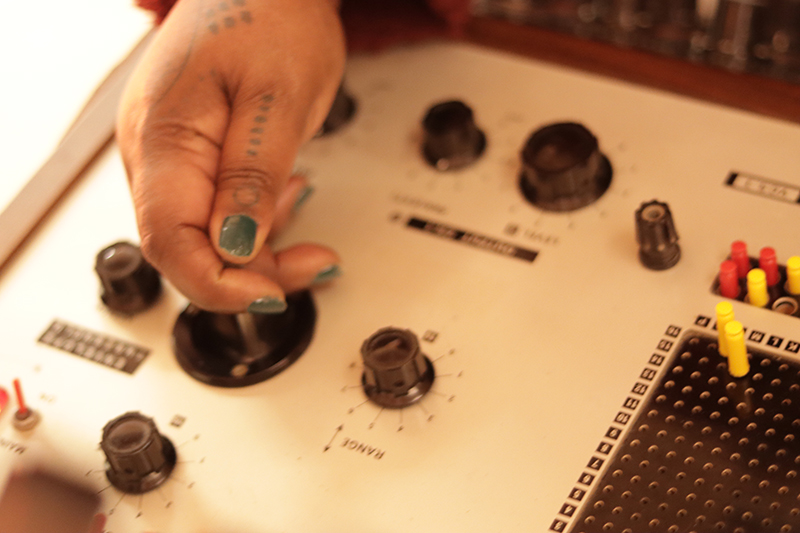
The interesting thing about performing with the VCS4 is that it gives me so much to concentrate on. Between the joystick, the patch pins and the controls, I’m completely immersed in what I’m doing. In a strange way, the instrument frees me from thinking about myself because all my attention is focused on the music.
I’m not necessarily trying to make audiences dance or react in a particular way. What I really hope is that the work opens up their imagination. I want to encourage people to listen differently, notice things differently and perhaps leave the performance hearing the world in a new way.
How do you see experimental electronic music evolving, especially with technologies like AI?
I think AI is a tool, and like any tool it depends on how it’s used.
It has the potential to make music-making more accessible, which I think is genuinely exciting. At the same time, AI works by recombining what’s already there. Human creativity comes from lived experience, emotion and intuition, and I don’t think that’s something AI can truly replace.
I’m not particularly worried about AI taking over experimental music. People who genuinely love experimental music are looking for individuality and curiosity. That’s something I still believe comes from people rather than algorithms.
Is there a project or artistic direction you’re particularly excited to explore in the coming years?
One idea that’s stayed with me comes from Eliane Radigue, who spoke about finding one tiny detail within a synthesiser and following it wherever it leads. I love that approach.
More broadly, I’m interested in continuing to shape my own artistic identity. I’d love to build a body of work that’s fearless, interdisciplinary and unmistakably my own.
What advice would you give to someone starting out with modular synthesis?
The first thing I’d say is: give yourself time.
Those first hundred hours with an instrument are incredibly important. There’ll be moments when you feel like you’re making progress and moments when you feel completely lost. That’s part of the process. Keep coming back. Fall in love with the instrument and celebrate the moments when something suddenly clicks.
And don’t worry about sounding like anyone else. Modular synthesis offers almost infinite possibilities. Rather than trying to recreate somebody else’s sound, spend your time discovering your own. Only you can make the music that sounds like you.
I’d especially say this to girls and women, and particularly Black women and women of colour. You may not see many people who look like you in these spaces. Don’t let that stop you.
Nobody else can build your relationship with an instrument. Nobody else can make the music you’re here to make. Your perspective is valuable precisely because it’s yours, and experimental music needs more voices, not fewer.