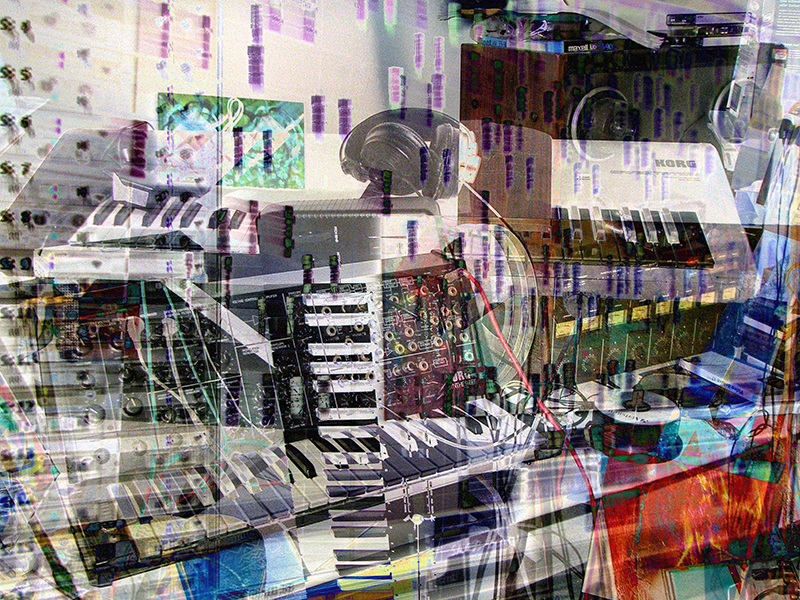
A piano goes off the rails, a trumpet splits in two, a modular synthesizer conjures sounds with no apparent source, a magnetic tape seems to remember a noise that never existed. The elements rub against one another, distort, change skin.
With Hans Castrup, the ear loses its footing before it can even make sense of what it hears.
It all began in 1982 with Erfahrungswerte, a sixty-minute cassette recorded on a Synthi AKS. More than forty years later, Castrup remains unwilling to settle into a recognisable style. The instruments and techniques change, each new project opening up a different set of possibilities rather than repeating a formula that has already worked.
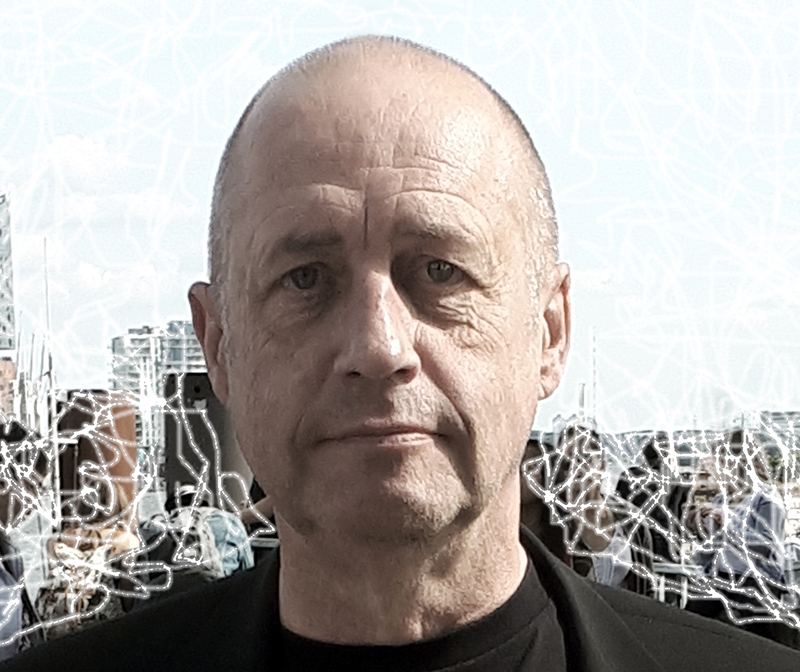
A German visual artist, painter, photographer and writer, Hans Castrup approaches composition much as he approaches an image: through layers, cuts, accidents and overlaps. Field recordings, acoustic instruments and electronic textures enter into unexpected relationships. Their original identities begin to blur, and what emerges cannot always be traced back to its source.
His releases on Karlrecords, Attenuation Circuit and Mahorka reveal a practice built on investigation rather than mastery. The studio becomes a space for testing, assembling and taking things apart again. Connections appear, hold for a moment, then give way to something unforeseen.
Castrup does not explain the unfamiliar away. He leaves the listener to follow its shifting contours, to wonder how disparate elements have found their way into the same piece. The pleasure lies as much in that uncertainty as in the music itself: the sense that something has happened, even if we cannot quite say what.
The world is still there.
But it has moved.
Would you please retrace your career? What have you been working on lately, and do you have any upcoming performances?
I’ve been making music seriously since 1981, starting with the project Poison Dwarfs, which led to several cassette releases. The project continued with various lineups until around 1988, when my bandmates wanted more songwriting, something I refused. After a break, another cassette appeared in 1991, followed by a hiatus until 2008, when two CDs were released.
In 1981, I acquired my first synthesizer, an MS-20, and began experimenting with tape recording using a Philips recorder that allowed me to overdub tracks manually. Later, I moved on to a second recorder, then to four- and eight-track machines, and eventually to cutting and collaging tape.
I was fascinated by large modular synthesizers, but they were far beyond my means. Meanwhile, many electronic musicians I knew were moving towards harmonic and melodic music, which I had gradually come to reject. During the 1980s, I was drawn to New Wave and Industrial music, and later to the composers of the electronic avant-garde. Although fellow musicians often found my experiments exciting, they were reluctant to include them in their band recordings, perhaps because of their rock-oriented approach. Audiences remained equally reserved, and much of my work ended up in a drawer. My first solo cassette, released in 1982, attracted little attention.
From 1988 onwards, I started several duo projects with female singers, but none succeeded. I continued recording solo, though much of this work remained unfinished and unreleased. Demos were repeatedly rejected, and my releases only began in 2007, initially as short radio pieces. Wider recognition came in 2013, thanks to Thomas Herbst of Karlrecords, for which I remain deeply grateful. From there, things began to take their own course.
From the beginning, my studio motto has been: “Press the record button before the first note is played.” I encountered this idea around 1973 in a text by Holger Czukay, published as a letter to the editor in Riebes Fachblatt, and it made a lasting impression on me through CAN. I was particularly inspired by the idea of making all recordings myself. The term “home recording” didn’t exist back then.
I still work this way today, except for most voice recordings for radio pieces. Over the years, I’ve built up an extensive sound archive, although some material, especially tapes, has been lost. Still, I have several weeks’ worth of recordings.
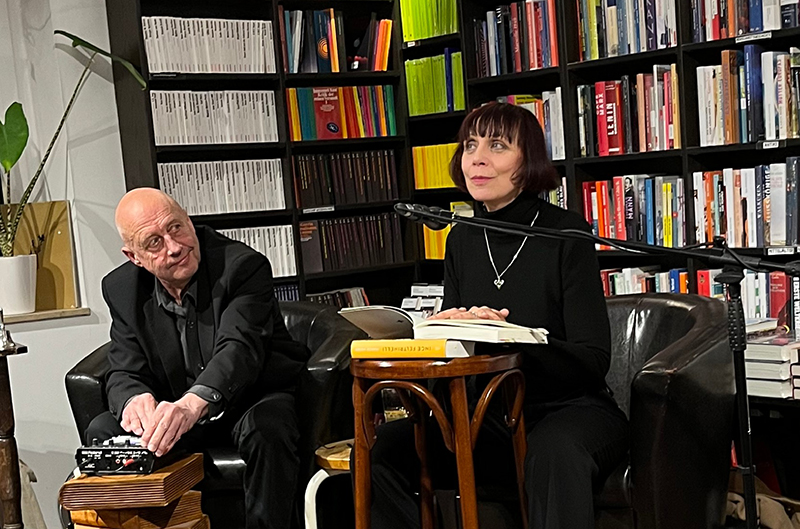
My recent work includes short audio pieces with singer and speaker Ulrike Teepe, longer sound collages, some featuring her voice, and three pieces with American trumpeter James Hill, one of which has been released. I also combine new sounds with older recordings from my archive. Rediscovering and reworking these sounds, giving them a new life, is particularly exciting.
Live performances have always been rare, but I hope to play a few shows in 2026 and present new sound installations, which have long been an important part of my work.
For the first 30 years of my career, I was primarily regarded as a painter and graphic artist. At the time, working across different disciplines was often frowned upon, based on the assumption that one could only excel in one field. Multimedia art was not taken seriously by many. Fortunately, this has changed considerably.
Your compositional process is also based upon the use of acoustic instruments that you process or combine with Electronic. How do you work to marry that Electronic with your acoustic matiere?
At a certain point, I began incorporating field recordings and voices into my collages, followed by acoustic instruments distorted through long tape loops, tape manipulation, and later effects units. I once owned a sampler, but it always felt alien to me.
My relationship with sampling changed when I started working with audio on a computer. These programs could be used much like tape recorders, allowing everything to be connected to everything else. This opened up new creative and practical possibilities.
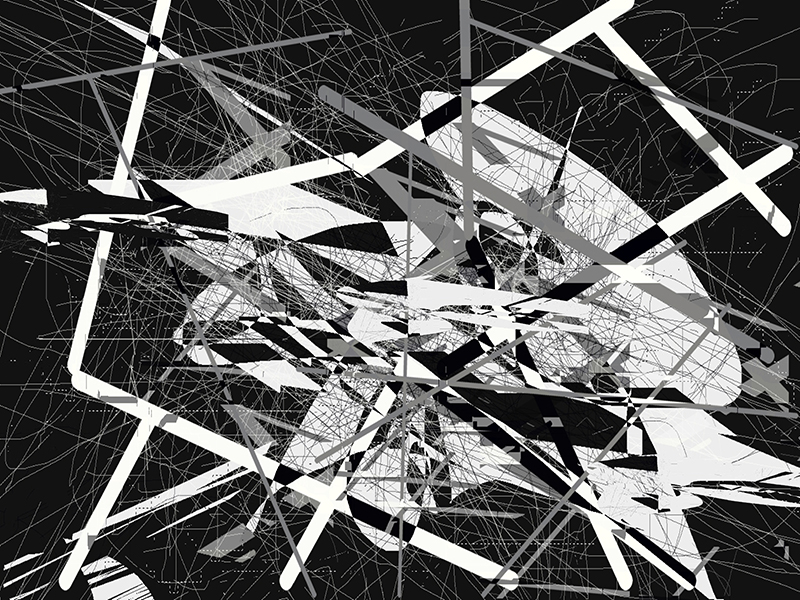
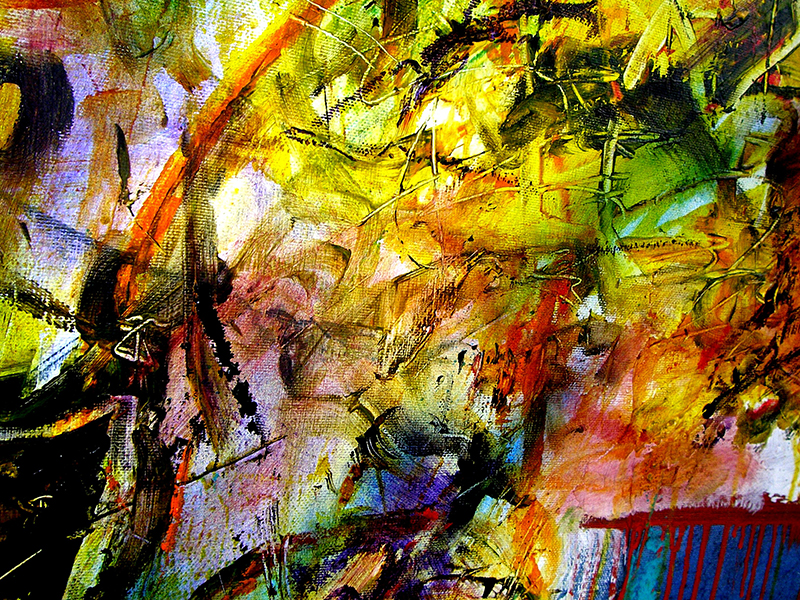
I think of working with sound as mixing paint on a palette or canvas: layering thinned colors creates new hues, while mixing several colors produces different results. Repeat either process too often, however, and the colors become muddy or indistinct. The same applies to sounds and their frequencies.I make no distinction between acoustic and electronic material, judging each sound solely by how well it serves the track or collage in progress. Outdoor recordings appeal to me because they often contain more noise and, sometimes, interesting spatial qualities. Instrument recordings, too, interact with both natural and artificial spaces.
Embracing imperfection as a compositional element further enriches the sound. In the analog era, recorded sound was physical, with frequencies stored magnetically on tape. Today, digital recordings consist of streams of zeros and ones. Yet electricity is involved in both cases, whatever the source or recording method. To me, this points to an equivalence between acoustic and electronic signals. Once a sound passes through an effects processor, moreover, its original source becomes secondary: it has become an electronic signal.
What do you usually start with when composing?
How do you see the relationship between sound and composition?
I always begin by pressing the record button. It’s a ritual that helps me concentrate.
Working with modular synthesizers has always been somewhat challenging in this respect, because I first have to discover where a recording should begin. When everything is being recorded, finding that starting point can be difficult.These days, I usually start by improvising a few chords on a VST piano or another virtual instrument, such as a bass. I prefer the piano, partly because it can sometimes be acoustic. Alternatively, I might import a file from my sound archive and combine it with other recordings or add piano sounds to it.
When I have no specific goal in mind, I like to introduce an element of chance by loading older recordings.
The result can surprise me, almost as if I were playing with someone I know very well but who can still surprise me. You could describe this process as a form of extended improvisation, or instant composition. Improvisation plays a major role in my work: I select the most compelling moments from numerous improvised passages and use them to compose sound collages deliberately.

How strictly do you separate improvising and composing?
A concert with the ambient electronic musician EMERGE in 2024 worked very well. I work best live, however, with pre-recorded tracks that I can then mix. The mix ultimately drives the previously created idea ad absurdum.
What type of instrument do you prefer to play?
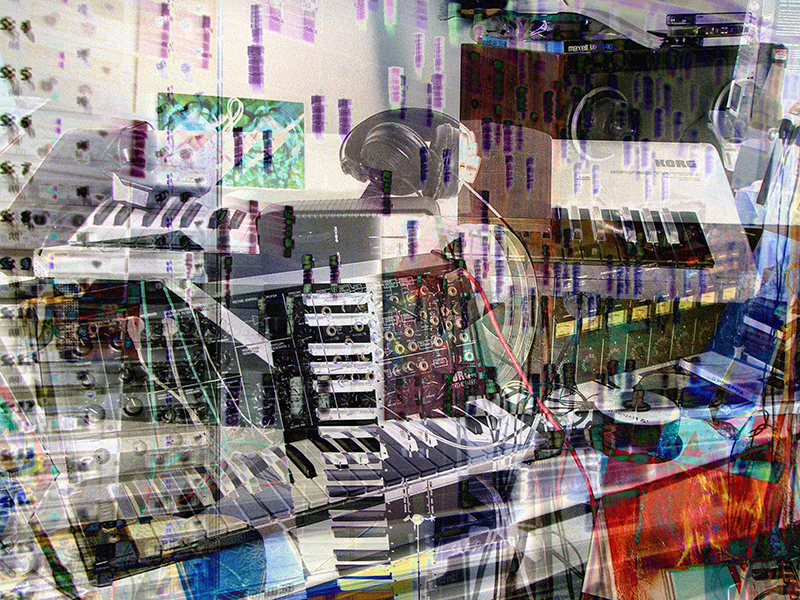
My favourite ‘instrument’ is always the studio itself. It contains all the elements that are important to me, and my special combination of instruments and effects is well coordinated for intuitive use.
Currently, the piano, that means at first the Concert Grand in Samplitude, but also the acoustic piano, is my favorite instrument for laying the groundwork for sound collages. I also really like using “stretched” piano as a foundation. Or piano sounds whose attack I clip beforehand, giving them a somewhat ethereal quality.
I also like to use excerpts from longer abstract collages, which in different atmospheres and speeds. The sound as such (I don’t know how else to describe it) significantly influences the course of each of my compositions through its intensity and potential drama.
I’ve long been a fan of freeware, as many of these instruments contain strange inconsistencies that can be used in interesting ways.
How can one avoid losing the spontaneity that the analogue instrument allows and that so many composers have lost since they do everything from their computer? The click of the mouse doesn’t sound like the turn of a knob, does it?
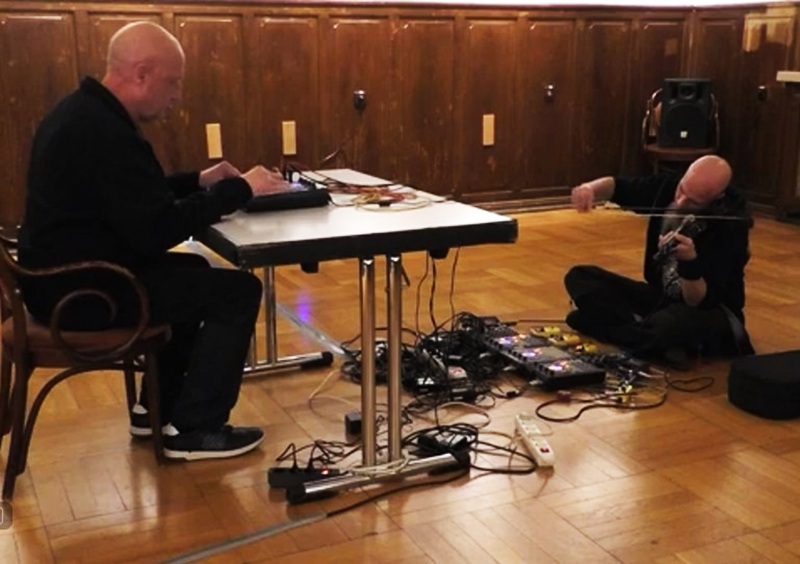
It’s important to me to record as much as possible myself. And instead of relying on MIDI functions, I record audio files to edit, create layers, and potentially loop, transpose, etc. – ultimately, to use the computer like a tape machine.
Manipulating sounds by turning a physical knob is undeniably more “tangible.”
But – as I said – if you explore beyond the obvious spectrum of sounds with and within digital devices, experimenting with microtonal tunings in your DAW, or using pitch to move beyond the limits of the keyboard, or incorporating effects directly into the recordings to further modulate them with additional manipulation, then the computer can also open up some new and surprising sonic possibilities.
How were you first acquainted to Modular Synthesis? When did that happen and what did you think of it at the time?
How does it marry with your other « compositional tricks »?
What was your first module or system?
My first encounter with the (semi-)modular MS-20 was in 1981. Its relatively low price, unlike competing instruments that were beyond my budget, made it an obvious choice. At first, I felt somewhat overwhelmed by this admittedly modest synthesizer. But Korg’s patch sheets, labeled with instrument names yet producing sounds barely recognizable as such, immediately sparked my curiosity. Triggering the MS-20 via a Roland CR-78 and looping entire tape recordings were equally appealing.
I already owned a Big Muff distortion pedal, a phaser, and a Copycat tape echo. Combined with tape-speed variations and the recorder’s so-called “dub function,” these tools opened up a wide range of possibilities. Many results sounded alien, and I often lacked the reference points to place them within an established musical canon. Today, I find many of these early-1980s sounds more usable than I did at the time. My aesthetic was still strongly shaped by musical idols such as CAN and King Crimson, while the diversity of the New Wave scene helped me find new directions.
Drawing on my experience as a painter, I tried to recreate the techniques and sonic effects of artists I admired. This worked to some extent, particularly with the arrival of 19-inch rack effects such as the Yamaha SPX90 and, later, multitrack tape machines. From the late 1980s, I also explored a kind of “art rock,” using instruments such as the Juno-6, Yamaha DX7, and eventually the Korg Wavestation.
Gradually, however, this approach led to a creative dead end. In the mid-1990s, Oval and Tortoise renewed my enthusiasm by incorporating noise and errors into their music. Their work encouraged me to rethink my own productions: the MS-20 returned to my tracks, and tape noise became something to embrace rather than suppress.
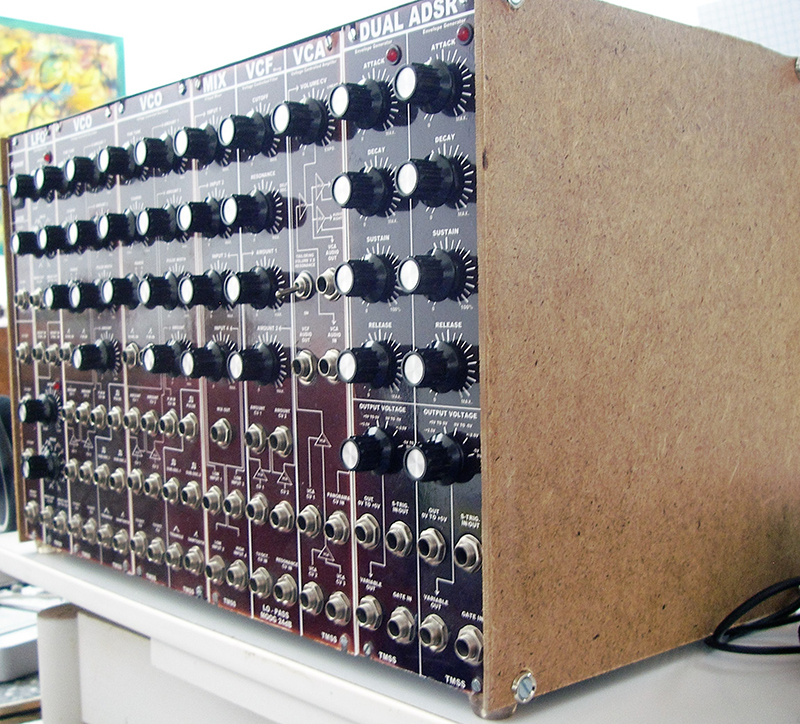
My first experience with a fully modular system came much later, with an instrument kindly lent to me by my colleague Bert Fleissig. Built from 1995 onwards by German electrical engineer H. Theis, it is one of the earliest models, housed in an archaic-looking MDF case; later versions were more robust. To my ears, its sound recalls Moog synthesizers. I began experimenting with it in August 2025.
What was the effect of that discovery on your compositional process? On your existence?
Good. I’m now considering getting my own system. But next time I’ll get a more recent model…
Quite often modularists are in need for more, their hunger for new modules is never satisfied? How do you explain that?
Perhaps it’s the collector’s instinct? To always have everything complete – similar to a collection of records, books, or stamps?
But seriously: I realized early on that even the sound palette of a synthesizer isn’t infinite – comparable to that of an orchestra or the palette of possible colors of a painter.
The moment came when it became clear to me that the diversity of sounds, which are based on a few waveforms plus noise, cannot be fundamentally changed. The modules, however, as the name suggests, offer potential possibilities here.
I imagine that many modular musicians are, deep down, searching for “THE new” sound. And that’s why they remain true to the idea that something world-changing might happen one day. And that will probably happen with the next module they buy.
Perhaps for some, it’s also about emulating the aesthetics of their idols, wanting to sound like artists (…). And hoping that these “ideal sounds” can be recreated with new modules?
Would sampler modules be an option? As I know, an analog sampler probably isn’t feasible …
Maybe a module that works like a cassette recorder? Whose recordings are fed into the modular system?
Do you tend to use pure modular systems, or do you bring in outside effect and devices when playing or recording?
External effects have been an essential part of the studio since I began recording. I enjoy working with a pre-processed sound just as much as with a “pure” one. There are no preconditions for me here.
Often, a sound only becomes interesting and unique through the effect. Furthermore, I’ve long tried to avoid sounding (directly) comparable to others. This approach also stems from my development as a painter. Initially, at a certain point in my work, I didn’t want any “recognizability” through representational elements in my paintings. Then I tried to avoid similarities to other painters.
Of course, I eventually realized that this is impossible. But especially in music, I still sometimes cling to this idea (or more accurately, illusion?).
Do you find that you record straight with no overdubbing, or do you end up multi-tracking and editing tracks in post-production?
I always work with frequent interventions in post-production. Multitracking plus some editing and the use of delay and reverb.
The Theis synthesizer has an audio input. Through this, I sent most of the tracks created in this context (as well as some others) that I burned to CD “back” into and through the modular system. By feeding it with its own processing results, I let the system practise (kind of positive) auto-cannibalism.
This method leads to extremely exciting results that acoustically transform the original tracks significantly.
The results of these processes were then further edited and collaged.
What do you think that can only be achieved by modular synthesis that other forms of electronic music cannot or makes harder to do?
The main difference certainly is to find in the many spontaneous possibilities to make fundamental changes to a track.
Any advice you could share for those willing to start or develop their “Modulisme” ?
Don’t overthink it beforehand and let chance surprise you. And then, don’t overanalyze it. That should only happen when the track itself signals: I’m finished and no further action is needed.
And sometimes, “mistakes” can bring new insights…